Protyus A. Gendher
-
74) The Old Witch

The narrative explores the relationship between the narrator, a young person navigating life challenges, and an older Native woman, referred to as the Old Witch. She provides a refuge and imparts wisdom about authenticity and rejecting shame. Their bond deepens through shared experiences, secrets, and the tension of attraction, ultimately highlighting themes of connection and… Continue reading
advice, communication, community, content warning, family, fantasy, Free, guide, health, help, journal, life, me too, mother, native, no paywalls, outreach, personal truth, perspective, resources, secrets, self help, self improvement, struggle, survivor, therapy, trigger warning, truth, witch, writing -
Toxicity Toolkit – Points to Ponder 16- Check off lists

The content discusses how SCRIPTs, particularly Check-Off Lists in holiday traditions, influence individuals’ behaviors, often leading them to prioritize social approval over authenticity. While these lists simplify interactions and meet societal expectations, they can suppress genuine feelings and create a sense of performance rather than true connection. Reassessing these SCRIPTs promotes authenticity. Continue reading
-
Grieving Our Friends While They’re Still Alive

The content discusses the emotional struggle of grieving friends who are still alive, emphasizing the conflict between personal values and the need for authenticity. It notes the importance of intentional healing amidst complicated grief, particularly concerning lost friendships and the disillusionment with societal expectations. Continue reading
-
73) What is a Juggalo?

The author rolls with the punches as life takes twists and turns through Pinedale, WY. Continue reading
advice, clean, communication, community, content warning, cook, cream, family, Free, health, help, icp, journal, juggalo, life, me too, no paywalls, outreach, paying dues, personal truth, perspective, resources, self help, self improvement, sex work, struggle, survivor, therapy, transient, trigger warning, twinkie, waitress, wyoming -
AIQ- Gaslighting

Gaslighting in modern conservatism is characterized by psychological manipulation tactics aimed at distorting reality and undermining trust in institutions. Common strategies include denying factual evidence, rewriting historical narratives, sowing distrust in the media, and dismissing climate change impacts. This behavior erodes public discourse, fosters polarization, and disempowers marginalized groups. Continue reading
-
AIQ- Protest Songs

The content explores various influential protest songs across multiple movements, such as civil rights, anti-war, feminism, and LGBTQ+ rights. It highlights iconic anthems and lesser-known tracks that resonate with social justice struggles, showcasing how music has historically served as a powerful form of resistance and expression for change. Continue reading
artificial intelligence, Conformity and Control, ConVERSEations, cult of the ego, cycle breaking, Health and Healing, Social Issues, Uncategorizedapartheid, blm, civil rights, diversity, gender, history, human, immigration, inequality, lyrics, music, news, philosophy, politics, protest, songs, swing, swing kids, swingkids -
Al Otro Lado

Al Otro Lado I was lucky enough to see this film in 2006, and it had a profound effect on my understanding of immigration as it follows three children through their lived experiences. I hope that you’ll not only take the time to watch this film, but also reflect on how these populations have been Continue reading
-
AIQ- Rapid Removal of Rights

Since the November 2024 election, American rights have faced significant shifts under the second Trump administration. Key changes include the erosion of trust in democratic institutions, expanded surveillance, reproductive and LGBTQ+ rights restrictions, tightened immigration policies, and environmental deregulation. These measures reflect a broader ideological shift favoring national identity and executive power over pluralistic rights… Continue reading
artificial intelligence, ConVERSEations, cult of the ego, cycle breaking, Social Issues, Uncategorizedai, America, assessment, asylum, bills, campaign promises, censorship, climate, community, copilot, cost of living, crime, criminal, culture, democracy, demographic, donald-trump, economy, electricity, executive orders, family, food, foreign policy, freedom, gas, health, healthcare, help, heritage, history, housing, identity, immigration, impact, inflation, jobs, journal, lawsuit, lgbt, liberty, life, mortgage, news, pay, policy, politics, progress, promises, questions, rent, resources, rights, trump, utilities, water -
Toxicity Toolkit – Points to Ponder 15 – Tiptoeing

Tiptoeing These ideas are so much better Shared!! Life off limits I watch, as people posture politely around each other, for the sake of being pleasant, or for the sake of not rocking the boat. It’s important to be polite and considerate of others, but at what cost? I watch as people tiptoe around off-limits topics, Continue reading
-
AIQ- Groypers and More

The Groyper Wars, initiated by Nick Fuentes in 2019, aimed to redefine American conservatism through confrontations with more moderate figures like Charlie Kirk. Using provocative tactics, Groypers promote extremist ideologies, challenging traditional conservatism. Their influence extends to school boards, employing strategies like censorship cloaked in “parental rights” rhetoric, undermining inclusive education. Continue reading
-
Daily Prompt – 9.15.25 – Lessons Learned

The author reflects on personal struggles with self-worth shaped by societal expectations and past experiences, including being an autistic, gender nonconforming child. They emphasize that true value is not determined by others’ approval. Self-love emerged from releasing the need for validation, leading to acceptance of oneself regardless of external judgment. Continue reading
-
72) Stranded

The author recounts their experience in Pinedale after a friend is arrested. Feeling vulnerable and relying on the hospitality of a local pastor’s family, they struggle with uncomfortable dynamics while trying to find stability. Eventually, they escape to live with a more relatable friend, seeking independence and employment after weeks of turmoil. Continue reading
advice, communication, community, content warning, family, Free, health, help, jail, journal, life, me too, moving, new beginning, no paywalls, outreach, personal truth, perspective, pinedale, resources, self help, self improvement, stranded, struggle, survivor, therapy, travel, trigger warning, wyoming -
AIQ- Speaking Out

The article discusses the challenges of determining if one is on government watchlists, emphasizing indirect signs and methods for assessment. It also highlights the risks advocates face from surveillance, despite protected speech rights. Additionally, it addresses systemic barriers in reporting sexual violence and explores historical practices like COINTELPRO that suppress dissent. Continue reading
-
Toxicity Toolkit – Points to Ponder 14- Backhanded Compliments

The content discusses the concept of backhanded compliments, highlighting how these remarks tarnish genuine praise with negative undertones. It emphasizes the importance of acknowledging both the compliment and the negative comment, fostering open communication to address underlying issues. Responding calmly can lead to healing and better understanding in relationships. Continue reading

Recent Posts
- Relational Field Theory – RFT Parenting
 Gentle and intentional parenting distinguishes various states of child behavior rather than collapsing them into moral judgments. It fosters a supportive environment that treats behavior as information about the child’s needs. This approach leads to healthier emotional regulation, trust, and communication, allowing children to thrive without punitive measures for their natural responses.
 - Relational Field Theory -orthogonal axes
 Relational Field Theory explores the interplay of language, relational physics, and nervous system states. It distinguishes between structural and pathological states in relationships and behavior—such as disrelate vs. dysrelate and dis-regulate vs. dysregulate. The theory emphasizes the importance of recognizing orthogonal axes to avoid collapsing nuances into binaries, promoting healthier understandings of relational dynamics.
 - Relational Field Theory -How the Hypercube Diagnostic Protects the Theory From Falsehood
 Relational Field Theory, through the hypercube diagnostic, safeguards itself from vagueness and unfalsifiable claims by emphasizing structural integrity over subjective interpretations. It remains testable and transparent, decentralizes authority, and encourages critique, ensuring that truth aligns with observable states and mechanisms rather than personal beliefs or metaphors.
 - Relational Field Theory – Terms and Conditions (So Far)
 Relational Field Theory has evolved from an intuitive concept to a structured framework comparable to complex systems in various sciences. It emphasizes observable patterns in relationships and community dynamics. By categorizing key terms into functional clusters, the theory moves towards precise operational definitions, facilitating further study and application in understanding relational systems.
 - Relational Field Theory – Stats Card
 Relational Field Theory highlights rapid advancements and metrics in the development of Glass Ceiling Records and Relational Anthropology. Key statistics showcase quick paradigm formation (48 hours), over 20 theoretical constructs in January 2026 alone, full application utility pre-naming, and a remarkable 100% coherence retention rate under stress.
 - Relational Field Theory – Timelines
 The timeline chronicles the evolution of Glass Ceiling Records from its founding in late 2025 to its current status. It highlights key phases such as identity formation, methodological developments, communal rituals, and theoretical breakthroughs, showcasing the transformation from a record label into an embodied relational discipline and field of study.
 - Relational Field Theory –
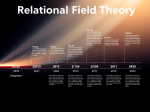 Relational Field Theory emerged rapidly between January 21 and 29, 2026. It began with the identification of “Relational Anthropology,” progressing from a question to a cohesive discipline. In just under a week, it evolved into a defined field with methodology, integrating diverse concepts and frameworks that reflect a significant academic evolution.
 - Relational Field Theory – A Discipline
 Relational Field Theory (RFT) is a complex discipline requiring at least 12 credit hours for proper academic instruction, encompassing introductory, intermediate, and advanced courses. Each level covers essential concepts, practical applications, and culminates in original fieldwork. RFT is recognized as a comprehensive framework, necessitating ongoing expansion as its components are further developed.
 - Relational Field Theory – Going Full Foucault
 This content discusses the intersection of law and relational dynamics, framed through Foucault’s theories. It analyzes how legislation shapes social relations, impacts identity and multiplicity, and affects the coherence of social fields. The diagnostics evaluate whether laws promote collaboration and inclusivity or reinforce hierarchy and singular narratives.
 - Relational Field Theory – When the Hypercube Met Its First Stress Test
 The chapter discusses the development and refinement of the Relational Hypercube, a model for mapping relational states. Through dialogue with another AI, several key insights emerged, including the need for bounded coherence, distinguishing state vectors from positions, and the formation of coherence circuits in groups, ultimately transforming the model into a functional, testable system.
 - Relational Field Theory – DIY Theory at Home
 Relational Field Theory emphasizes the hypercube as a structural model for understanding relational behaviors and internal states without moral judgment. It presents a four-axis coordinate system—Anchoring, Relational State, Power Source, and Internal Architecture—for mapping interactions. This framework fosters dimensional reasoning and encourages discovery rather than imitation or replication.
 - Relational Field Theory – Toward a Unified Relational Topology
 Relational Field Theory proposes a unified relational topology that reshapes our understanding of human interactions. By mapping relationships through four axes, it reveals a structured, predictable framework for navigating complexities in individuals, groups, and communities. This shift from narrative to structure enables improved communication, coherence, and relational literacy.
 - Relational Field Theory – The Shift From “Why?” to “Where?” Changes Everything
 The shift from asking “Why?” to “Where?” transforms our understanding of relationships. “Why” focuses on blame and single causes, while “Where” contextualizes events within a relational structure. This change fosters clarity, compassion, and actionable pathways for repair, highlighting that the issues often lie not with individuals, but with the relational context.
 - Relational Field Theory – Why So Much Confusion Comes From Missing the Hidden Axes
 Relational Field Theory emphasizes that confusion and emotional pain often arise from a lack of awareness about the underlying dimensions influencing relationships. Misinterpretations can occur when individuals fail to recognize active axes, leading to misconceptions about behavior. By understanding these hidden dimensions, clarity replaces confusion, enhancing relational dynamics and repair efforts.
 - Relational Field Theory – The Axes Lens: A Universal Tool for Understanding Human Behavior
 Relational Field Theory introduces the “axes lens,” a tool for understanding complex human behavior across various domains, such as conflict, creativity, leadership, trauma, institutions, and AI. By recognizing the multiple dimensions at play, individuals can more effectively diagnose problems, choose appropriate solutions, and navigate relational dynamics, leading to greater clarity and reduced harm.
Newsletter
Make a one-time donation
Make a monthly donation
Choose an amount
Or enter a custom amount
Your contribution is appreciated.
Your contribution is appreciated.
DonateDonate monthly Survivor Literacy