Denied Accommodations
Disabled students routinely face outright denial of legally protected accommodations.
Common denials include:
- extended time on exams
- flexible deadlines
- note‑taking support
- accessible seating
- reduced‑distraction testing rooms
- remote participation options
These aren’t luxuries.
They’re basic access — and institutions still say no.
Delayed Accommodations
Even when accommodations are approved, they often arrive:
- weeks late
- mid‑semester
- after major assignments
- after exams
- after harm has already occurred
A delayed accommodation is functionally a denied accommodation.
Students lose grades, opportunities, and stability while waiting for paperwork to move.
Punitive Implementation
Some accommodations are granted — but implemented in ways that punish the student:
- professors publicly announce accommodations
- students are forced to “prove” disability repeatedly
- extended time requires separate scheduling hoops
- testing centers are far from classrooms
- students must remind instructors every week
- accommodations are framed as burdens
Access becomes a negotiation instead of a right.
Excessive Documentation Demands
Disabled students are asked for:
- new evaluations every semester
- expensive medical letters
- proof of “severity”
- proof of “continuity”
- proof of “impact”
- documentation from specialists they cannot afford
These demands disproportionately harm poor, rural, and chronically ill students.
The system treats disability as something to be doubted, not supported.
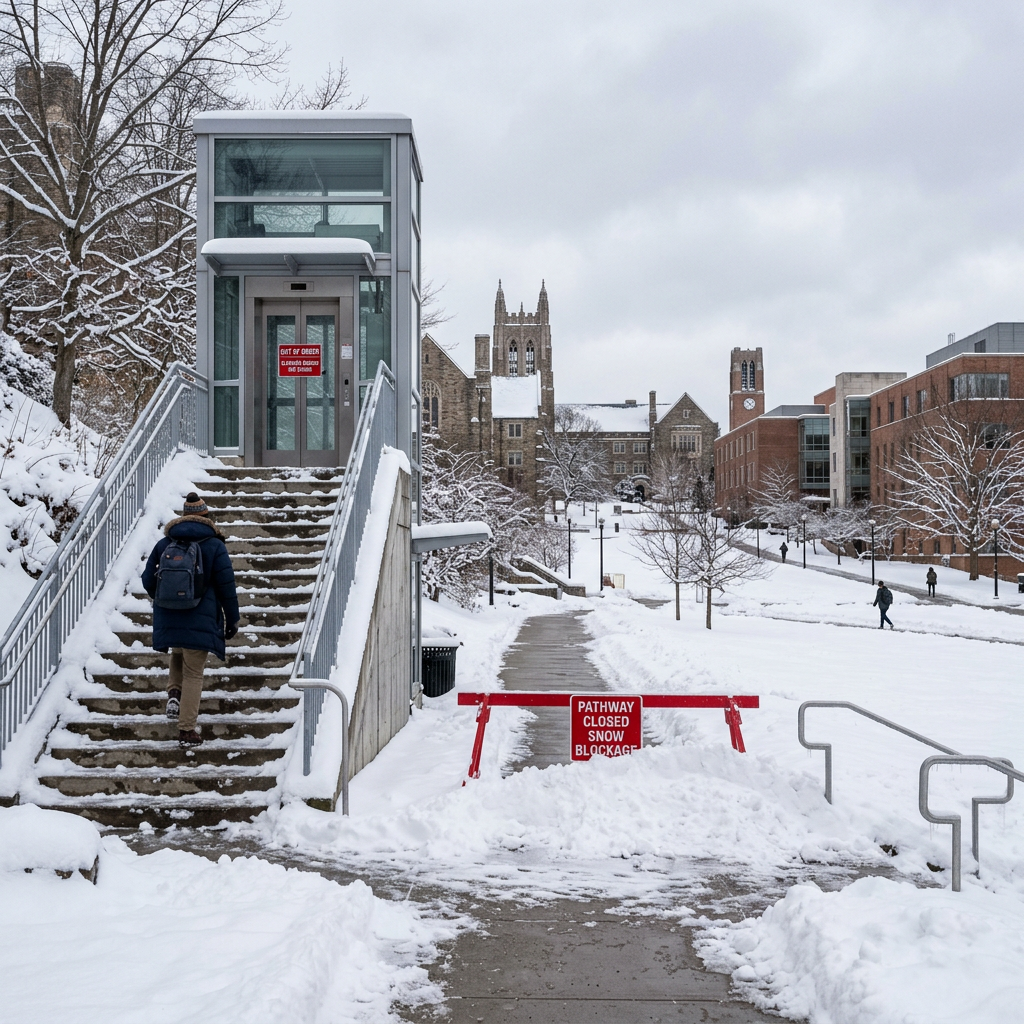
Inaccessible Buildings & Infrastructure
Many campuses still have:
- no elevators
- broken elevators
- inaccessible bathrooms
- steep ramps
- long distances between buildings
- inaccessible emergency procedures
- snow and ice removal failures
Students are told to “just manage,” even when the environment is unsafe.
Professor Noncompliance
Even when accommodations are approved, professors may:
- refuse to implement them
- claim they “don’t believe in accommodations”
- ignore emails
- reduce grades as retaliation
- accuse students of cheating
- shame students for needing support
Students are forced to choose between access and conflict with authority.
The Emotional & Academic Toll
Access failures cause:
- lower grades
- missed deadlines
- increased absences
- worsened symptoms
- burnout
- withdrawal from courses
- dropping out entirely
Disabled students aren’t failing.
They’re being failed.
Who Gets Hurt
These failures disproportionately impact:
- chronically ill students
- neurodivergent students
- mobility‑impaired students
- psychiatric‑disabled students
- students with invisible disabilities
- students without financial or family support
The students who need stability the most face the most instability.
The Result
Disability access failures:
- deny legal rights
- delay support
- punish students
- reinforce stigma
- create academic harm
- increase dropout rates
- protect institutions instead of people
Accommodations are supposed to level the playing field.
Instead, they often become another barrier — another gate — another way the system decides who gets to stay and who gets pushed out.
We Believe You
Go to the Series Archive.

Apple Music
YouTube Music
Amazon Music
Spotify Music
Structural Violence in Higher Education
- COLLEGE HOUSING: ACCESSIBILITY & AFFORDABILITY – How Dorms Became Profit Centers Instead of Support Systems
- TUITION VS INCOME & COST OF LIVING – Why College Became Financially Inaccessible for Most Families
- THE DIGITAL DIVIDE – How Students Without Laptops, Wi‑Fi, or Quiet Spaces Are Shut Out Before Learning Even Begins
- TRANSCRIPTS HELD HOSTAGE – How Institutions Block Mobility, Employment, and Graduation Until Students Pay Up
- GRADUATION FEES – How Students Are Charged One Last Time Before They Leave
- TRANSPORTATION DESERTS – How Rural Students Are Physically Cut Off From Higher Education
- FOOD INSECURITY AMONG COLLEGE STUDENTS
- LICENSURE EXAM COSTS – How Professional Gatekeeping Becomes Another Financial Barrier
- DISABILITY ACCESS FAILURES – How Accommodations Become Barriers Instead of Support
- Infrastructural Coercion: How Resource‑Gated Power Creates Captivity
- REMEDIAL CLASSES AS A HIDDEN TUITION SINK – How “Catch-Up” Courses Drain Students Before They Even Begin
- FREE TUITION COUNTRIES & SOCIAL EFFECTS – What Happens When Education Is a Public Good Instead of a Debt Trap
- CATCH‑22s IN HIGHER EDUCATION – How Requirements Trap the Students With the Least Resources
- PREDATION WITHIN THE ACADEMY – How Power, Gatekeeping, and Exploitation Shape the Academic Experience
- UNPAID INTERNSHIPS – How Free Labor Became the New Entry-Level Job
- BOOK COSTS THEN VS NOW – How Textbooks Became a Captive-Market Cash Extraction System
- TUITION CHANGE OVER TIME – How College Went From Public Good to Revenue Stream
- BARRIERS TO ACCESS – How Structural Obstacles Keep Students Out Before They Ever Reach the Classroom
- THE FAFSA MAZE – How Bureaucracy Blocks Poor and First‑Gen Students Before They Even Begin
- Good Citizen v. Bad Student: Why Academia Keeps Talking to Itself, and a Guide to Bring It Off the Shelf
- Why I Left Academia, and Why I Write
- THE MENTAL HEALTH CRISIS – How Understaffed Counseling Centers, Long Waitlists, and Punitive Policies Push Students Past Their Limits
- WAR ON STUDENT SUCCESS SERVICES – How Upward Bound, McNair, and DEI Became Targets — And Why Students Pay the Price
- THE ADJUNCT CRISIS – How Students Pay Premium Tuition While Their Instructors Earn Poverty Wages
- THE MYTH OF SCHOLARSHIPS AS A FIX – Why “Just Apply for Scholarships” Is Not a Real Solution — And How the Numbers Prove It
- LOAN FORGIVENESS & DANGLED CARROTS – How “Relief” Programs Keep Borrowers in Perpetual Limbo
- DEGREE REQUIREMENTS & DEGREE CREEP – How the Goalposts Keep Moving While the Pay Stays the Same
- THE MYTH OF “COLLEGE IS THE ONLY PATH” – How a Narrow Narrative Pushes Students Into Debt Instead of Toward Real Opportunity
- THE “PROFESSIONAL ATTIRE” TAX – How Required Clothing for Internships, Teaching, Nursing, and Fieldwork Becomes Another Hidden Cost
- THE DIGITAL DIVIDE – How Students Without Laptops, Wi‑Fi, or Quiet Spaces Are Shut Out Before Learning Even Begins
Leave a Reply