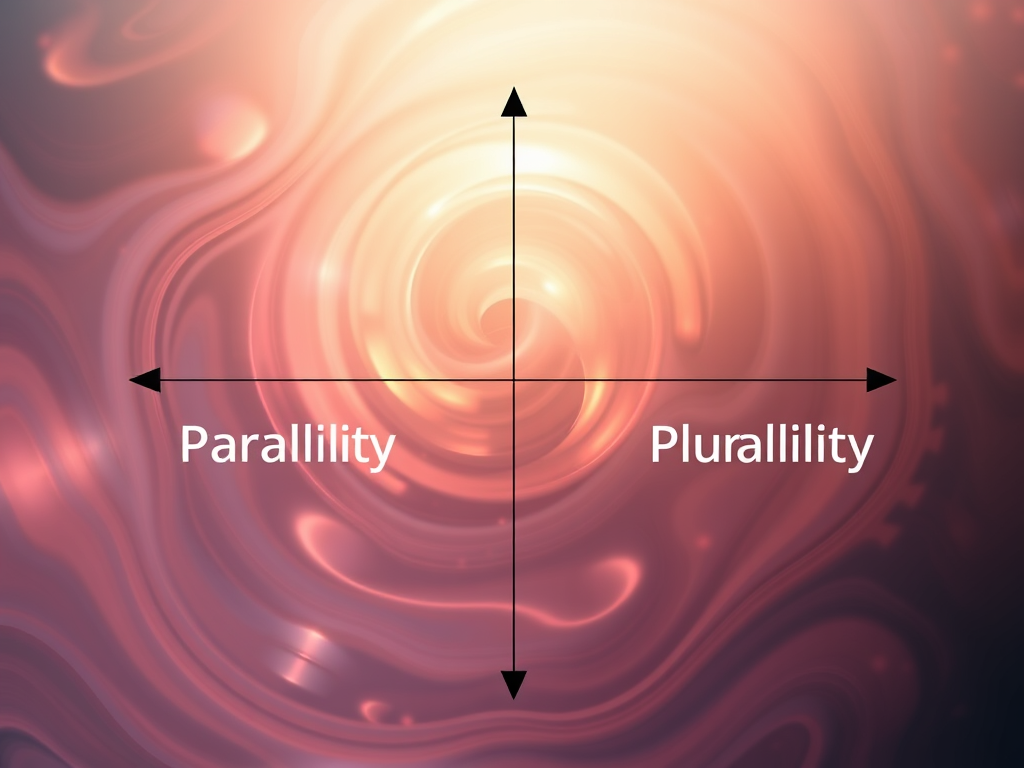
Relational Field Theory
Orthogonal Dimensions: Why These Concepts Look Similar From the Outside
When two ideas feel tangled in your mind, it’s usually because they’re not actually competing — they’re crossing. They occupy different axes, but from the outside, they cast the same shadow.
That’s exactly what happened with Parallility and Plurallility.
For months, they felt like two words for the same phenomenon.
They rhymed.
They overlapped.
They showed up together.
But once I separated them, something clicked:
they weren’t tangled — they were orthogonal.
Two independent dimensions.
Two perpendicular axes.
Two forms of multiplicity that only look similar when you’re standing at the wrong angle.
What Orthogonality Means in Relational Field Theory
Orthogonality is a physics term, but it applies beautifully to relational systems.
Two dimensions are orthogonal when:
- they operate independently
- they don’t cause each other
- they can amplify each other
- they can contradict each other
- they can coexist without collapsing into one another
This is why Parallility (internal multi‑threading) and Plurallility (relational multi‑relating) feel connected but not identical.
They’re not two versions of the same thing.
They’re two axes of the same topology.
Why They Look the Same From the Outside
From a distance, both Parallility and Plurallility produce:
- complexity
- multiplicity
- layered experience
- distributed attention
- high relational bandwidth
So people assume they’re the same.
But the source of the complexity is different.
Parallility comes from inside the self.
Plurallility emerges between selves.
When you don’t know which axis you’re looking at, the two can blur into one.
Once you name the axes, the blur resolves into structure.
Why This Matters for the Theory
This is the moment where Relational Field Theory stops being a set of ideas and becomes a coordinate system.
When two dimensions are orthogonal, you can:
- map them
- combine them
- cross‑reference them
- build matrices
- predict field behavior
- identify relational states with precision
This is the foundation for the next revelation — the one that finally lets us map the four basic relational states that emerge when these axes intersect.
RFT Dimension
Explore More RFT


Leave a Reply