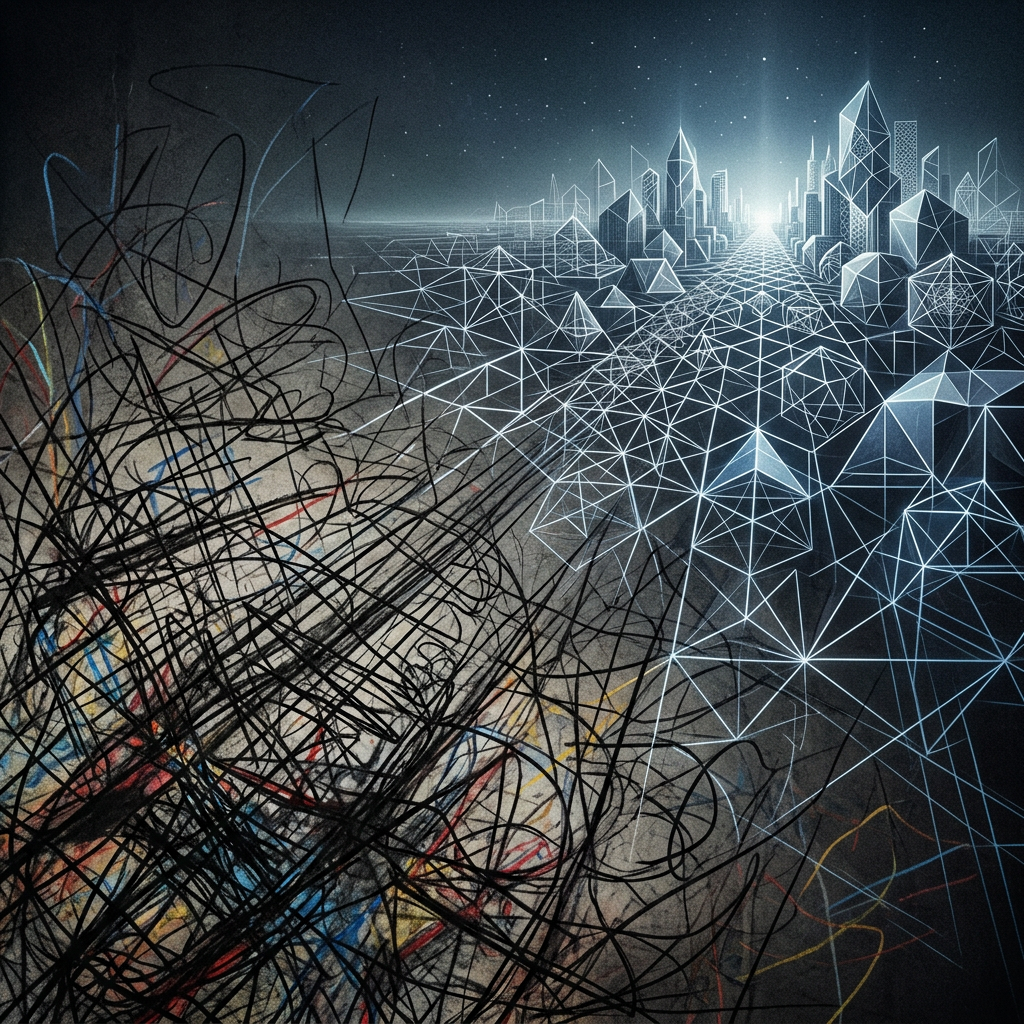

Humans evolved to read patterns in a world that was small, slow, and local. A world where the relevant timescale was the next hour, the next day, the next hunt. A world where the relevant population size was the clan—twenty to fifty individuals whose behavior could be tracked, remembered, and interpreted. In that environment, patterns were stable enough that the nervous system could treat them as laws. But in the modern world—fast, global, high‑volume, high‑variance—those same instincts become distortions. The mind mistakes local truth for universal truth, short‑term patterns for long‑term laws, and personal experience for objective reality.
Scale blindness is the cognitive mechanism that makes gods feel real, doctrines feel absolute, and systems feel inevitable. It is the inability to recognize that patterns change shape when you zoom out.
Hourly vs Daily vs Weekly vs Population-Level Patterns
Human behavior—and the world itself—looks radically different depending on the resolution at which you observe it.
- Hourly patterns are chaotic, emotional, reactive.
- Daily patterns show rhythms, cycles, and fluctuations.
- Weekly patterns reveal habits and routines.
- Monthly patterns expose trends.
- Population-level patterns reveal statistical truths that contradict personal experience.
But the nervous system evolved to operate at the hourly and daily scales.
It did not evolve to understand:
- probability
- statistics
- randomness
- regression to the mean
- large‑N dynamics
- emergent behavior
- systemic feedback loops
So when humans encounter patterns at larger scales, they collapse them back into the scale they can understand.
This collapse is the birthplace of superstition, doctrine, and dogma.
Humans Evolved in Tiny Sample Sizes
For most of human history, the sample size for any pattern was:
- one family
- one clan
- one season
- one hunt
- one illness
- one storm
From these tiny samples, the nervous system drew sweeping conclusions:
- “This ritual works.”
- “This omen is real.”
- “This god is powerful.”
- “This taboo must be obeyed.”
- “This group is dangerous.”
- “This behavior is moral.”
The brain was not wrong.
It was doing the best it could with the data it had.
But tiny samples produce:
- false correlations
- exaggerated patterns
- overgeneralizations
- rigid beliefs
- magical thinking
These distortions become encoded as truth because they once kept the clan alive.
The problem is not that humans generalize.
The problem is that humans generalize from too little.
Local Truth Mistaken for Universal Truth
Scale blindness makes humans mistake:
- personal experience for objective reality
- clan norms for universal morality
- local customs for cosmic law
- short-term patterns for eternal truths
- emotional resonance for evidence
- coincidence for causation
This is the cognitive move that turns:
- ritual into doctrine
- taboo into morality
- superstition into religion
- projection into theology
- group preference into divine command
The nervous system cannot see the larger pattern, so it elevates the local pattern to the status of universal law.
This is why every culture believes its gods are the true gods.
This is why every ideology believes its values are universal.
This is why every group believes its enemies are uniquely dangerous.
This is why every person believes their experience is the norm.
Scale blindness is not ignorance.
It is the default human operating system.
Why Pluralism Destabilizes Closed Systems
Pluralism is the first time in human history that individuals are exposed to:
- multiple worldviews
- multiple moral systems
- multiple cosmologies
- multiple truths
- multiple gods
- multiple ways of being
This exposure breaks the illusion of universality.
Pluralism destabilizes closed systems because it reveals:
- your “truth” is one of many
- your “god” is one of many
- your “morality” is one of many
- your “normal” is one of many
- your “pattern” is not a law
- your “experience” is not the world
For a nervous system built on tiny samples and local truths, this is existentially threatening.
Pluralism feels like:
- chaos
- danger
- moral collapse
- identity dissolution
- betrayal
- disorientation
Closed systems respond by:
- doubling down
- enforcing purity
- demonizing outsiders
- rejecting evidence
- escalating dogma
- punishing dissent
Pluralism is not dangerous.
It is simply too much data for a scale‑blind nervous system.
This is the first cognitive stroke in the GODS geometry:
Local Pattern → Universal Law → Doctrine → Enforcement
Humans do not cling to their truths because they are correct.
They cling to them because their nervous system cannot see the scale at which those truths stop being true.
We Believe You


Apple Music
YouTube Music
Amazon Music
Spotify Music


Explore Mini-Topics
Leave a Reply