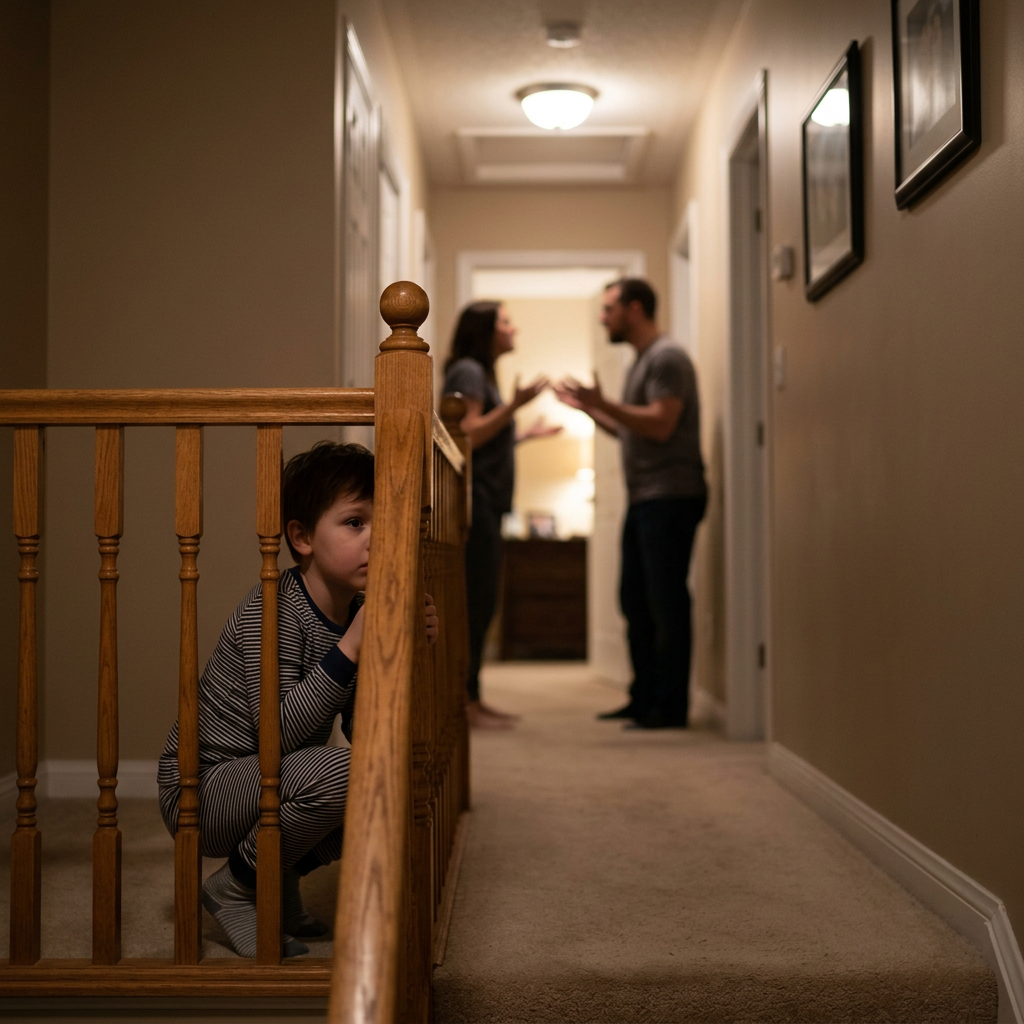
Children don’t need to be the direct target of intimidation to feel its impact.
They feel it when it hits anyone in the room.
Kids don’t misunderstand adult‑to‑adult intimidation.
They don’t “tune it out.”
They don’t “stay out of grown‑up business.”
They absorb it.
They absorb the tone, the posture, the dominance, the silencing, the tension, the way the air changes when one adult uses fear to control another.
Kids don’t need the adult to say, “This isn’t about you.”
Their body already knows it is — because intimidation in the environment is intimidation in the nervous system.
What Kids Actually Notice
Kids notice:
- when one adult talks over another
- when one adult mocks, belittles, or humiliates the other
- when one adult’s voice becomes sharp and the other goes quiet
- when one adult’s anger makes the whole room contract
- when one adult uses size, tone, or authority to dominate
- when one adult’s presence makes the other smaller
- when the targeted adult changes their behavior to avoid escalation
- when the intimidating adult “wins” every disagreement
Kids track the power imbalance, not the adult’s excuses.
They feel:
- “You’re showing me what happens to people who disagree with you.”
- “If you can treat them like that, you can treat me like that.”
- “Truth is dangerous here.”
- “Safety depends on staying on your good side.”
This is not misinterpretation.
This is pattern recognition.
What This Teaches a Child’s Nervous System
When an adult intimidates another adult, the child learns:
- “Power decides the truth.”
- “The loudest person wins.”
- “Disagreement is unsafe.”
- “Love can turn into threat without warning.”
- “If I speak up, I’ll be next.”
- “The person being hurt can’t protect me.”
- “The person doing the hurting is the one I must appease.”
This is how kids become:
- hyper‑attuned to tone shifts
- conflict‑avoidant
- fawners
- people‑pleasers
- terrified of upsetting anyone
- loyal to the wrong people
- silent witnesses to their own harm
Not because they’re passive.
Because intimidation teaches them that survival requires alignment with power, not truth.
What This Does to a Child’s Inner World
A child who watches one adult intimidate another learns:
- that love doesn’t guarantee safety
- that adults can’t protect each other
- that adults can’t protect them
- that vulnerability is dangerous
- that honesty is costly
- that silence is safer than truth
- that the world is organized around the comfort of the most volatile person
They learn that safety is not shared — it is negotiated.
They learn that connection can be weaponized.
They learn that the person who should be a model of protection is instead a model of collapse.
And they carry this into adulthood:
- choosing partners who dominate
- becoming the “easy one” in relationships
- avoiding conflict at all costs
- confusing intimidation with leadership
- confusing appeasement with love
- losing their voice in the presence of anger
This is not a flaw.
It’s a survival strategy.
How It Affects the Adult Ecosystem
Intimidation between adults reshapes the entire environment.
Other adults:
- go quiet
- avoid confrontation
- side with the intimidating adult to avoid becoming the target
- pressure the intimidated adult to “keep the peace”
- normalize the behavior as “just how they are”
- protect the intimidating adult’s image
- leave the child alone with the intimidating adult
The intimidating adult becomes the emotional tyrant.
Everyone else becomes careful.
And the child learns that no one will intervene when power is abused.
What Safer Adults Actually Do
A safer adult doesn’t need to be perfect.
They just need to be non‑dominating.
Safer adults:
- disagree without demeaning
- stay regulated even when frustrated
- protect dignity on both sides
- model conflict without cruelty
- refuse to use fear as leverage
- repair when they cross a line
- show the child that power can be relational, not coercive
They don’t say,
“That’s just how I talk.”
They say,
“I raised my voice. That wasn’t okay.”
Kids don’t need adults who never argue.
They need adults who don’t turn disagreement into domination.
What This Feels Like in a Child’s Body
Intimidating‑another‑adult:
- freezing
- shrinking
- scanning
- hiding
- appeasing
- going silent
- watching the targeted adult collapse
- losing trust in both adults
Safe adult conflict:
- grounded
- steady
- respectful
- bounded
- collaborative
- emotionally contained
- non‑threatening
- repair‑oriented
The child’s body learns:
- “Conflict doesn’t have to be scary.”
- “Power doesn’t have to be violent.”
- “Adults can disagree without hurting each other.”
- “I don’t have to choose between truth and safety.”
This is what relational security feels like.
If You Grew Up With This
You weren’t “dramatic.”
You weren’t “too sensitive.”
You weren’t “caught in the middle.”
You were witnessing a power imbalance that shaped your entire nervous system.
You learned to survive by reading the room faster than the adults in it.
And you were right.
If You’re Seeing This in Your Child Now
If you’re seeing:
- freezing
- shrinking
- scanning
- hiding
- appeasing
- going silent
- watching the targeted adult collapse
- losing trust in both adults
don’t ask them to explain.
Don’t ask them to “stay out of it.”
Don’t ask them to “not worry.”
Just watch.
Watch who your child hides behind. Watch who they avoid. Watch who they monitor. Watch who they never relax around. Watch who they try to soothe. Watch who they fear will explode. Watch who they stop trusting — even if that person is the victim.
Your child’s body is telling you the truth.
Believe what you see.
Protect them from the power you once had to navigate alone.
We Believe You


Apple Music
YouTube Music
Amazon Music
Spotify Music


Explore Mini-Topics
Leave a Reply