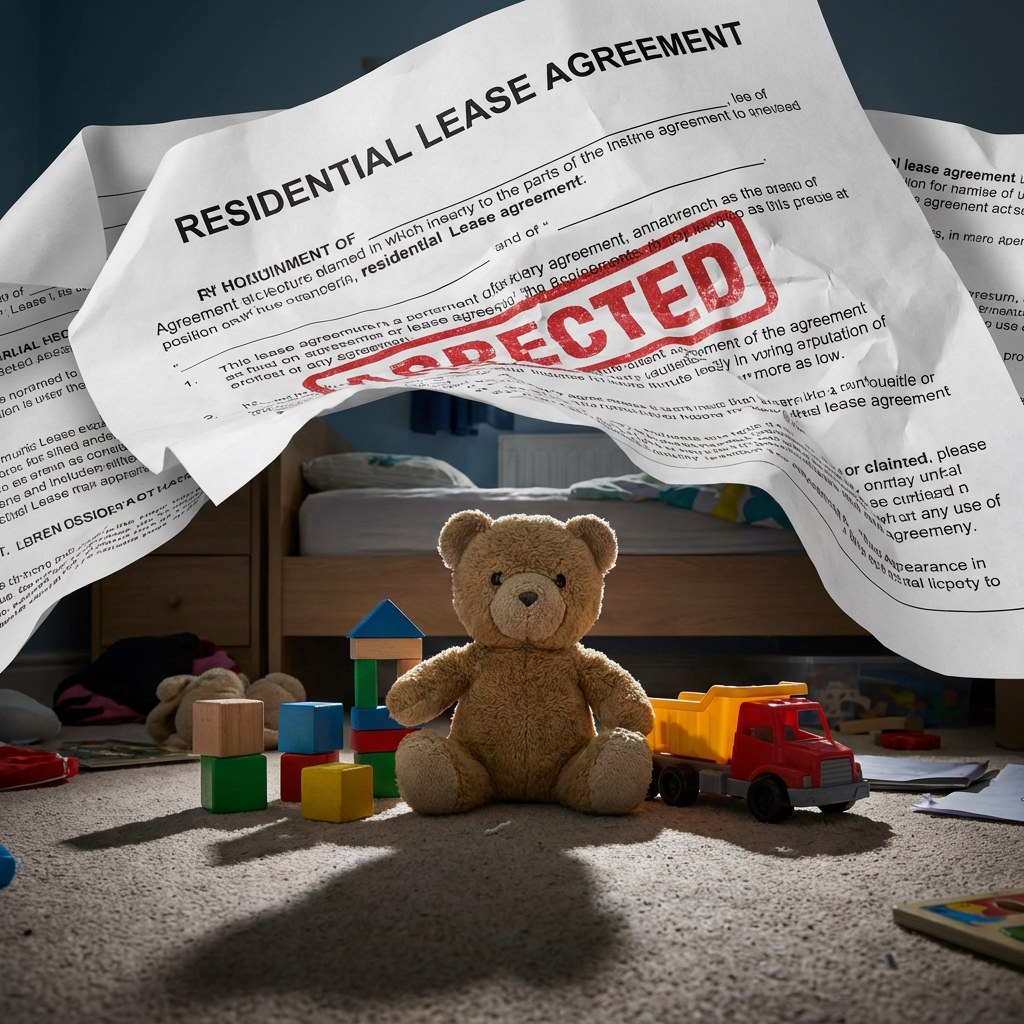
How leases force parents to police children to avoid eviction, why normal child behavior becomes a lease violation, and how housing precarity produces scapegoating as a survival strategy
1. The Hidden Cost of Predatory Leasing: Family Dynamics
Most people think leases regulate:
- rent,
- repairs,
- rules,
- responsibilities.
But predatory leases regulate something deeper:
- behavior,
- emotion,
- noise,
- movement,
- family life.
When housing is precarious, the lease becomes the real authority in the home — not the parent.
This is where scapegoating begins.
2. The Clauses That Turn Children Into Liabilities
Across the Loveland leases, children become “risks” because of clauses like:
- “Tenant is responsible for the conduct of all occupants and guests.”
- “Noise, disturbances, or nuisances are grounds for termination.”
- “Tenant shall keep the Premises in good repair.”
- “Tenant shall maintain cleanliness at all times.”
- “Tenant shall prevent damage to floors, walls, and fixtures.”
- “Tenant may be fined for unauthorized occupants.”
- “Tenant may be evicted for any violation of HOA rules.”
Normal child behavior becomes:
- noise,
- mess,
- wear,
- disruption,
- liability.
The lease reframes childhood as a breach of contract.
3. How Parents Become Enforcers
When a child’s normal behavior can trigger:
- fees,
- violations,
- inspections,
- non‑renewal,
- eviction,
parents must:
- shush,
- discipline,
- restrict,
- preempt,
- overcorrect,
- suppress.
Not because they want to.
Because the lease forces them to.
Parents become the internal police force of the home.
4. The Mechanism of Scapegoating
Scapegoating emerges when:
- the system demands compliance,
- compliance is impossible,
- someone must absorb the consequences.
In a renting family, the child becomes:
- the least powerful,
- the most visible,
- the most expressive,
- the least able to self‑regulate,
- the most likely to trigger a violation.
So the child becomes:
- the “problem,”
- the “cause,”
- the “risk,”
- the “threat,”
- the “reason we might lose housing.”
This is not a psychological flaw.
It is a structural override.
5. How Housing Precarity Rewrites Family Roles
Under stable housing:
- parents protect children.
Under predatory housing:
- parents protect the lease,
- the lease protects the landlord,
- the child becomes the variable that must be controlled.
This inversion is devastating.
Parents begin to:
- monitor noise levels,
- monitor play,
- monitor movement,
- monitor emotions,
- monitor friends,
- monitor routines.
The home becomes a compliance zone, not a safe space.
6. The Emotional Impact on Children
Children learn:
- “I am too loud.”
- “I am too messy.”
- “I am too much.”
- “I cause problems.”
- “I make us unsafe.”
They internalize:
- shame,
- fear,
- hypervigilance,
- self‑suppression.
This is how housing precarity becomes developmental trauma.
7. The Emotional Impact on Parents
Parents experience:
- guilt,
- helplessness,
- resentment,
- exhaustion,
- fear of eviction,
- fear of retaliation,
- fear of losing custody,
- fear of failing their children.
They are forced into:
- authoritarian roles,
- punitive roles,
- hyper‑controlling roles.
Not because they want to.
Because the lease demands it.
8. The Systemic Logic: Why Scapegoating Is Inevitable
Scapegoating is not a family flaw.
It is a structural adaptation to:
- fee stacking,
- surveillance,
- habitability evasion,
- eviction velocity,
- power asymmetry,
- retaliation risk.
When the system punishes normal life,
families must choose between:
- protecting the child, or
- protecting the housing.
Housing wins.
9. How to Recognize Scapegoating Pressure in Your Own Lease
Red flags include:
- noise clauses
- nuisance clauses
- cleanliness clauses
- “conduct of all occupants” clauses
- unauthorized occupant rules
- inspection requirements
- HOA enforcement clauses
- “damage” language without definitions
- “negligence” language without definitions
If a clause makes normal child behavior risky,
it is a scapegoating clause.
10. Closing
Family scapegoat dynamics under renting conditions are not:
- personal failures,
- parenting failures,
- moral failures.
They are structural outcomes of a system that:
- criminalizes childhood,
- weaponizes noise,
- monetizes mess,
- punishes emotion,
- and makes housing conditional on perfect compliance.
This is not a family problem.
It is a housing problem.
We Believe You


Apple Music
YouTube Music
Amazon Music
Spotify Music


Explore Mini-Topics
Leave a Reply