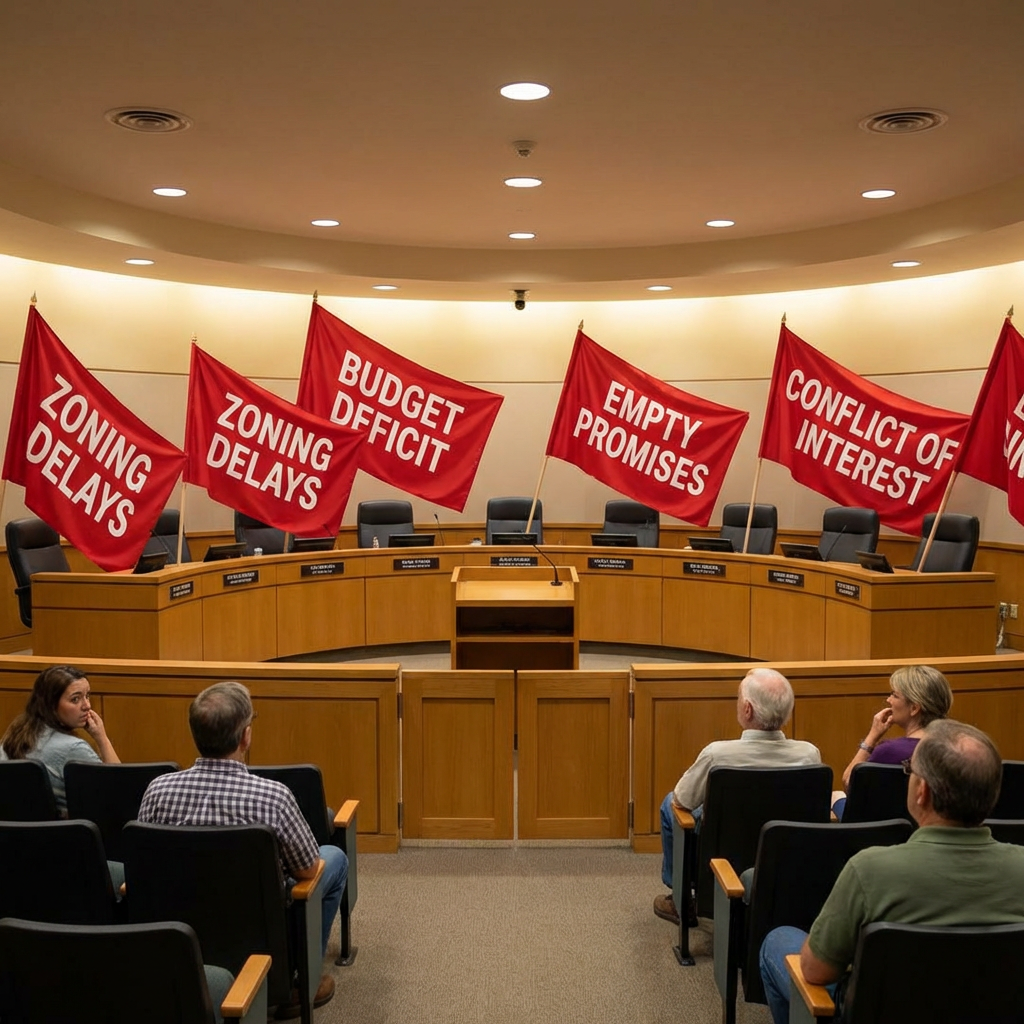
1. Executive Sessions as the New Inner Room
In hostage‑pledge systems, the most consequential decisions move into a protected inner chamber. Access becomes the currency of belonging. When substantive deliberation migrates to executive session, the public is repositioned as outsiders who must accept outcomes without witnessing the negotiation that shaped them.
2. Thin Public Agendas as Ritual, Not Deliberation
A hostage‑pledge system maintains the appearance of openness while relocating power elsewhere. A thin agenda functions like a ceremonial script: the performance of transparency without the substance of it. The public sees the ritual, not the reasoning.
3. Public Comment as Controlled Venting
Hostage‑pledge systems allow expression only within strict boundaries. Time limits, topic policing, and post‑decision comment slots convert public speech into a pressure‑release valve rather than a participatory tool. The public is permitted to speak but not to influence.
4. Information Scarcity as a Dependency Mechanism
When documents are late, incomplete, or inaccessible, the public becomes dependent on the institution’s interpretation. Hostage‑pledge systems thrive on asymmetry: those inside the system have context; those outside must trust or guess.
5. Procedural Tools as Enforcement
“Call the question,” cutting off debate, and blocking amendments are enforcement mechanisms. They function like the rules in a hostage‑pledge household: the authority figure controls the tempo, the tone, and the terms of engagement. Resistance is framed as disruption.
6. Staff as the Authorized Interpreters
In hostage‑pledge dynamics, intermediaries become the only legitimate narrators. Staff framing replaces public reasoning. The public sees conclusions, not the cognitive process. This creates a single sanctioned storyline.
7. Predictable Voting Blocs as Pre‑Aligned Loyalty Structures
When votes fall into rigid blocs, the deliberation has already happened elsewhere. This mirrors hostage‑pledge loyalty patterns: alignment is secured before the public moment, and dissent is symbolic rather than influential.
8. Fragmentation of Issues as Disorientation
Breaking complex issues into scattered agenda items mirrors the fragmentation tactic in hostage‑pledge systems: keep people too disoriented to track the whole pattern. Without the full picture, the public cannot mount coherent resistance.
9. Public Hearings as Symbolic Compliance
A hostage‑pledge system maintains the forms of participation to avoid revolt. Hearings become symbolic compliance — a way to say “you were heard” without allowing input to alter outcomes. Participation becomes performance.
10. Delegitimizing Public Input as Emotional Misbehavior
When residents are told they’re emotional, uninformed, or uncivil, the system reframes their participation as misbehavior. This is classic hostage‑pledge logic: the authority defines what counts as “appropriate,” and dissent becomes a violation of the pledge.
11. Transparency as Rhetoric, Not Practice
Hostage‑pledge systems often talk about transparency while reducing it. The pledge becomes: trust us, accept our framing, and do not ask for more. The public is expected to demonstrate loyalty through compliance.
12. Decisions Announced, Not Debated
When the public learns about decisions after they’re made, the hostage‑pledge dynamic is fully active. The public’s role is to absorb, not shape. The pledge is enforced through inevitability: “This is what we’ve decided.”
13. The Core Hostage‑Pledge Pattern
The shift is not about efficiency or decorum. It is about redefining the public’s role from participants in governance to observers of authority. The pledge becomes: accept the decisions, trust the process you cannot see, and remain grateful for the information you are given. The public is not invited into the room where power is shaped — only into the room where it is displayed.
Apple Music
YouTube Music
Amazon Music
Spotify Music


Explore Mini-Topics
Leave a Reply