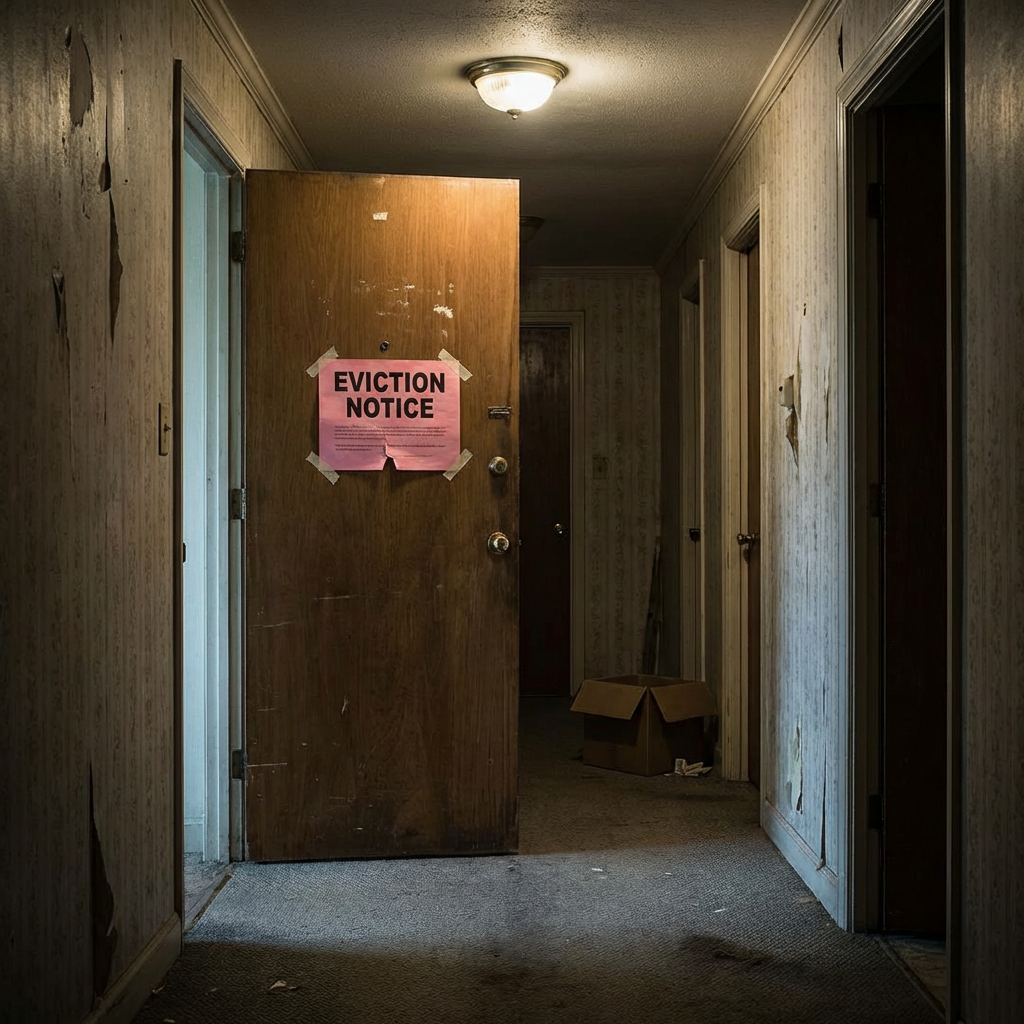
3‑day notices, crime‑free addenda, and “absolute rent” clauses — how leases create instant pathways to eviction, and why default is a design feature, not a failure
1. The Myth of “Eviction as a Last Resort”
Landlords often claim:
- “We only evict when we have no choice.”
- “Eviction is rare.”
- “Tenants must have done something serious.”
But the leases you provided tell a different story.
They are engineered so that:
- default is easy,
- eviction is fast,
- defenses are limited,
- and the landlord’s discretion is absolute.
Eviction is not a breakdown of the system.
It is the intended outcome when tenants cannot maintain perfect compliance.
2. The Clauses That Accelerate Eviction
Across the Loveland leases, eviction velocity is created through clauses like:
- “3‑day notice to cure or vacate.”
- “Any and all amounts shall be considered Additional Rent.”
- “Your promise to pay rent is independent, absolute, without right to offset.”
- “Tenant is responsible for all occupants and guests.”
- “Any activity that has the potential to escalate into criminal activity…”
- “Tenant may be evicted for any violation of HOA rules.”
- “Tenant may be evicted for noise, odors, or disturbances.”
- “Tenant may be evicted for unauthorized occupants.”
These clauses create instant eviction pathways.
A single misstep — or allegation — becomes grounds for removal.
3. The “Absolute Rent” Trap
One of the most dangerous clauses in your leases:
“Your promise to pay rent is independent, absolute, without right to offset, for any reason whatsoever.”
This clause attempts to eliminate:
- the right to withhold rent for habitability,
- the right to offset costs,
- the right to assert defenses,
- the right to negotiate repairs.
It is void under Colorado law, but landlords use it anyway because:
- tenants don’t know it’s void,
- courts rarely challenge boilerplate,
- and the threat alone is enough to enforce compliance.
This clause is designed to make nonpayment inevitable.
4. Crime‑Free Addenda: Eviction Without Evidence
Crime‑free housing addenda allow eviction for:
- alleged criminal activity,
- suspected criminal activity,
- “potential” criminal activity,
- activity by guests,
- activity by family members,
- activity the tenant did not know about,
- activity that never resulted in charges.
These clauses violate:
- due process,
- Colorado eviction law,
- basic contract principles.
But they persist because they give landlords:
- maximum discretion,
- maximum speed,
- maximum plausible deniability.
Crime‑free addenda are eviction accelerators.
5. Manufactured Default: How Leases Create Failure
Default is not something tenants “fall into.”
It is something the lease manufactures.
Here’s how:
1. Fee stacking creates unpayable balances.
Late fees → admin fees → posting fees → interest → “additional rent.”
2. Habitability evasion forces tenants to choose between safety and compliance.
Report mold → risk non‑renewal.
Don’t report mold → risk damage charges.
3. Surveillance creates constant opportunities for violation.
Noise → violation.
Odors → violation.
Guests → violation.
Children → violation.
4. Discretion clauses allow landlords to escalate anything.
“Management may determine…”
“At landlord’s sole discretion…”
“Potential to escalate…”
5. Crime‑free clauses allow eviction without wrongdoing.
Suspicion → default.
Association → default.
Presence → default.
Default is not a tenant failure.
It is a structural inevitability.
6. Eviction as a Revenue Strategy
Eviction is profitable because it allows landlords to:
- keep deposits,
- charge cleaning fees,
- charge repair fees,
- charge lock change fees,
- charge court fees,
- charge sheriff’s fees,
- re‑rent at a higher price.
Eviction is not the end of the revenue stream.
It is the reset button that starts the next cycle.
7. The Family Consequence: Eviction as Behavioral Control
When eviction is fast and default is easy:
- parents must enforce the lease,
- children become liabilities,
- noise becomes dangerous,
- mess becomes dangerous,
- conflict becomes dangerous.
Parents begin policing:
- volume,
- movement,
- play,
- emotion,
- expression.
Not because they want to.
Because the lease makes housing conditional on perfect behavior.
This is how eviction velocity produces scapegoating dynamics inside families.
8. How to Recognize Eviction Triggers in Your Own Lease
Red flags include:
- “3‑day notice” language
- “absolute rent” clauses
- “additional rent” clauses
- crime‑free addenda
- broad default definitions
- “sole discretion” language
- HOA violation liability
- noise/odor clauses
- unauthorized occupant penalties
- interest rates above statutory limits
If a clause makes eviction easy, it is part of the velocity design.
9. Closing
Eviction is not a rare event.
It is not a moral judgment.
It is not a tenant failure.
It is a structural feature of predatory leasing.
When default is easy and eviction is fast,
the home becomes a conditional privilege, not a right.
This is not a personal failure.
It is a structural design.
We Believe You


Apple Music
YouTube Music
Amazon Music
Spotify Music


Explore Mini-Topics
Leave a Reply