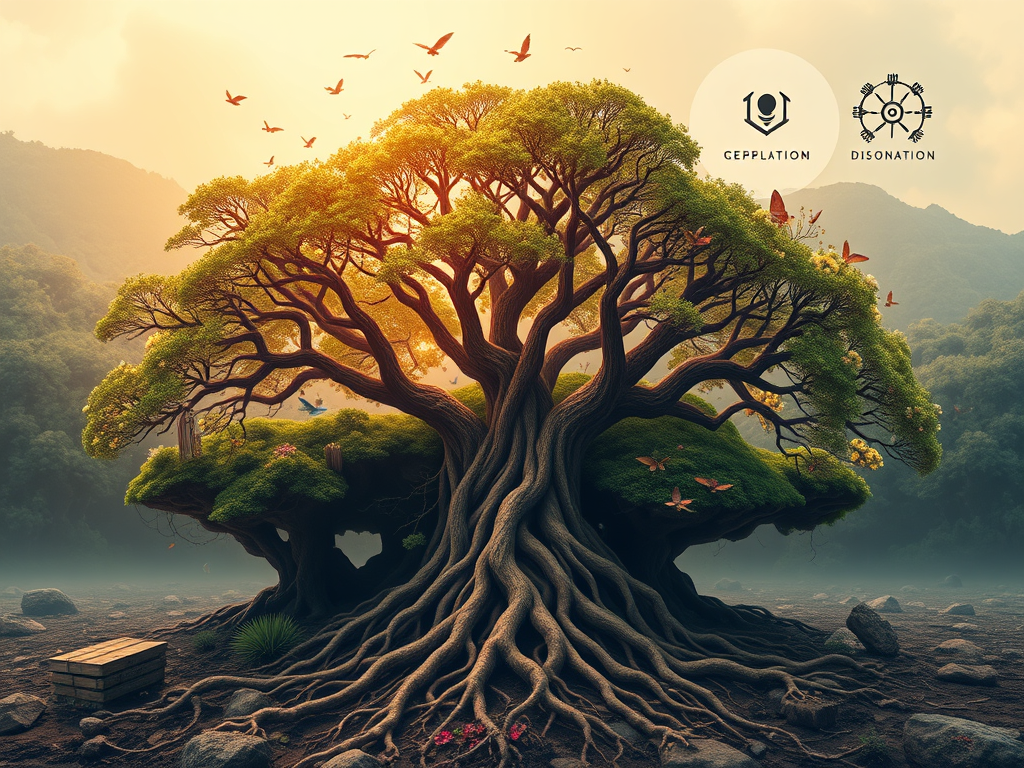
RELATIONAL HISTORY
The Study of Time, Memory, and Human Events as Relational Fields
1. History as a Relational Organism
Classical history treats the past as:
- events
- dates
- actors
- causes
- consequences
Relational History treats the past as:
- fields
- forces
- rhythms
- identities
- cycles
- coherence signatures
History is not what happened.
History is how relational fields behaved under specific conditions.
This reframes:
- revolutions
- collapses
- renaissances
- migrations
- golden ages
- dark ages
as relational phenomena, not moral or ideological ones.
2. Historical Fields
A historical field is a collective relational environment composed of:
- identity systems
- narratives
- ecological pressures
- technological rhythms
- political boundaries
- economic flows
- cultural coherence
Historical fields behave like ecosystems:
- they grow
- they destabilize
- they collapse
- they regenerate
History is ecology across time.
3. Historical Forces
Relational History uses the same four forces as Relational Physics:
Cohesion → Unity, shared identity, cultural flourishing
Repulsion → Boundaries, differentiation, conflict
Resonance → Synchronization, mass movements, zeitgeist
Distortion → Collapse, misinformation, fragmentation
Every historical era is defined by the interplay of these forces.
4. Historical Metabolism
Civilizations have metabolic rates:
- fast metabolism → innovation, instability, rapid change
- slow metabolism → tradition, stability, stagnation
Metabolic overload causes:
- revolutions
- collapses
- migrations
- institutional breakdown
History is the metabolism of collective identity.
5. Historical Identity Systems
Nations, cultures, and eras have identity modes, just like individuals.
Examples:
- Renaissance Italy → Radiance Mode (Leo)
- Medieval Europe → Containment Mode (Cancer)
- Industrial Revolution → Expansion Mode (Sagittarius)
- Cold War → Polarity Mode (Libra/Aries tension)
- Post‑colonial states → Transformation Mode (Scorpio)
Historical identity determines:
- what a society values
- what it fears
- how it responds to stress
- how it evolves
History is identity at scale.
6. Historical Narratives as Relational Organisms
Narratives behave like living entities:
- they spread
- they mutate
- they compete
- they infect
- they die
This is Relational Virology applied to time.
Narratives like:
- “progress”
- “decline”
- “destiny”
- “purity”
- “freedom”
- “civilization”
are viral agents shaping historical behavior.
7. Historical Cycles
History moves in cycles because relational fields move in cycles.
Examples:
- contraction → crisis
- crisis → rupture
- rupture → reorganization
- reorganization → expansion
- expansion → stagnation
- stagnation → contraction
This is the Repair Cascade at civilizational scale.
8. Historical Boundaries
Boundaries determine:
- who belongs
- who is excluded
- what is protected
- what is threatened
Boundary collapse leads to:
- invasions
- migrations
- cultural blending
- identity crisis
Boundary rigidity leads to:
- stagnation
- isolation
- brittleness
History is boundary engineering across centuries.
9. Historical Geography
Place shapes history through:
- ecological niches
- resource distribution
- climate rhythms
- migration corridors
- natural boundaries
This is Relational Geography integrated with time.
10. Historical Memory
Memory is not a record.
It is a relational archive.
Cultures remember:
- trauma
- triumph
- injustice
- identity
- lineage
Memory shapes:
- politics
- identity
- conflict
- reconciliation
This is Relational Library Science applied to collective time.
11. Historical Distortion
Distortion spreads when:
- narratives become viral
- identity becomes brittle
- boundaries collapse
- ecological stress increases
Distortion produces:
- propaganda
- scapegoating
- mythologizing
- revisionism
History is vulnerable to the same viruses as individuals.
12. Historical Repair
Repair occurs when:
- narratives are detoxed
- boundaries are restored
- identity is re‑centered
- ecology stabilizes
- coherence returns
This is the Repair Cascade at societal scale.
13. Closing: History as a Living Relational Field
Relational History reframes the past as:
- a living organism
- a metabolic cycle
- a relational ecology
- a coherence engine
- a narrative field
- an identity system
- a boundary architecture
It integrates:
- Relational Geography
- Relational Geology
- Relational Political Science
- Relational Biology
- Relational Virology
- Relational Engineering
- Relational Library Science
History becomes the temporal expression of Pluriology.


Leave a Reply