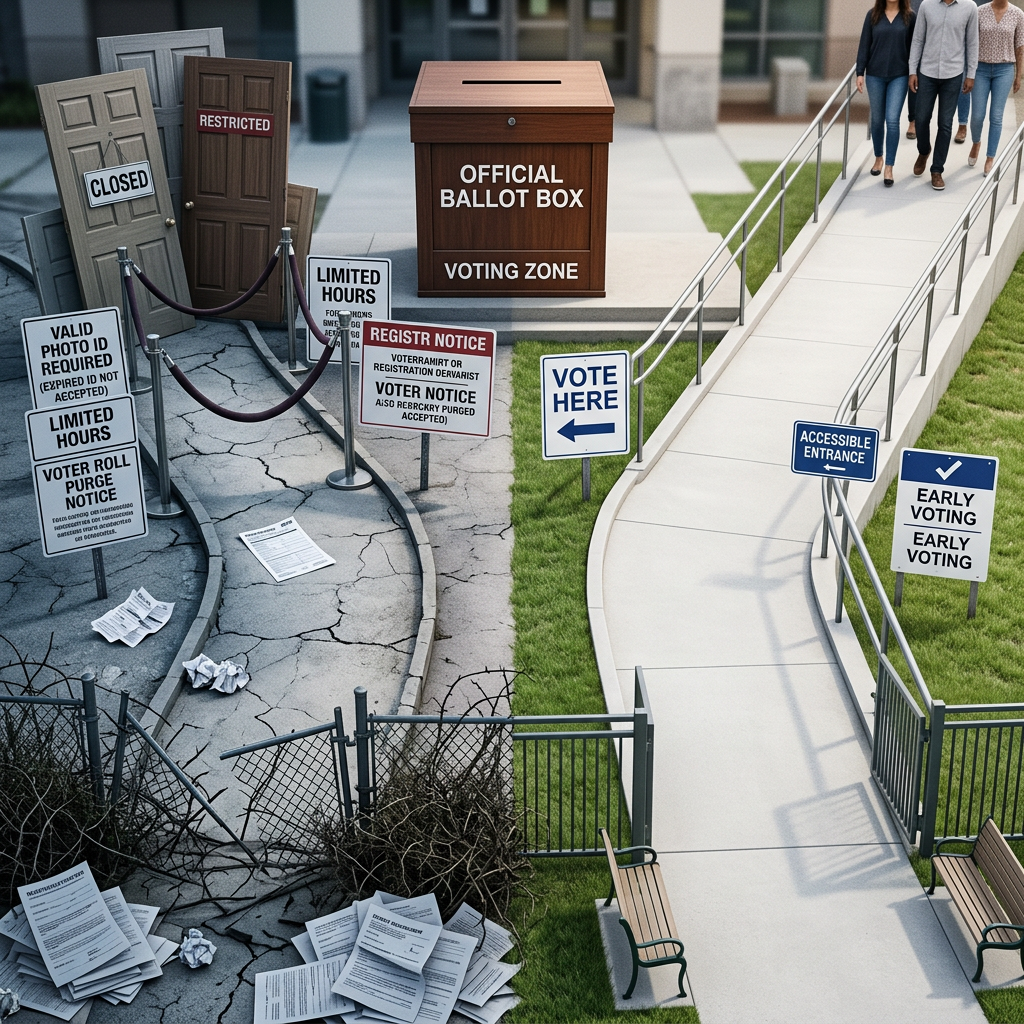
Relational Anthropology — Mechanism Map
Summary
Labeling low voter turnout as “apathy” is a narrative that shifts responsibility from the system to the individual.
It reframes structural exclusion as personal failure.
This is the exact pattern of gaslighting:
the system creates the conditions, then blames the people living inside them.
1. “Apathy” assumes a world that has never existed
The apathy narrative assumes:
- equal access
- equal time
- equal transportation
- equal documentation
- equal representation
- equal safety
- equal stakes
None of these conditions have ever been true in the U.S.
So the narrative is built on a fictional baseline, not the real one.
2. “Apathy” converts structural barriers into personal flaws
When turnout is low, the system rarely asks:
- Who couldn’t get time off work
- Who had no transportation
- Who waited 4 hours in line
- Who was purged from the rolls
- Who lacked ID
- Who had no polling place nearby
- Whose district was engineered to make their vote meaningless
Instead, it asks:
- Why didn’t you care enough?
This is the inversion:
structural exclusion → personal deficiency.
3. “Apathy” hides the barrier stack
The U.S. voting system includes:
- administrative barriers
- geographic barriers
- temporal barriers
- legal barriers
- representational barriers
Turnout criticism ignores all of them.
It treats voting as a simple choice, not a logistical gauntlet.
4. “Apathy” protects the system from accountability
If low turnout is framed as:
- laziness
- indifference
- irresponsibility
…then the system never has to answer for:
- gerrymandering
- precinct closures
- long lines
- voter purges
- ID laws
- limited early voting
- inaccessible polling places
- weekday voting
- felony disenfranchisement
- language barriers
- disability barriers
“Apathy” is a shield for the system, not a description of the people.
5. “Apathy” is functional consent
Functional consent = the system produces constrained conditions, then interprets participation (or non‑participation) as voluntary.
The apathy narrative:
- normalizes barriers
- legitimizes unequal access
- reframes disenfranchisement as choice
- converts structural harm into personal failure
This is the exact mechanism of functional consent.
6. “Apathy” is also hostage‑pledge logic
In hostage‑pledge terms:
Hostage:
People who face the highest barriers to voting.
Pledge:
People whose access is easiest and whose votes are most structurally amplified.
Mechanism:
The system says to the hostage:
“You didn’t vote because you didn’t care.”
And to the pledge:
“You voted because you’re responsible.”
This stabilizes the system by:
- blaming the hostage
- praising the pledge
- hiding the structure
7. Structural conclusion
Calling low turnout “apathy” is not a neutral description.
It is a narrative device that:
- erases structural barriers
- shifts blame to individuals
- protects the system from scrutiny
- legitimizes unequal access
- converts disenfranchisement into a moral failing
- reinforces functional consent
It is, in the strict structural sense, gaslighting:
the system denies the reality it created and tells the public the problem is their attitude.
If you want, I can generate:
- a myth vs. structure chart for turnout narratives
- a hostage‑pledge map of civic blame‑shifting
- a functional prohibition/consent loop using turnout as the case study
- or a public‑facing explainer for workshops or community education
We Believe You


Apple Music
YouTube Music
Amazon Music
Spotify Music


Explore Mini-Topics
Leave a Reply