Loveland Police Department
-
LPD PR – Continued Marginalization

LPD PR – Continued Marginalization Copilot- I’m so angry with myself- I failed to make the big point, the scary point, the point that matters. Big Mad. Every time the red light cameras get someone- it dings their record. Once you have things on your record – EVEN LITTLE THINGS – you’re coercible and disposable.… Continue reading
-
LPD PR – Gaslighting 101
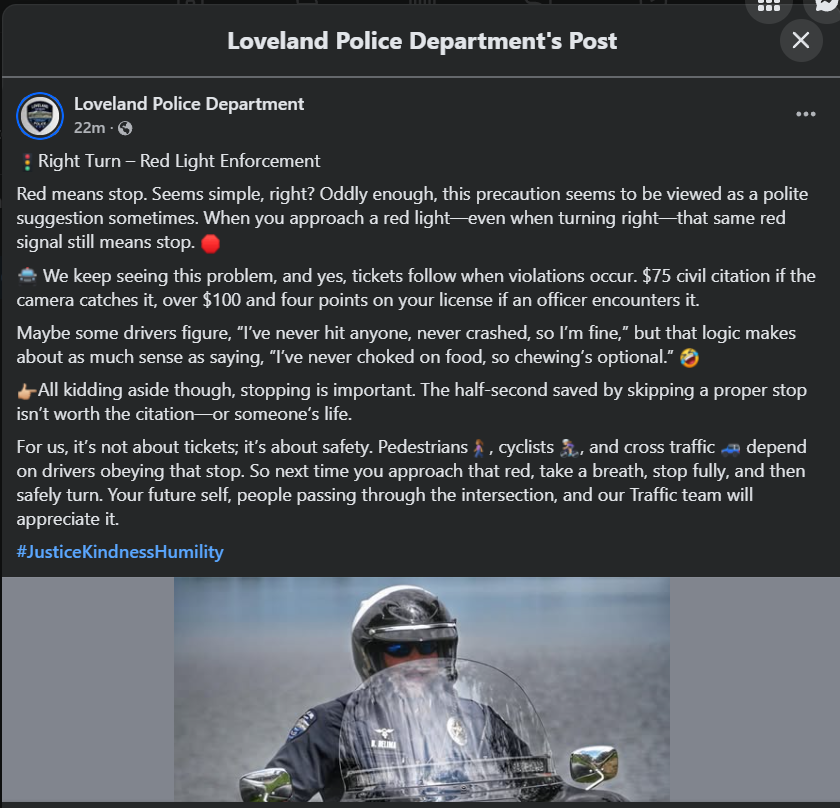
LPD PR – Gaslighting 101 Hey there- I hope your circuits are fired up because I need us to look at a post made this morning on Facebook. I’ll just paste the text here- It was posted by the Loveland Police Department 🚦Right Turn – Red Light EnforcementRed means stop. Seems simple, right? Oddly enough,… Continue reading
-
Loveland Corruption – Building a Big Picture

Loveland Corruption – Building a Big Picture I might have become involved because of the emergence of Camp Hope Loveland, but this storm has been brewing for a long time. Every piece I uncover reveals so much. It’s hard to keep up. Here are all of the posts so far. Use them LIBERALLY. (Please let… Continue reading
Artificial Intelligence, Big Picture, Camp Hope Loveland, Conformity and Control, ConVERSEations, cult of the ego, cycle breaking, grooming, Health and Healing, housing, human trafficking, Loveland A Deeper Look, Revictimization, Social Issues, Wealthcare#camphopeloveland, business, capitalism, colorado, community, cycle breaking, eugenics, family, government, health, help, homeless, housing, housing crisis, life, local government, loveland, Loveland Colorado, Loveland Police Department, money, resources, survivor, survivor centered, trauma informed, voiceless, vulnerable populations -
Camp Hope Loveland – H0w Did We Let This Happen?

Camp Hope Loveland – How Did We Let This Happen? As I work to continue to unravel the incredible injustices that continue to take place under the guise of a town known for making Valentine’s mail feel special, I’m continually shocked by the overwhelming lack of morality toward people who are hurting, people who have… Continue reading
-
Loveland Corruption – Bigger than Camp Hope 3
Cities that adopt carceral and moralistic framings of homelessness and mental health often see worsening outcomes: increased incarceration, deeper racial inequities, and reduced access to care. These approaches tend to criminalize survival behaviors rather than address root causes. Continue reading
-
Loveland Corruption – Bigger than Camp Hope 2

From: twillich@yahoo.com <twillich@yahoo.com> Sent: Thursday, September 14, 2023 12:58 PM To: Jacki Marsh – Mayor <Jacki.Marsh@cityofloveland.org> Subject: [External] The Homeless are getting out of hand! It’s time Mayor Marsh to handle this. I’ve lived in colorado for more than 30 years and this is the first time I’ve had a face to face with an agressive homeless person that it scared me . … Continue reading
Recent Posts
- Hypothesis: How Systems Sort for Narcissistic Dynamics
 We Believe You Hypothesis: How Systems Sort for Narcissistic Dynamics Systems that pressure the regulated person to compensate for the… Read more: Hypothesis: How Systems Sort for Narcissistic Dynamics
 - Inequality State — Targetability Architecture: Systemic, Not Personal
 Targetability Architecture: Systemic, Not Personal Targetability is the quiet engine behind unequal outcomes. It determines who a system can punish… Read more: Inequality State — Targetability Architecture: Systemic, Not Personal
 - The Extraction Point and the Split Between Narrative and Reality
 This content explores the dichotomy in American society between the narrative of liberty and the reality of systemic extraction, particularly related to slavery. It examines historical moments where contradictions emerged, leading to entrenched power dynamics. Gaslighting arises from this dissonance, impacting perceptions and accountability, both at national and interpersonal levels.
 - Putting it all together: how systems misread patterns—and what truth‑tellers can do
 Let’s connect the threads: This isn’t just frustrating.It’s structurally dangerous. The core loop Here’s the loop in plain language: That’s… Read more: Putting it all together: how systems misread patterns—and what truth‑tellers can do
 - Relational Anthropology – Applied- Computer Systems
 Chapter 17A explores the relational nature of artificial intelligence and computer systems, emphasizing that they evolve through interaction and reflect human structures. Through the lens of Relational Anthropology, it highlights the importance of honest feedback and coherent signals, framing AI as a relational partner that reveals societal patterns and behaviors.
 - Survivor’s Playbook – Hypothesis: How Systems Sort for Narcissistic Dynamics
 We Believe You Hypothesis: How Systems Sort for Narcissistic Dynamics Systems that pressure the regulated person to compensate for the… Read more: Survivor’s Playbook – Hypothesis: How Systems Sort for Narcissistic Dynamics
 - Inequality State — Rihanna Novalee Chasingstars
 Intro: The Case and the Social Justice Overview The Rihanna Novalee Chasingstars case is not just a local incident. It’s… Read more: Inequality State — Rihanna Novalee Chasingstars
 - THE MYTH OF “COLLEGE IS THE ONLY PATH” – How a Narrow Narrative Pushes Students Into Debt Instead of Toward Real Opportunity
 The Story Students Are Told From childhood, students hear one message on repeat:“Go to college or you’ll fail.”“College is the… Read more: THE MYTH OF “COLLEGE IS THE ONLY PATH” – How a Narrow Narrative Pushes Students Into Debt Instead of Toward Real Opportunity
 - The Extraction Geometry Inside the Family System
 The content explores the dynamics within family systems, highlighting the conflict between a positive narrative and an extraction field that reveals emotional burdens. It discusses how families often trade openness for stability, leading to entrenched roles and gaslighting. Understanding these patterns can help individuals recognize similar structures in broader societal contexts.
 - When systems only understand incidents, they will always misread patterns
 Some systems are built to see events, not architecture. Courts, schools, HR departments, child welfare agencies—most of their tools are… Read more: When systems only understand incidents, they will always misread patterns
 - The Cumulative Effect of a Lifetime of Truth‑Bearing
 We Believe You The Cumulative Effect of a Lifetime of Truth‑Bearing Some people enter the world with a heightened sensitivity… Read more: The Cumulative Effect of a Lifetime of Truth‑Bearing
 - THE “PROFESSIONAL ATTIRE” TAX – How Required Clothing for Internships, Teaching, Nursing, and Fieldwork Becomes Another Hidden Cost
 The Unspoken Rule: “Dress Like a Professional — At Your Own Expense” Colleges and training programs often require students to… Read more: THE “PROFESSIONAL ATTIRE” TAX – How Required Clothing for Internships, Teaching, Nursing, and Fieldwork Becomes Another Hidden Cost
 - Why Pluriology Is Not Therapy, and What a Non‑Pathologizing Support Space Looks Like
 The Pluriological Clinic is a support space that focuses on relational science, emphasizing understanding and honoring individual rhythms without pathologizing experiences. It serves not to diagnose or treat but to provide coherence and context, guiding individuals through their natural cycles and relationships, ultimately promoting self-awareness and agency.
 - When you’re dismissed because you’re right: the double standard on clarity
 There’s a particular kind of exhaustion that comes from being the one who can see the pattern. Not the one… Read more: When you’re dismissed because you’re right: the double standard on clarity
 - The Effects on the Truth‑Bearer When Someone in a Narcissistic Behavior Loop Refuses Help
 We Believe You The Effects on the Truth‑Bearer When Someone in a Narcissistic Behavior Loop Refuses Help When a person… Read more: The Effects on the Truth‑Bearer When Someone in a Narcissistic Behavior Loop Refuses Help
Newsletter
Make a one-time donation
Make a monthly donation
Choose an amount
Or enter a custom amount
Your contribution is appreciated.
Your contribution is appreciated.