How Government Priorities Lock the Blender Into Place
When the loss of intergenerational transmission, the rise of ultra‑processed foods, and the pressures of the modern economy are viewed together, they form a self‑reinforcing system. But the system does not operate in a vacuum. It is shaped and stabilized by a fourth force: the structure of government subsidies.
Subsidies determine which foods are cheap, which industries thrive, and which forms of labor are economically viable. They reveal the priorities of the state more clearly than rhetoric ever could.
1. What the Government Subsidizes
Federal subsidies overwhelmingly support:
- commodity crops (corn, soy, wheat, cotton, rice)
- industrial dairy
- large‑scale livestock operations
- processed food inputs
- fuel, feed, and export markets
- crop insurance for industrial agriculture
These subsidies make the raw materials of ultra‑processed foods artificially cheap. Corn becomes corn syrup. Soy becomes seed oil. Wheat becomes refined flour. Dairy becomes surplus cheese and milk powder.
The result is a food landscape where:
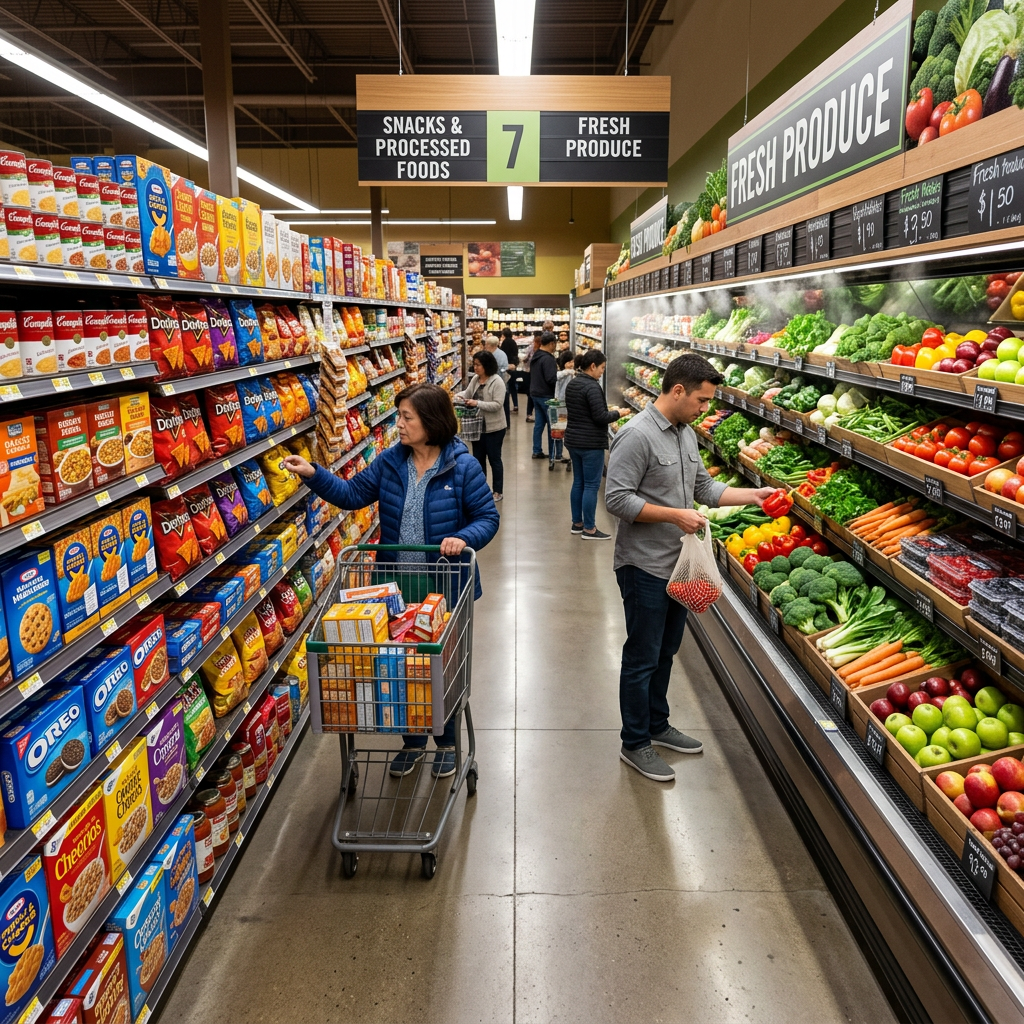
- ultra‑processed foods are the cheapest calories
- whole foods are comparatively expensive
- scratch cooking is economically disincentivized
- industrial food becomes the default for time‑poor households
Subsidies do not merely influence the market. They shape the daily diet of the population.
2. What the Government Does Not Subsidize
The state provides almost no support for:
- vegetables
- fruits
- legumes
- whole proteins
- small farms
- local food systems
- household cooking skills
- community health practices
- intergenerational knowledge transmission
The foods and skills that support long‑term health receive no structural reinforcement. They survive only where households have the time, resources, and lineage to maintain them — conditions that have been systematically eroded.
3. How Subsidies Interact With the Loss of Transmission
When intergenerational skills disappear, households lose the ability to transform raw ingredients into meals. Subsidies then ensure that the cheapest available foods are those requiring no skill to prepare.
The interaction is direct:
- loss of cooking skills → increased reliance on processed foods
- subsidies → processed foods become the cheapest option
- economic pressure → households choose what is affordable and fast
- health declines → medical dependency increases
- medical costs → economic pressure intensifies
- time scarcity → skill transmission becomes impossible
Subsidies turn the loss of transmission into a permanent condition.
4. How Subsidies Interact With Ultra‑Processed Foods
Ultra‑processed foods exist because the subsidized ingredients that compose them are cheaper than the cost of producing whole foods. This creates a structural inversion:
- the most biologically harmful foods are the most affordable
- the most biologically supportive foods are the most expensive
This inversion is not accidental. It is the predictable outcome of subsidizing industrial inputs rather than nutritional outputs.
5. How Subsidies Interact With the Modern Economy
The modern economy demands constant labor. Subsidies ensure that the foods compatible with constant labor — fast, portable, shelf‑stable, hyper‑palatable — are the most accessible.
The economy removes the time for cooking.
Subsidies remove the affordability of whole foods.
Ultra‑processed foods fill the gap.
Skill transmission collapses further.
Dependency deepens.
This is not a cultural drift.
It is a structural alignment.
6. The Full Blender: A Closed System of Extraction
When all four forces combine, they form a closed loop:
- Loss of transmission → households cannot cook or heal
- Ultra‑processed foods → industrial products replace lost skills
- Economic extraction → households lack time to rebuild competence
- Subsidies → processed foods remain the cheapest option
- Health collapse → medical dependency rises
- Rising costs → economic pressure intensifies
- Slack disappears → skill transmission becomes impossible
Each layer reinforces the others.
Each layer stabilizes the system.
Each layer extracts value from households while eroding their autonomy.
7. The Consequence: Structural Dependency
The subsidy structure ensures that:
- industrial food is cheap
- whole food is expensive
- cooking is time‑prohibitive
- healing is outsourced
- health is fragile
- households are dependent
- resilience is rare
The system does not merely fail to support household competence.
It actively undermines it.
8. The Surviving Lineages
Amid this architecture, some individuals retain fragments of older transmissions — food skills, healing arts, repair knowledge. These lineages now serve as the seeds of reconstruction. They demonstrate that the collapse was not caused by a lack of interest or discipline, but by the disappearance of the structural conditions under which competence can form.
The subsidy layer reveals the final truth:
The system was not built to support household resilience.
It was built to support industrial extraction.
Rebuilding begins with understanding the architecture.
We Believe You


Apple Music
YouTube Music
Amazon Music
Spotify Music


Explore Mini-Topics
Leave a Reply