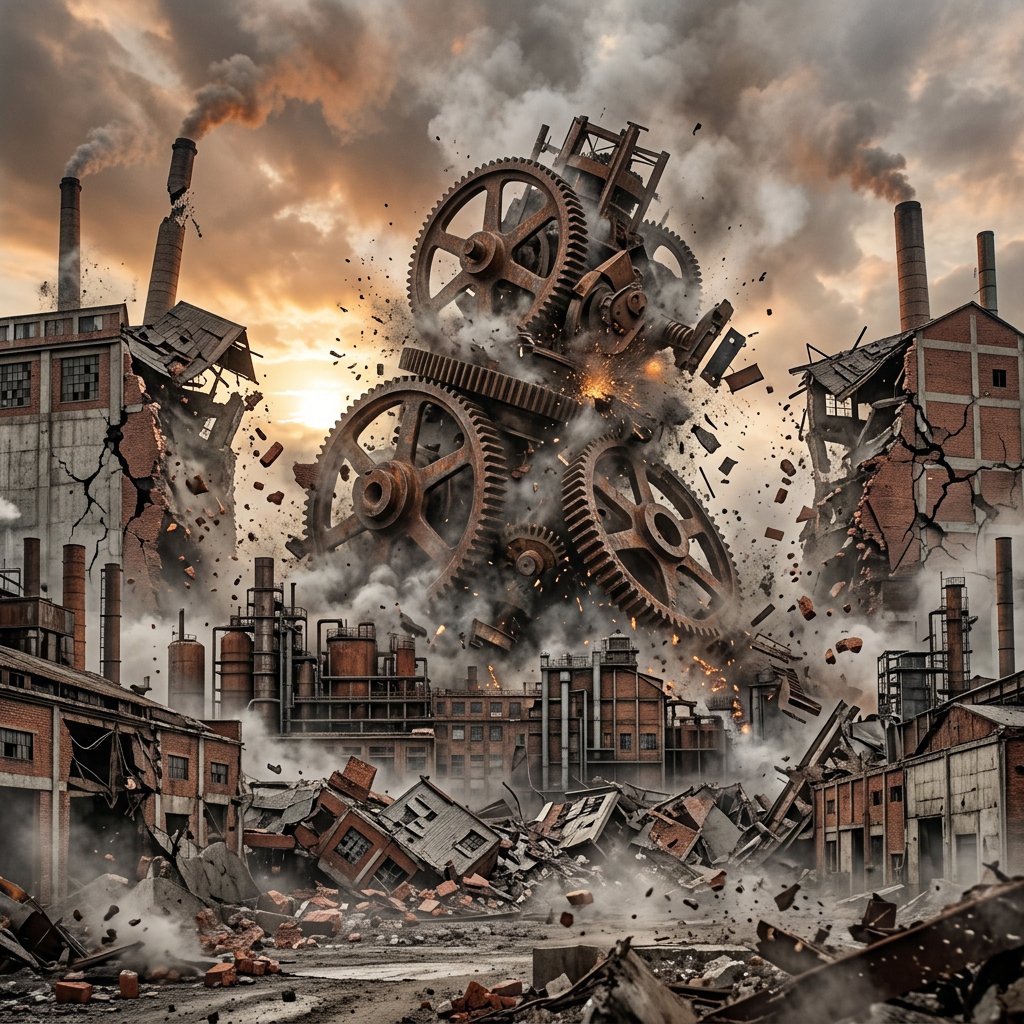
Labor, Policy, Economics, Skill Transmission, and Health
The Extraction Stack is the layered system that demanded more than any one person could sustainably give, while insisting that the demand was normal, natural, and necessary. Its collapse does not begin with rebellion. It begins with recognition — the moment the architecture becomes visible.
1. The Double Day
Extraction begins with the Double Day: the requirement to perform both paid labor and unpaid domestic labor as the price of admission to the public sphere. This was framed as equality, but functioned as coercion. Time, energy, and attention — the raw materials of skill transmission — were consumed before they could be invested in the next generation.
2. The Disappearance of Slack
The Double Day erased the slack that households once relied on. Without slack, there is no teaching, no modeling, no apprenticeship, no lineage. Skills that require repetition and calm — cooking, butchery, preservation, repair — evaporate when every day is a triage. The loss of slack is the loss of the conditions under which competence can form.
3. The Outsourcing Loop
As exhaustion deepened, households outsourced what they no longer had time to do: cooking, cleaning, childcare, food preparation. Each outsourced task removed another opportunity for children to witness competence. The less a family could do, the less the next generation learned to do. The loop reinforced itself, and the household’s internal capacity shrank.
4. The Devaluation of Domestic Skill
Domestic labor was reframed as unskilled, invisible, and unimportant. What had once been considered essential knowledge became optional, then burdensome, then obsolete. The culture treated the loss of these skills as progress rather than erosion. The disappearance of food literacy was not seen as a warning sign, but as a marker of modernity.
5. Policy‑Engineered Single Parenthood
Single parenthood did not emerge organically. It was manufactured through policy: welfare rules that penalized cohabitation, housing assistance that required a single head of household, child support systems that assumed conflict, and criminal justice structures that removed adults from families. This turned the Double Day into the Impossible Day. A two‑adult household barely survives the Double Day. A one‑adult household cannot. Skill transmission collapses when one adult must carry every form of labor alone.
6. Mass Incarceration as a Structural Driver
Mass incarceration removed millions of adults from households, destabilized family systems, and created generational single parenthood. Mandatory minimums, the drug war, cash bail, and felony disenfranchisement fractured the domestic sphere. The result was not just emotional and economic devastation, but the collapse of intergenerational apprenticeship. A child cannot learn what no adult is present to model.
7. The Unaffordability Crisis and the Triple Day
By the 2000s–2020s, the economy added a new extraction layer: wages stagnated, housing costs exploded, healthcare became unaffordable, and gig work became survival. Adults were forced into the Triple Day: paid labor, unpaid domestic labor, and supplemental income labor. Even if the Double Day had left room for teaching (it didn’t), the Triple Day sealed the collapse. There is no world where someone working 60–80 hours a week can transmit the skills that keep households resilient.
8. The Rise of Dependency
As skills disappeared, dependency increased. Households became reliant on industrial food systems, convenience products, and pre‑processed goods. Autonomy shrank. Resilience shrank. The ability to feed oneself from raw materials became rare enough to be considered a specialty. Dependency was framed as convenience, but functioned as capture.
9. The Health Collapse
The loss of cooking and butchery skills produced a predictable outcome: metabolic collapse. Ultra‑processed foods filled the vacuum left by lost competence. Meals became high‑calorie but low‑nutrient, engineered to override satiety rather than support it. The body bore the cost of the system’s convenience. Chronic disease became normalized, then blamed on individuals rather than the structure that produced it.
10. The Satiety Inversion
As whole‑food cooking disappeared, so did the physiological signals that regulate hunger. Protein leverage was disrupted. Blood sugar spikes replaced steady energy. Meals became fast, soft, and hyper‑palatable — designed for speed, not nourishment. The disappearance of scratch cooking was not just cultural loss; it was a biological assault.
11. The Gaslighting Layer
To maintain the system, the culture insisted that nothing was wrong. The Double Day was empowerment. Exhaustion was normal. Convenience was progress. Skill loss was irrelevant. Dependency was freedom. The health crisis was personal failure. The system required people to doubt their own perception of harm.
12. The 1980 Cohort: Raised for One World, Forced Into Another
Those born around 1980 were trained for stay‑at‑home wifehood, domestic mastery, and single‑income households — a world that no longer existed by the time they reached adulthood. They were prepared for slow food and scratch cooking, but forced into a labor market that demanded constant work, gig income, and 24/7 productivity. This mismatch was not personal failure. It was structural betrayal.
13. The Moment of Recognition
Collapse begins when the individual sees the stack clearly. When they realize that their survival depends on skills the culture no longer transmits. When they understand that what was framed as personal failure was structural impossibility. Recognition is the first rupture in the architecture — the moment the invisible becomes visible.
14. The Return of Competence
The collapse of extraction is not the end of the self. It is the end of distortion. As the stack fails, competence returns — not as nostalgia, but as autonomy. Skills re‑emerge. Lineages re‑form. The individual begins to rebuild what the system allowed to decay. Cooking becomes medicine. Butchery becomes literacy. Food becomes agency.
15. The New Foundation
What emerges after collapse is not a return to the past, but a reconstruction of agency. The person who sees the stack can no longer be captured by it. They build systems that nourish rather than extract. They teach what was not taught to them. They become the point where the lineage restarts. The new foundation is not built on exhaustion, but on competence, clarity, and care.
The Collapse of the Extraction Stack is not a crisis. It is a turning point — the moment when the architecture of harm loses its hold, and the architecture of relation begins to rise.
We Believe You


Apple Music
YouTube Music
Amazon Music
Spotify Music


Explore Mini-Topics
Leave a Reply