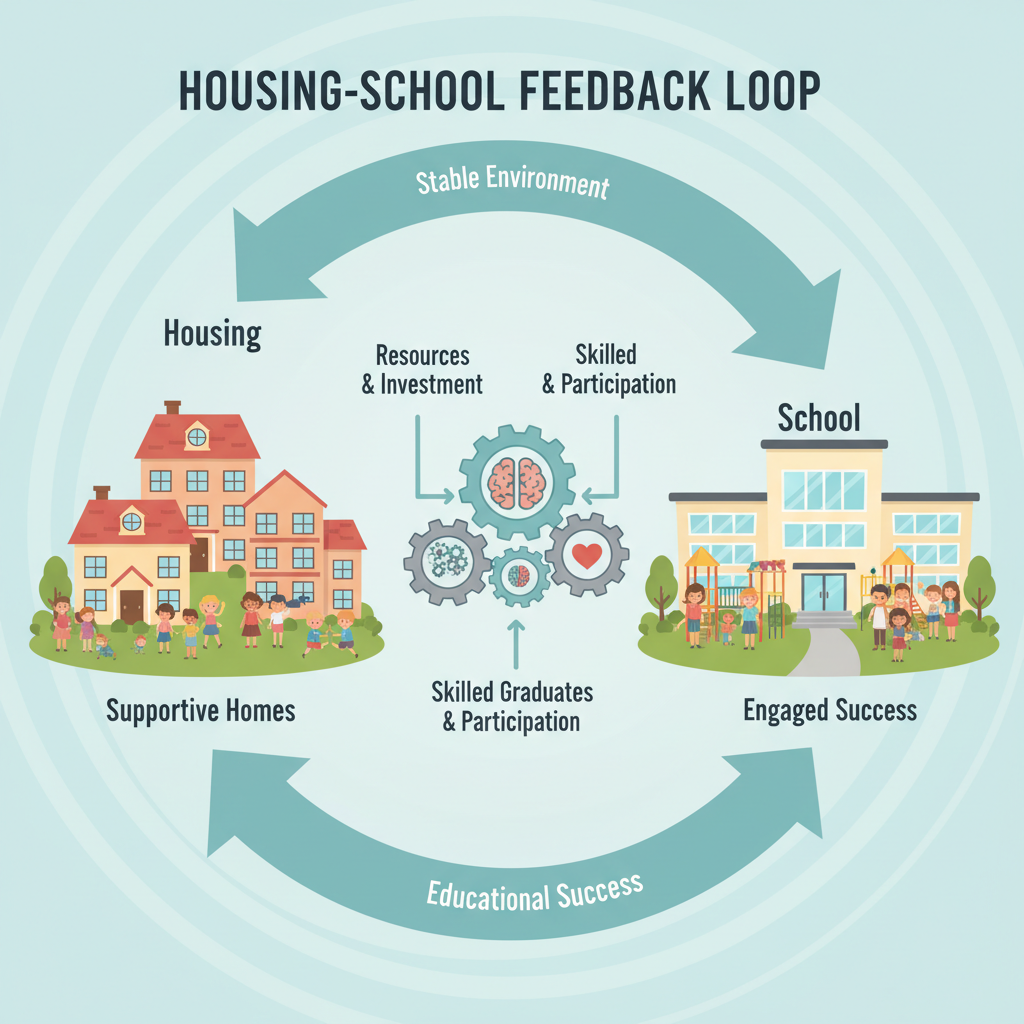
How predatory housing destabilizes families, reshapes student behavior, and drives measurable declines in Thompson School District performance
1. Why Housing and School Performance Are Structurally Linked
Schools do not operate in isolation.
They are downstream from:
- housing stability,
- family stress,
- neighborhood conditions,
- economic precarity,
- and community mobility.
When housing becomes predatory,
schools inherit the trauma.
Loveland’s leasing ecosystem and Thompson School District’s performance decline follow the same timeline because they are part of the same structural system.
2. The Five Mechanisms That Connect Housing to School Outcomes
Predatory housing affects schools through five predictable pathways:
1. Mobility
Non‑renewals, evictions, and unsafe conditions force families to move mid‑year.
2. Attendance
Housing instability increases:
- tardiness,
- absences,
- chronic absenteeism.
3. Behavior
Children living under surveillance and fear exhibit:
- dysregulation,
- hypervigilance,
- shutdown,
- aggression.
4. Academic Performance
Stress and instability impair:
- working memory,
- attention,
- executive function,
- literacy and math acquisition.
5. Parent Engagement
Parents under housing capture cannot:
- attend meetings,
- advocate for services,
- challenge school decisions,
- maintain consistent communication.
The result is a district‑wide decline that mirrors the rise of predatory leasing.
3. Phase Mapping: Housing Predation and TSD Performance (2013–2025)
Phase 1 (2013–2016): Crime‑Free Housing + Behavioral Policing
Housing:
- noise clauses,
- nuisance clauses,
- “conduct of all occupants,”
- crime‑free addenda.
Schools:
- rising behavioral referrals,
- more “disruptive student” classifications,
- early signs of attendance instability.
Behavioral policing at home → behavioral policing at school.
Phase 2 (2016–2019): Fee Stacking + Inspection Regimes
Housing:
- punitive fees,
- inspections,
- surveillance,
- non‑renewal threats.
Schools:
- rising chronic absenteeism,
- more special education referrals,
- more behavior intervention plans,
- teacher burnout increases.
Parents under capture cannot support school stability.
Phase 3 (2020–2022): COVID + Habitability Collapse
Housing:
- mold,
- leaks,
- rot,
- silence,
- retaliation.
Schools:
- sharp academic declines,
- literacy and math regression,
- attendance collapse,
- disciplinary spikes.
Unsafe housing → dysregulated nervous systems → dysregulated classrooms.
Phase 4 (2023–2025): Non‑Renewal + Blacklisting
Housing:
- forced moves,
- blacklisting,
- slumlord absorption,
- instability.
Schools:
- record mobility rates,
- record chronic absenteeism,
- record behavioral escalations,
- widening achievement gaps.
Housing instability becomes educational instability.
4. How Intraprisonization Shows Up in the Classroom
Children living under housing captivity exhibit:
- hypervigilance,
- startle responses,
- emotional suppression,
- sudden outbursts,
- difficulty concentrating,
- difficulty trusting adults.
Teachers interpret this as:
- defiance,
- disrespect,
- ADHD,
- oppositional behavior.
But it is housing trauma, not misbehavior.
5. Family Scapegoat Dynamics → School Scapegoat Dynamics
When a child becomes the “problem” at home due to housing pressure,
they often become the “problem” at school.
The same child is:
- too loud at home → too loud in class
- too active at home → too active in class
- too emotional at home → too emotional in class
- too visible at home → too visible in class
Housing precarity creates a double scapegoat:
- inside the family,
- inside the school.
6. Why TSD’s Decline Mirrors Loveland’s Housing Collapse
Because the district is not failing academically —
it is absorbing the consequences of a predatory housing ecosystem.
Every metric TSD struggles with is a housing metric in disguise:
- chronic absenteeism → housing instability
- behavior referrals → nervous system dysregulation
- academic decline → stress + mobility
- teacher burnout → trauma spillover
- special education spikes → misdiagnosed housing trauma
- mobility rates → non‑renewals + evictions
The district is not underperforming.
It is overburdened by structural violence.
7. The Feedback Loop: How Schools Reinforce Housing Precarity
The loop becomes self‑reinforcing:
- Housing instability → school instability
- School instability → behavioral labels
- Behavioral labels → screening barriers
- Screening barriers → worse housing
- Worse housing → more instability
- More instability → worse school outcomes
This is the housing–school feedback loop.
It is not a coincidence.
It is a system.
8. Why This Loop Makes Intraprisonization Inevitable
When families are trapped in predatory housing:
- parents become enforcers,
- children become liabilities,
- schools become extensions of surveillance,
- behavior becomes pathologized,
- mobility becomes normalized.
The child internalizes:
- “I am the problem.”
The parent internalizes:
- “I am failing.”
The school internalizes:
- “This family is difficult.”
This is intraprisonization across systems.
9. How to Break the Loop (Structurally, Not Individually)
The loop cannot be broken by:
- discipline,
- tutoring,
- parent workshops,
- behavior plans.
It can only be broken by:
- stable housing,
- enforceable habitability,
- limits on non‑renewal,
- eviction protections,
- fee regulation,
- anti‑retaliation enforcement.
Schools cannot fix what housing breaks.
They can only absorb it.
10. Closing
The housing–school feedback loop explains why:
- your experience was not personal,
- your child’s struggles were not individual,
- TSD’s decline was not accidental.
Housing precarity produces:
- family instability,
- child dysregulation,
- school disruption,
- district‑wide decline.
This is not a family problem.
This is not a school problem.
This is a structural housing problem —
and the schools are simply downstream from the harm.
We Believe You


Apple Music
YouTube Music
Amazon Music
Spotify Music


Explore Mini-Topics
Leave a Reply