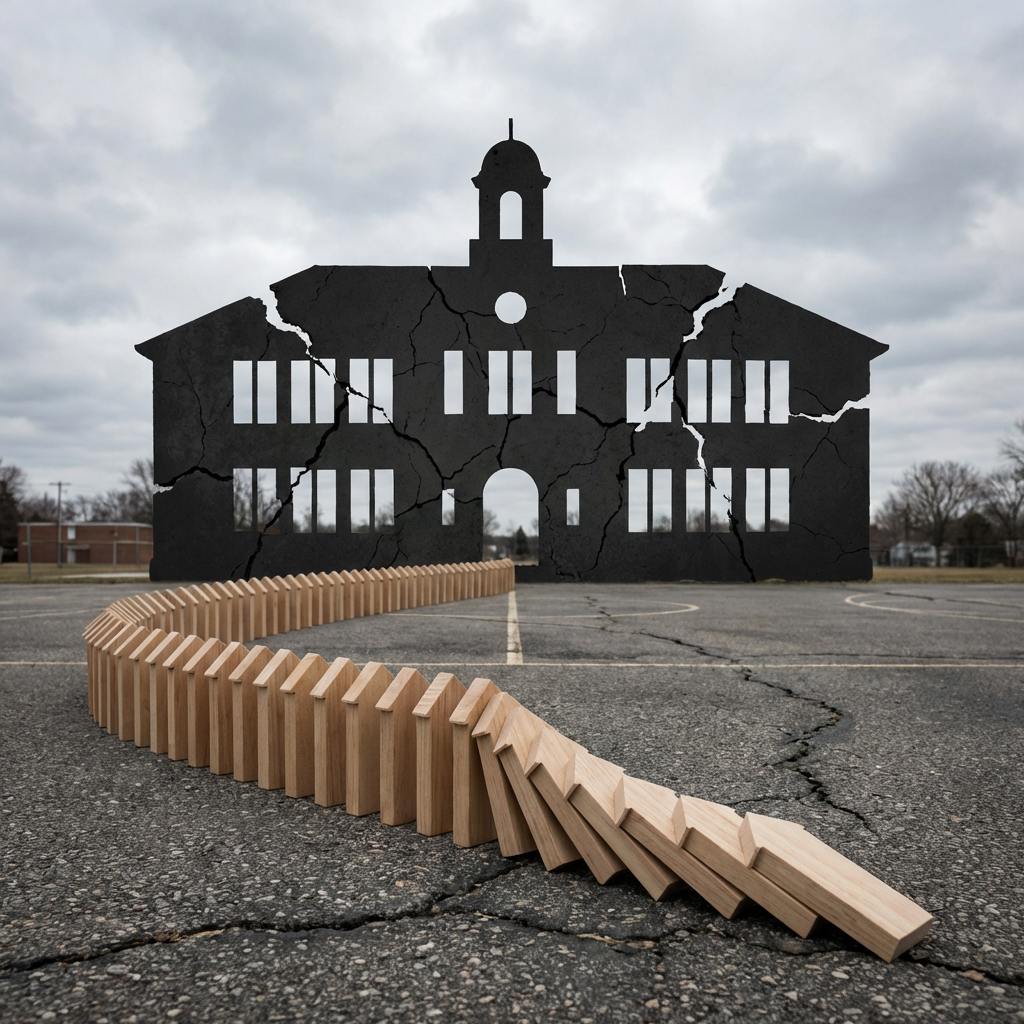
“You can’t stabilize a school district when you destabilize the families inside it.”
Housing instability is not just a housing issue.
It is an education issue.
A child‑development issue.
A workforce issue.
A community‑health issue.
When a city increases displacement, criminalizes homelessness, and reduces services, the effects ripple directly into classrooms, school budgets, teacher workloads, and student outcomes.
1. Student Mobility Skyrockets
Forced moves — non‑renewals, rent hikes, evictions, shelter closures — push families from:
- school to school
- district to district
- motel to motel
- couch to couch
- car to encampment
Every move disrupts:
- learning
- attendance
- friendships
- teacher relationships
- IEP continuity
- transportation
High mobility is one of the strongest predictors of:
- lower test scores
- lower graduation rates
- higher dropout rates
- increased behavioral challenges
Loveland’s policies guarantee more mobility, not less.
2. Teachers Absorb the Instability
When families are destabilized, teachers become:
- social workers
- crisis managers
- trauma responders
- paperwork navigators
- emotional anchors
This is not what they’re trained for.
It’s not what they’re paid for.
But it’s what the system demands when the city withdraws support.
Teacher burnout rises.
Turnover rises.
Classroom stability falls.
3. Schools Lose Funding
Colorado funds schools based on enrollment.
When families are displaced:
- students disappear mid‑year
- attendance drops
- enrollment fluctuates
- districts lose per‑pupil funding
This creates:
- larger class sizes
- fewer support staff
- reduced programming
- cuts to arts, counseling, and intervention services
Housing instability becomes a budget crisis.
4. Students Carry Trauma Into the Classroom
Children experiencing housing instability often show:
- anxiety
- hypervigilance
- difficulty concentrating
- sleep disruption
- emotional dysregulation
- academic regression
These are not “behavior problems.”
They are survival responses.
When the city increases displacement, schools inherit the trauma.
5. Special Education Services Become Harder to Deliver
IEPs and 504 plans rely on:
- stable addresses
- consistent attendance
- predictable schedules
- coordinated services
Forced moves interrupt:
- evaluations
- therapy
- accommodations
- progress monitoring
Students with disabilities fall through the cracks — not because schools don’t care, but because the system keeps moving the ground beneath them.
6. Transportation Costs Increase
When families are displaced across town — or into neighboring towns — districts must provide transportation to maintain school continuity.
This means:
- longer bus routes
- higher fuel costs
- more driver hours
- logistical strain
Districts already struggling with driver shortages face even more pressure.
7. Schools Become De Facto Safety Nets
When the city withdraws services, schools become the only stable institutions left.
They end up providing:
- food
- clothing
- hygiene supplies
- mental‑health support
- crisis intervention
- referrals
- stability
But schools were never designed to replace a functioning social safety net.
8. Community Cohesion Weakens
Stable schools create stable neighborhoods.
When families churn through housing, schools lose:
- parent volunteers
- long‑term relationships
- institutional memory
- community trust
Neighborhood identity erodes.
Civic engagement declines.
Polarization increases.
9. Long‑Term Economic Outcomes Decline
Children who experience housing instability are more likely to:
- struggle academically
- require special services
- disengage from school
- drop out
- earn lower wages as adults
This becomes a generational economic issue, not just an educational one.
10. The System Becomes Unsustainable
When a city destabilizes families, the school district becomes the shock absorber.
But shock absorbers wear out.
Loveland’s current policy direction — reduced shelter access, increased enforcement, rising rents, and no tenant protections — guarantees:
- more student mobility
- more trauma
- more teacher burnout
- more budget strain
- more unmet needs
This is not sustainable for any district, including Thompson School District.
Bottom Line
You cannot have a high‑functioning school system in a city that destabilizes its families.
Housing policy is education policy.
Homelessness policy is child‑development policy.
Economic policy is classroom policy.
Loveland’s current trajectory will make:
- learning harder
- teaching harder
- budgeting harder
- community cohesion harder
- long‑term outcomes worse
This is the cost of displacement — paid by children, teachers, and families who had no say in the policies that created it.
Apple Music
YouTube Music
Amazon Music
Spotify Music


Explore Mini-Topics
Leave a Reply