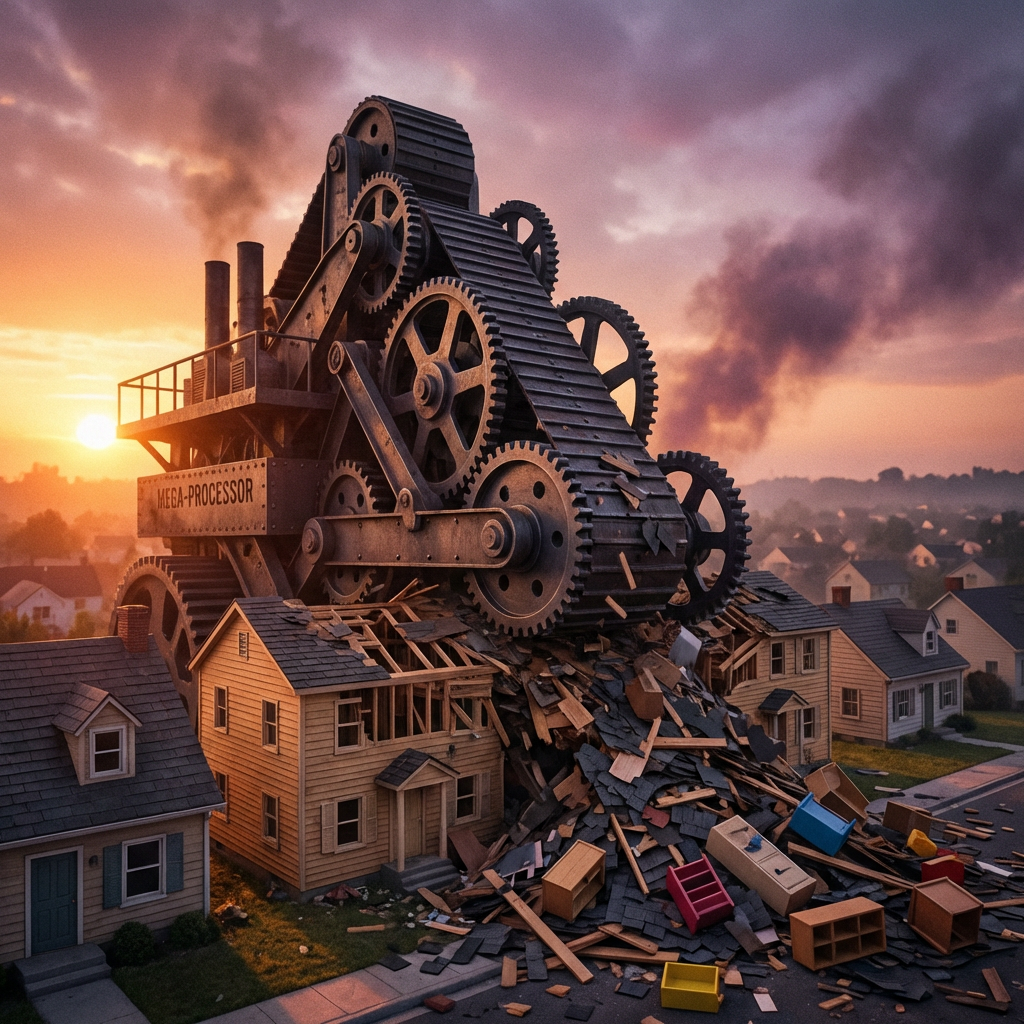
“Loveland’s Housing Crisis Isn’t an Accident — It’s a System Built to Push People Out”
Displacement in Loveland doesn’t happen randomly. It isn’t the result of a few bad landlords, a handful of negligent property managers, or a couple of strict HOAs. It is the predictable outcome of a system designed to keep people moving, keep rents rising, and keep accountability out of reach.
This machinery doesn’t look like machinery. It looks like paperwork, policies, inspections, fines, and “standard procedures.” It looks like professionalism. It looks like neutrality. But beneath the surface, it functions with the precision of an engine — one that extracts value from instability and punishes anyone who tries to stay put.
The System Begins With Scarcity
Loveland’s housing market is built on manufactured scarcity. There are fewer rentals than people who need them, fewer affordable units than families who qualify, and fewer protections than the instability demands.
Scarcity creates leverage.
Leverage creates compliance.
Compliance keeps the machine running.
In a market this tight, tenants don’t negotiate. They accept whatever terms are offered — no matter how punitive, restrictive, or unrealistic.
The Lease as a Weapon
Modern leases in Loveland are not simple agreements. They are legal fortresses designed to protect landlords and expose tenants.
Common clauses include:
- unlimited entry
- unlimited inspections
- unlimited photo documentation
- mandatory landscaping standards
- mandatory maintenance responsibilities
- no right to withhold rent
- no right to offset for unaddressed repairs
- no guarantee of renewal
- fees for nearly every action
These clauses create a one‑way power structure.
The tenant carries all the risk.
The landlord carries none.
HOAs as Enforcement Arms
In “good neighborhoods,” HOAs act as private governments. They enforce aesthetics, not safety. They prioritize appearances, not stability. And they operate with almost no oversight.
Their tools include:
- violation letters
- fines
- escalating threats
- pressure on landlords
- pressure on property managers
HOAs don’t evict tenants directly.
They don’t have to.
They create conditions that make non‑renewal inevitable.
Property Managers as Gatekeepers
Property managers in Loveland often function as the operational arm of displacement. They control:
- applications
- approvals
- inspections
- maintenance
- fines
- communication
- renewal decisions
They can deny renewal without cause.
They can raise rent without justification.
They can issue violations without evidence.
They can ignore repairs without consequence.
And because they operate under the banner of “policy,” their actions appear neutral even when they are deeply harmful.
The Financial Incentives Behind Turnover
Turnover is profitable.
Every move generates:
- application fees
- administrative fees
- cleaning fees
- inspection fees
- new deposits
- new rent increases
- new opportunities to deny renewal
Long‑term tenants don’t generate revenue.
Turnover does.
The system is designed to reward displacement.
The Emotional and Physical Toll
Forced nomadism doesn’t just move people. It breaks them down.
Families experience:
- chronic stress
- financial depletion
- physical injury from repeated moves
- emotional exhaustion
- loss of community
- disruption of children’s schooling
- deterioration of mental health
These are not side effects.
They are part of the machinery.
A destabilized tenant is easier to control.
A destabilized tenant is less likely to fight back.
A destabilized tenant is more profitable.
The Role of Employers
Housing instability doesn’t exist in isolation. It intersects with workplace instability — wage theft, inconsistent hours, corporate collapse, and low pay.
When a job becomes unpredictable, housing becomes unpredictable.
When income collapses, housing collapses.
The machinery of displacement relies on this overlap.
It thrives on it.
The Myth of Personal Failure
Public narratives often blame individuals:
- “They should budget better.”
- “They should move somewhere cheaper.”
- “They should work harder.”
- “They must have done something wrong.”
But these narratives collapse under scrutiny.
People aren’t losing housing because they’re irresponsible.
They’re losing housing because the system is designed to push them out.
The Machinery in Motion
Across Loveland, the same pattern repeats:
- A family moves into a rental.
- The lease is restrictive.
- The HOA is punitive.
- The property manager is unresponsive.
- The workplace is unstable.
- The rent increases.
- The violations accumulate.
- The non‑renewal arrives.
- The family moves again.
Each move drains savings, health, time, and hope.
Each move makes the next one harder.
Each move pushes families closer to the edge.
This is not a series of isolated events.
It is a system.
Why This Matters
Loveland’s homelessness crisis cannot be understood without understanding the machinery of displacement. The encampments, the motel families, the people sleeping in cars — these are not anomalies. They are the visible outcome of a system that has been operating in the shadows for years.
The machinery of displacement is not broken.
It is functioning exactly as designed.
Episode 11 exposes the architecture.
Episode 12 reveals the final layer: how Loveland talks about homelessness while actively producing it.
Apple Music
YouTube Music
Amazon Music
Spotify Music


Explore Mini-Topics
Leave a Reply