Part XXXII — The John F. Kennedy Administration: The Politics of Promise, the Reality of Power, and the Unfinished Revolutions of the 1960s
John F. Kennedy (1961–1963) presided over one of the most mythologized periods in American history.
His presidency was brief, glamorous, and filled with symbolic power — but also marked by profound structural tensions that would erupt after his death.
Kennedy embodied a generational shift:
- youth replacing the old guard
- technocracy replacing machine politics
- global idealism replacing Cold War fatalism
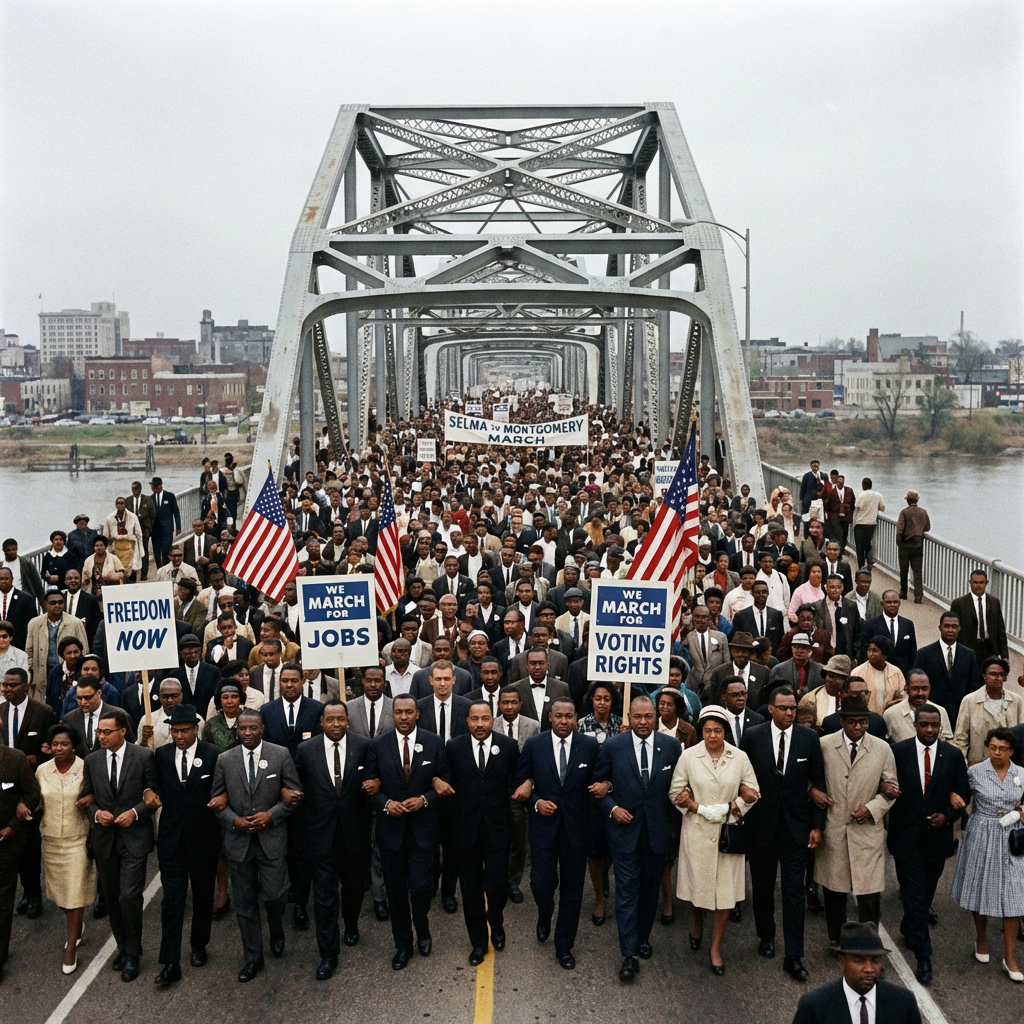
- civil rights activism forcing federal action
But beneath the optimism of the “New Frontier,” the nation was entering one of the most turbulent decades in its history.
Kennedy’s presidency is the moment when the founding contradiction — liberty for some, captivity for others — reappears in its early‑1960s form:
A nation that celebrated freedom and modernity confronted racial apartheid at home, Cold War brinkmanship abroad, and social movements demanding a deeper democracy than the political system was prepared to deliver.
To understand Kennedy’s presidency, we have to map the forces shaping the era.
The Major Social Forces at Play (1961–1963)
1. The Intensification of the Cold War
The U.S. and the Soviet Union competed over:
- nuclear weapons
- ideological influence
- proxy conflicts
- global prestige
The threat of annihilation shaped policy.
2. The Rise of the Civil Rights Movement
Black Americans demanded:
- desegregation
- voting rights
- federal protection
Grassroots activism accelerated.
3. The Expansion of the National Security State
The CIA and Pentagon shaped:
- foreign policy
- covert operations
- global strategy
Kennedy inherited a powerful security apparatus.
4. The Growth of Youth Culture
A new generation embraced:
- activism
- cultural experimentation
- political idealism
The 1960s were beginning to take shape.
5. The Persistence of Segregation
In the South:
- Jim Crow remained law
- violence escalated
- federal intervention was resisted
The contradiction between national ideals and Southern reality sharpened.
6. The Technocratic Turn
Kennedy surrounded himself with:
- economists
- scientists
- policy experts
This was governance through expertise.
The Contradiction Kennedy Inherited
Kennedy inherited the same contradiction as his predecessors — but in its early‑1960s form:
The United States claimed to lead the free world while denying full freedom to millions of its own citizens and risking global destruction through nuclear brinkmanship.
Kennedy believed in moral leadership — but governed within the constraints of Cold War realism and domestic political caution.
The Key Events That Exposed the Tension
1. The Bay of Pigs (1961)
A CIA‑backed invasion of Cuba failed disastrously.
This:
- humiliated the administration
- strengthened Castro
- deepened Cold War tensions
Kennedy distrusted the national security establishment afterward.
2. The Berlin Crisis (1961)
The Soviets built the Berlin Wall.
Kennedy:
- reinforced West Berlin
- avoided escalation
- accepted division as reality
The Cold War hardened.
3. The Cuban Missile Crisis (1962)
The world came closer to nuclear war than ever before.
Kennedy:
- imposed a naval quarantine
- negotiated secretly
- avoided catastrophe
This was the defining moment of his presidency.
4. The Nuclear Test Ban Treaty (1963)
After the crisis, Kennedy pursued de‑escalation.
The treaty:
- banned atmospheric nuclear tests
- signaled a shift toward diplomacy
- marked a rare Cold War breakthrough
5. The Space Race
Kennedy committed the U.S. to landing a man on the moon.
This:
- mobilized science and industry
- symbolized national ambition
- reframed Cold War competition
6. The Freedom Rides (1961)
Civil rights activists challenged segregated interstate travel.
Kennedy:
- sent federal marshals
- pressured the ICC to act
- avoided public confrontation
He responded, but cautiously.
7. The Birmingham Campaign (1963)
Images of police violence shocked the nation.
Kennedy:
- addressed the nation
- called civil rights a “moral issue”
- proposed civil rights legislation
This was a turning point.
8. The March on Washington (1963)
Kennedy supported the march privately, cautiously.
The movement was outpacing the administration.
9. Kennedy’s Assassination (1963)
His death:
- froze his presidency in myth
- transferred unfinished agendas to LBJ
- intensified national trauma
The New Frontier became a symbol of unrealized possibility.
What Kennedy’s Administration Reveals
Kennedy’s presidency exposes a new dimension of the founding contradiction:
A nation that celebrated freedom and modernity confronted racial apartheid at home and nuclear brinkmanship abroad — revealing the limits of symbolic leadership in the face of structural crisis.
His administration reveals:
- idealism as political force
- caution as constraint
- civil rights as unavoidable national issue
- nuclear war as existential threat
- technocracy as new mode of governance
Kennedy did not resolve the contradiction.
He illuminated it — and left its resolution to the movements and leaders who followed.
Why This Matters for the Series
Kennedy adds a new layer to the pattern:
- Washington built federal power.
- Adams used federal power to suppress dissent.
- Jefferson used federal power to expand the nation while deepening inequality.
- Madison discovered the limits of constitutional compromise.
- Monroe created the illusion of unity while contradictions intensified.
- John Quincy Adams saw the contradictions clearly but lacked the power to resolve them.
- Andrew Jackson expanded democracy for the majority while intensifying captivity for everyone else.
- Martin Van Buren inherited the consequences — economic collapse and political realignment.
- Harrison & Tyler exposed constitutional ambiguity and accelerated sectional crisis.
- James K. Polk expanded the nation through war, pushing the slavery question to the breaking point.
- Zachary Taylor confronted the crisis directly but died before the nation chose its path.
- Millard Fillmore enforced compromise through coercion, deepening the contradictions.
- Franklin Pierce attempted unity through appeasement, unleashing violence and accelerating collapse.
- James Buchanan presided over the final breakdown of the political system.
- Abraham Lincoln confronted the contradiction directly and transformed the meaning of freedom.
- Andrew Johnson attempted to reverse that transformation, revealing the fragility of freedom.
- Ulysses S. Grant fought to secure Reconstruction against violent resistance.
- Rutherford B. Hayes ended Reconstruction, enabling a new racial order.
- Garfield & Arthur modernized the state while new exclusions emerged.
- Grover Cleveland (First Term) governed as a conservative reformer in an age of corporate power.
- Benjamin Harrison expanded federal authority to confront industrial inequality.
- Grover Cleveland (Second Term) faced economic collapse with tools that no longer fit a modern economy.
- William McKinley ushered in American empire and corporate consolidation.
- Theodore Roosevelt built the modern presidency and expanded federal power.
- William Howard Taft struggled to define the limits of Progressive governance.
- Woodrow Wilson expanded democracy abroad while restricting it at home.
- Harding & Coolidge presided over corporate conservatism and the illusion of stability.
- Herbert Hoover confronted systemic collapse with an ideology built for a different world.
- Franklin D. Roosevelt rebuilt the American state and redefined economic citizenship.
- Harry S. Truman built the national security state and globalized American power.
- Dwight D. Eisenhower consolidated Cold War order and presided over suburban prosperity.
- John F. Kennedy embodied the optimism and contradictions of the early 1960s — illuminating crises he would not live to resolve.
Each administration inherits the fault line.
Each administration reshapes it.
None escape it.
Next comes Lyndon B. Johnson — the president who will attempt the most ambitious expansion of American democracy since Reconstruction, while simultaneously escalating the Vietnam War and exposing the deepest fractures of the American project.
Apple Music
YouTube Music
Amazon Music
Spotify Music


Explore Mini-Topics
Leave a Reply