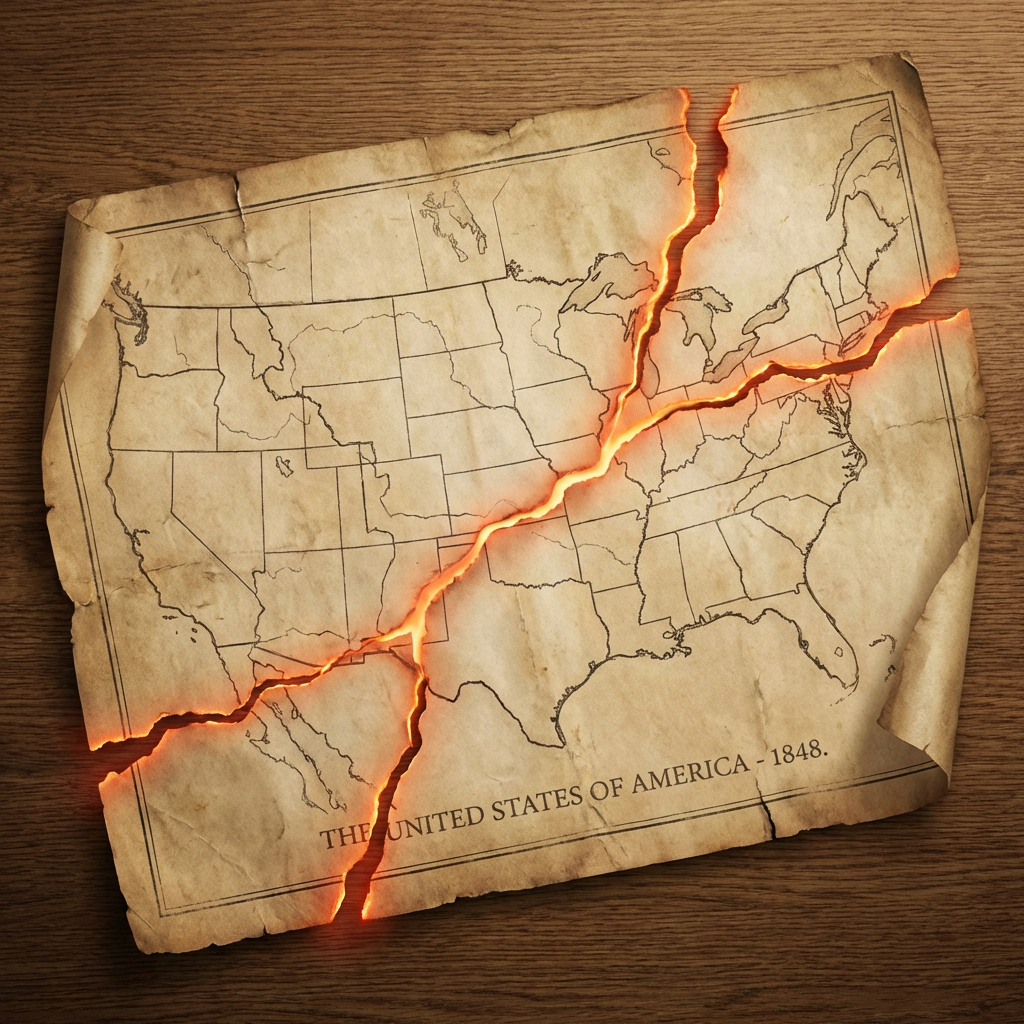
Part IX — The Harrison & Tyler Administrations: Constitutional Ambiguity, Sectional Hardening, and the Road Toward Crisis
The period from 1841 to 1845 is one of the strangest and most revealing in early American history.
William Henry Harrison served only 31 days before dying in office.
John Tyler — a man never intended to be president — suddenly found himself leading a nation already fracturing along lines of region, race, and political identity.
This era exposes a new layer of the founding contradiction:
The Constitution claimed to create a stable republic, but it left critical questions unanswered — including what happens when a president dies.
Tyler’s presidency forced the nation to confront this ambiguity while navigating intensifying sectional conflict, economic instability, and the accelerating expansion of slavery.
To understand this period, we have to map the forces shaping the era.
The Major Social Forces at Play (1841–1845)
1. The Rise of the Whig Party
The Whigs had formed in opposition to Jacksonian democracy.
They represented:
- commercial interests
- infrastructure development
- congressional supremacy
- suspicion of executive power
Harrison was their candidate.
Tyler was their compromise — and ultimately their undoing.
2. The Expansion of Slavery
Slavery was:
- spreading westward
- politically entrenched
- economically dominant in the South
- increasingly contested in the North
The nation was drifting toward sectional crisis.
3. The Question of Presidential Succession
The Constitution did not clearly state:
- whether the vice president becomes president
- or merely acts as president
Tyler’s claim to full presidential authority set a precedent that still stands.
4. The Push for Territorial Expansion
The nation was hungry for land:
- Texas
- Oregon
- California
- the Southwest
Expansion was tied to slavery, national identity, and geopolitical ambition.
5. Economic Instability
The Panic of 1837 still cast a long shadow.
The economy was fragile.
Banks were unstable.
Public confidence was low.
6. The Hardening of Sectional Identity
The country was splitting into:
- a free North
- a slave South
- an expansionist West
Each region had incompatible visions for the nation’s future.
The Contradiction Tyler Inherited
Tyler inherited the same contradiction as his predecessors — but in a more volatile form:
The United States claimed to be a unified republic, but its political structure was fracturing along lines of region, ideology, and economic interest.
Tyler’s presidency exposed how fragile the system truly was.
The Key Events That Exposed the Tension
1. Harrison’s Death and the Succession Crisis
When Harrison died, the Constitution was unclear about succession.
Tyler declared:
- he was not “acting president”
- he was the president
This assertion:
- angered Whigs
- created a constitutional precedent
- revealed gaps in the founding document
The Revolution promised stability.
The early republic delivered ambiguity.
2. Tyler vs. the Whig Party
Tyler was a Whig in name only.
He:
- vetoed Whig economic bills
- rejected the national bank
- opposed congressional supremacy
The Whigs:
- expelled him from the party
- attempted to isolate him politically
The president had no party.
The party had no president.
3. The Veto Power as Political Weapon
Tyler used the veto more aggressively than any president before him.
This:
- expanded executive authority
- enraged Congress
- deepened partisan conflict
The Revolution feared concentrated power.
Tyler embraced it when it suited him.
4. The Push to Annex Texas
Tyler made Texas annexation the centerpiece of his presidency.
Annexation meant:
- expanding slavery
- provoking Mexico
- accelerating sectional conflict
Tyler framed it as national destiny.
It was also a political gambit to appeal to the South.
5. The Webster–Ashburton Treaty (1842)
This treaty:
- settled the U.S.–Canada border
- reduced tensions with Britain
- strengthened northern security
It was one of Tyler’s few broadly supported achievements.
6. The Growing Sectional Divide
Every major issue — tariffs, banks, expansion, slavery — intensified regional identity.
The nation was becoming ungovernable under the existing structure.
What This Era Reveals
The Harrison–Tyler period exposes a new dimension of the founding contradiction:
A constitutional system built on compromise cannot function when the political community no longer shares a common vision.
This era reveals:
- the fragility of constitutional design
- the dangers of ambiguous succession
- the rise of sectional loyalty over national identity
- the power of expansionist ambition
- the centrality of slavery to national politics
Tyler didn’t create the contradictions.
He governed in a moment when they were becoming impossible to ignore.
Why This Matters for the Series
This era adds a new layer to the pattern:
- Washington built federal power.
- Adams used federal power to suppress dissent.
- Jefferson used federal power to expand the nation while deepening inequality.
- Madison discovered the limits of constitutional compromise.
- Monroe created the illusion of unity while contradictions intensified.
- John Quincy Adams saw the contradictions clearly but lacked the power to resolve them.
- Andrew Jackson expanded democracy for the majority while intensifying captivity for everyone else.
- Martin Van Buren inherited the consequences — economic collapse and political realignment.
- Harrison & Tyler exposed constitutional ambiguity and accelerated the sectional crisis.
Each administration inherits the fault line.
Each administration reshapes it.
None escape it.
Next comes James K. Polk — the president who will turn expansion into empire and push the nation to the brink of civil war.
Apple Music
YouTube Music
Amazon Music
Spotify Music


Explore Mini-Topics
Leave a Reply