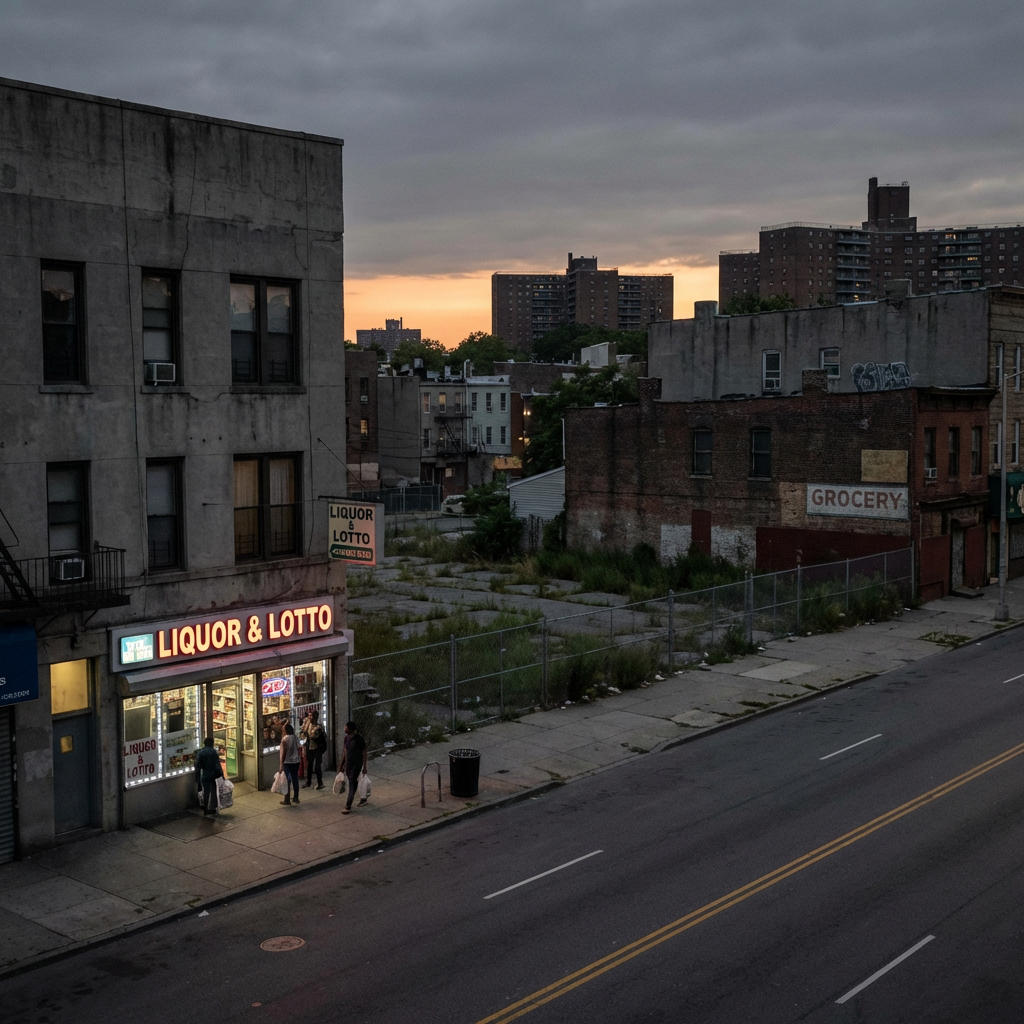
Post 6 — Food Apartheid and the Geography of Vulnerability
If engineered addiction shows how the body can be captured biochemically, food apartheid shows how entire communities can be captured geographically. This is where the architecture of engineered dependency becomes spatial — mapped onto neighborhoods, zip codes, and bodies that were never meant to survive on scarcity.
Food apartheid, food deserts, and structural neglect are not accidents.
They are strategies.
They are tools of governance.
They are the spatial expression of the same logic traffickers use interpersonally:
identify vulnerability → isolate → destabilize → extract.
Scarcity as a Designed Condition
“Food desert” is the polite term — the one that makes it sound like nature did it.
But nature didn’t do this. Policy did. Capital did. Power did.
Food apartheid is the intentional placement of:
- low‑quality food,
- high‑addiction food,
- overpriced food,
- or no food at all
into communities that have been historically marginalized or politically disempowered.
Scarcity here is not ecological.
It is engineered.
Scarcity creates:
- desperation,
- dysregulation,
- chronic illness,
- shortened lifespans,
- and lifelong dependency on the cheapest, most addictive calories available.
This is not a market failure.
It is a governance strategy.
Sorting: How Populations Are Managed Through Food
Food apartheid is also a sorting mechanism — a way to distribute harm predictably.
It determines:
- who gets sick,
- who ages quickly,
- who accumulates medical debt,
- who becomes “high‑risk,”
- who is blamed for their own suffering,
- and who remains politically quiet.
Food becomes a way to:
- concentrate illness,
- concentrate poverty,
- concentrate vulnerability,
- and concentrate power elsewhere.
This is population management through nourishment — or the lack of it.
Structural Neglect: The Slow Violence of Abandonment
Neglect is not passive.
Neglect is a policy choice.
Communities become “deserts” when:
- supermarkets refuse to build there,
- zoning laws restrict development,
- transportation is limited,
- wages are suppressed,
- and predatory retailers fill the gap.
The result is a landscape where the only available calories are:
- ultra‑processed,
- shelf‑stable,
- high‑addiction,
- low‑nutrition,
- and aggressively marketed.
Neglect creates the conditions for extraction.
Extraction justifies the neglect.
This is the panthenogenesis of power in spatial form.
The Geography of Vulnerability Mirrors the Psychology of Trafficking
Here is where the unified theory becomes unmistakable.
Food apartheid uses:
- scarcity,
- dysregulation,
- isolation,
- shame,
- and dependency.
Traffickers use:
- scarcity of safety,
- scarcity of belonging,
- scarcity of stability,
- scarcity of affection,
- and scarcity of alternatives.
Both systems:
- identify vulnerability,
- amplify it,
- isolate the target,
- destabilize the nervous system,
- and create conditions where compliance feels like survival.
The medium changes.
The architecture does not.
The Hostage‑Pledge System at the Community Level
In the hostage‑pledge system, someone’s vulnerability becomes the leverage that secures their compliance.
Food apartheid turns entire neighborhoods into hostages.
When your only options are:
- fast food,
- corner stores,
- dollar‑menu calories,
- and ultra‑processed addiction loops,
your survival becomes contingent on the very system harming you.
Your body becomes the hostage.
Your hunger becomes the leverage.
Your compliance becomes the pledge.
This is not metaphor.
This is governance.
Predictable Patterns of Harm
Food apartheid produces the same predictable patterns traffickers exploit:
- chronic stress,
- emotional dysregulation,
- unstable routines,
- financial precarity,
- social isolation,
- and internalized shame.
These are the exact conditions that make people vulnerable to relational capture.
The geography of vulnerability and the psychology of trafficking are two expressions of the same logic.
Why This Matters for the Unified Theory
Food apartheid shows that engineered dependency is not just biochemical or relational — it is spatial. It is infrastructural. It is designed into the landscape.
The same architecture that governs:
- cravings,
- shame,
- and biochemical hooks
also governs:
- neighborhoods,
- access,
- and survival.
In the next post, we’ll turn directly to trafficking — mapping how grooming, coercion, and relational capture follow the same logic as food apartheid, but at the scale of the individual nervous system.
Because the system doesn’t just control where you live.
It controls what you need — and who you must depend on to get it.
Apple Music
YouTube Music
Amazon Music
Spotify Music


Explore Mini-Topics
Leave a Reply