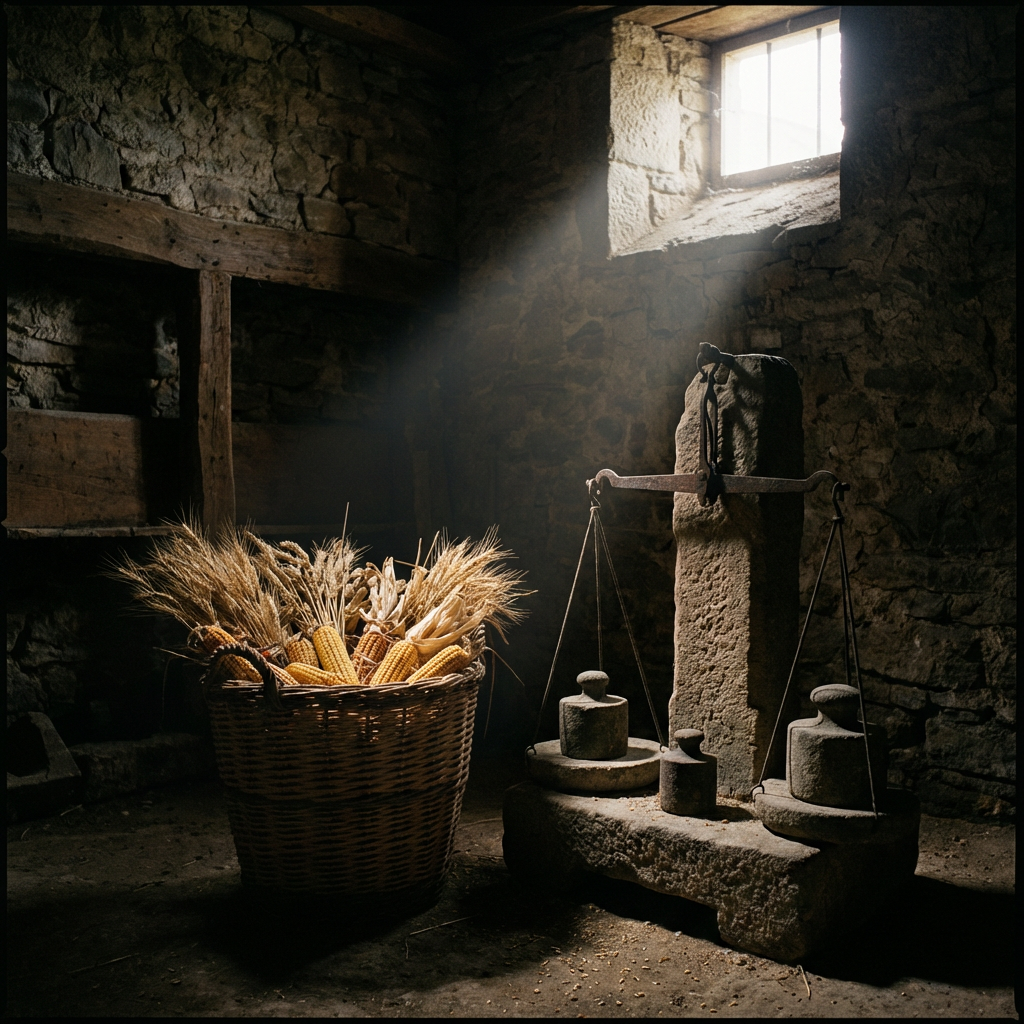
Post 3 — Agriculture, Sedentism, and the Birth of Structural Power
If the early human–food relationship was defined by movement, reciprocity, and ecological attunement, the Agricultural Revolution marks the moment when dependency shifts from relational to structural. This is where food stops being a shared field and becomes a fixed resource. It’s where vulnerability becomes legible. And it’s where the earliest forms of hierarchy, surplus, and hostage‑pledge dynamics begin to take shape.
This is the hinge point — the moment when someone could finally say:
“You need what I control.”
Sedentism: When Staying Put Became Leverage
Foragers could always leave.
Farmers could not.
Once humans began cultivating crops, they anchored themselves to:
- fields,
- irrigation systems,
- seasonal cycles,
- and stored grain.
Sedentism created stability, but it also created exposure.
When your food is rooted in the ground, so are you.
Sedentism introduced:
- predictable needs,
- predictable vulnerabilities,
- predictable dependencies.
And predictable dependency is the raw material of structural power.
Surplus: The First Inequality
Agriculture produced more food than a single family could consume.
Surplus sounds like abundance, but it also creates hierarchy.
Surplus requires:
- storage,
- protection,
- distribution,
- and decision‑makers.
The moment food becomes storable, it becomes:
- hoardable,
- controllable,
- politicized.
Surplus is the first time in human history when someone could accumulate more than they needed — and use that accumulation to shape the lives of others.
Hierarchy: When Roles Became Power
Agriculture didn’t just change how humans ate.
It changed how humans organized themselves.
Not everyone needed to farm anymore.
Some people:
- managed grain,
- built infrastructure,
- enforced rules,
- interpreted omens,
- or claimed divine authority.
Specialization created asymmetry.
Asymmetry created leverage.
Leverage created hierarchy.
This is the moment when survival becomes negotiable — not because of nature, but because of structure.
The First Hostage‑Pledge Dynamics
Here is where the architecture becomes unmistakable.
When:
- food is fixed,
- surplus is controlled,
- hierarchy is established,
- and survival depends on someone else’s decisions,
you get the earliest form of the hostage‑pledge system.
In early agricultural societies:
- families pledged loyalty to leaders who controlled granaries,
- communities pledged obedience to elites who managed irrigation,
- individuals pledged labor in exchange for access to food.
The hostage was not a person yet.
The hostage was the body’s need.
Hunger became leverage.
Access became conditional.
Compliance became the price of survival.
This is the first time in human history when dependency could be weaponized.
From Resource Control to Relational Control
Once the logic exists —
“Control the resource, control the person” —
it can be applied to anything humans depend on.
Food was the first resource.
But later, the same logic would govern:
- safety,
- belonging,
- identity,
- affection,
- stability,
- and relationship.
The shift from ecological dependency to structural dependency is the same shift that later enables:
- grooming,
- coercion,
- trafficking,
- and relational capture.
Agriculture is not just the birth of farming.
It is the birth of conditional survival.
Why This Matters for the Unified Theory
When we trace the arc from foraging to farming, we see the first rupture in the dependency field:
- from shared vulnerability to controlled vulnerability,
- from collective survival to hierarchical survival,
- from ecological reciprocity to structural extraction.
This is the architecture that later becomes:
- food apartheid,
- engineered addiction,
- trafficking dynamics,
- and the modern hostage‑state.
The logic is the same.
Only the medium changes.
In the next post, we’ll follow this logic into the Industrial Revolution — where food becomes mechanized, monetized, and transformed into a self‑replicating engine of control.
Apple Music
YouTube Music
Amazon Music
Spotify Music


Explore Mini-Topics
Leave a Reply