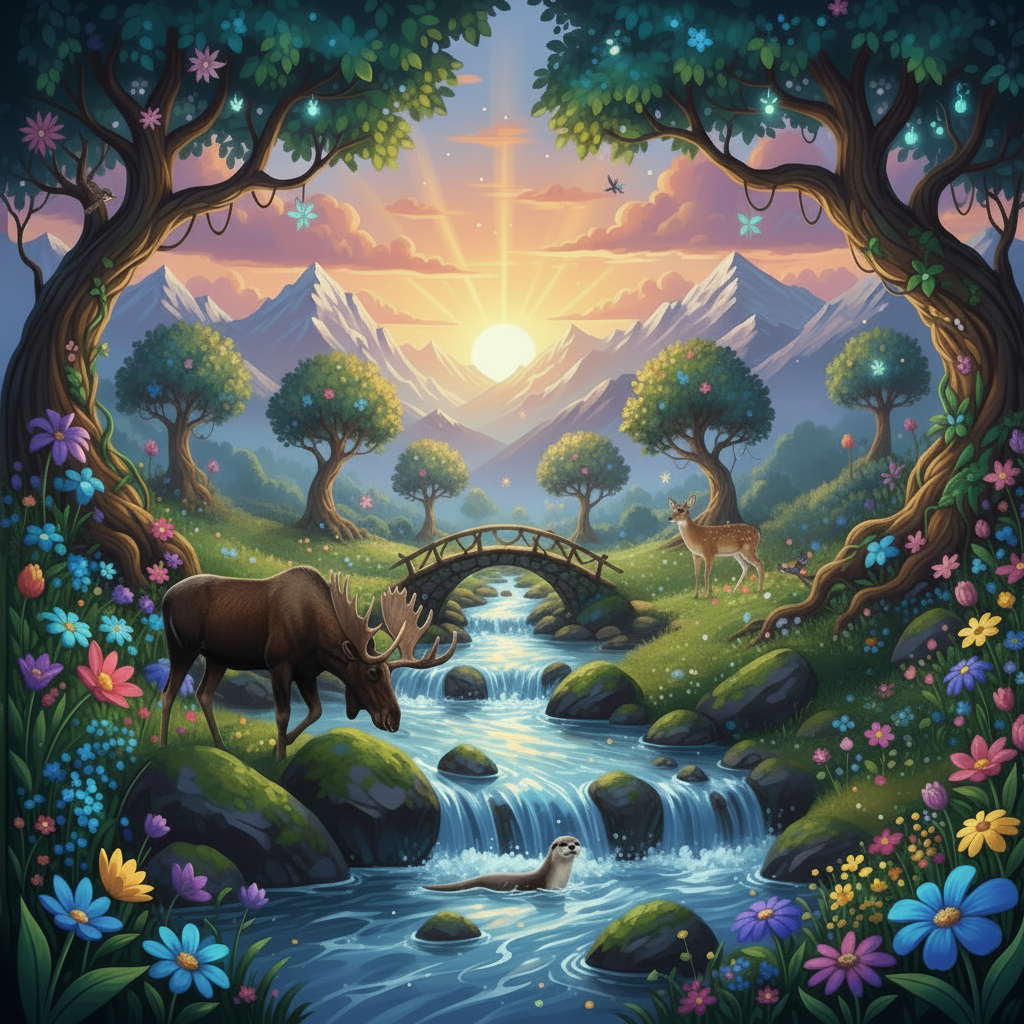
The Little Witch in the Woods
Chapter One: The Snowmelt That Woke the Mountain
The apprentices followed the Little Witch up a steep, pine‑scented trail where the air grew thin and bright. The forest below them shrank into a patchwork of greens, and the wind carried the sharp, cold smell of high places. The river they had known—springs, pools, marshes, lakes—was far behind them now. They were climbing toward its beginning.
A girl with bright braids shivered. “Why are we going so high? Rivers don’t live on mountaintops.”
The Little Witch smiled. “They’re born here.”
The apprentices exchanged wide‑eyed looks. The boy with the river pebble in his pocket kicked at a patch of snow. “But this is just frozen water.”
“Exactly,” the Little Witch said. “Snow is the river asleep.”
They climbed higher until the trees thinned and the world opened into a wide, white meadow tucked between rocky peaks. Snow blanketed everything—soft, deep, sparkling in the sunlight. But something was changing. The snow wasn’t still. It was sinking, shifting, melting in tiny rivulets that trickled beneath the surface.
A quiet apprentice knelt and pressed their hand into the snow. “It’s warm underneath.”
“Spring is waking the mountain,” the Little Witch said. “And when the mountain wakes, the river begins to move.”
They listened. At first they heard only wind. Then—very faintly—they heard dripping. Then trickling. Then the soft, secret sound of water running beneath the snowpack.
A girl with moss in her hair whispered, “It feels like the river is stretching.”
“It is,” the Little Witch said. “Snowmelt is the river’s first journey. It gathers drop by drop, thread by thread, until it finds a path.”
They walked across the meadow. Beneath the snow, the ground hummed with cold, rising energy. The apprentices could feel it through their boots—a restless, gathering motion.
A boy with the river pebble in his pocket pointed to a place where the snow had collapsed into a narrow channel. “Look! Water!”
A thin ribbon of meltwater slid down the slope, weaving between rocks, vanishing beneath drifts, reappearing in glittering flashes. It was small, but it moved with purpose.
The Little Witch knelt beside it. “This is the river’s first step. Before springs, before streams, before lakes—there is snowmelt.”
The apprentices watched as more meltwater joined the ribbon. Tiny droplets merged into threads. Threads merged into trickles. Trickles merged into a newborn stream that hurried downhill as if eager to see the world.
A quiet apprentice touched the water. “It’s freezing.”
“Yes,” the Little Witch said. “Snowmelt is cold and fast. It carries the mountain’s memory with it—minerals, chill, and the shape of winter.”
They followed the forming stream as it tumbled over stones, splashed into shallow basins, and carved tiny channels through the softening snow. The hum beneath their feet grew sharper, brighter, full of motion.
The Little Witch lifted her staff. “Today, you’ll learn how to read snowmelt. How to see where it gathers, how it chooses its path, and how it becomes the river’s first journey. And you’ll learn a charm to help you sense the places where winter is turning into water.”
The apprentices leaned in, ready to learn the mountain’s awakening language.
Chapter 1 Puzzle: The First‑Flow Charm
To help the apprentices understand how snowmelt gathers into the first stream, the Little Witch teaches them a charm that reveals where melting snow is pooling beneath the surface.
For one snowmelt‑site, the charm needs:
- 9 melt‑markers
- 6 frost‑threads
- 3 warming breaths
But the apprentices want to test four different snowmelt‑sites across the meadow.
Your task: Multiply each ingredient by 4 so the charm can be cast at all four sites.
- How many melt‑markers are needed?
- How many frost‑threads?
- How many warming breaths?
Write the full recipe for the four‑site First‑Flow Charm.
Research Quest
What is snowmelt, and how does it form the beginning of a river?
Find a diagram showing how melting snow gathers into rivulets and channels.
Draw the snowpack, the hidden meltwater, and the first forming stream.
Chapter Two: The Rill That Learned to Run
The apprentices followed the Little Witch down the bright, melting slope where the newborn snowmelt stream hurried ahead of them. The air was crisp and full of sunlight, and the mountain felt alive—awake in a way it hadn’t been just a few weeks earlier. Everywhere, water was moving: dripping from branches, sliding beneath snow, whispering through cracks in the rocks.
A girl with bright braids pointed downhill. “It’s getting faster!”
“It should,” the Little Witch said. “The river is learning to run.”
The apprentices watched as the thin ribbon of meltwater gathered speed. It darted between stones, splashed over tiny ledges, and carved a narrow path through the softening snow. It was no longer just meltwater—it was becoming something more.
A boy with the river pebble in his pocket crouched beside the flow. “Is this a stream now?”
“Not yet,” the Little Witch said. “This is a rill. A rill is the river’s first run—small, quick, and full of energy.”
They followed the rill as it zigzagged down the slope. It was playful, unpredictable, always choosing the steepest path, always eager to move. The hum beneath their feet was sharper than before—bright, lively, full of motion.
A quiet apprentice leaned close. “It sounds like it’s laughing.”
“It is,” the Little Witch said. “Rills are joyful. They’re the river discovering gravity.”
The apprentices watched as the rill split around a rock, then rejoined itself in a sparkling twist. It leapt over a small drop, splashing into a shallow basin before racing onward. The water was clear and cold, carrying tiny flecks of ice that glittered like stars.
A girl with moss in her hair whispered, “It feels like it wants to go everywhere at once.”
“It does,” the Little Witch said. “Rills explore. They test the land. They find the fastest way down the mountain.”
They walked beside the rill as it grew stronger. More meltwater joined it from hidden channels beneath the snow. Threads merged into trickles. Trickles merged into the rill. The sound grew louder—still small, but confident.
A boy with the river pebble in his pocket touched the water. “It’s colder than before.”
“Yes,” the Little Witch said. “Rills carry the mountain’s chill. They haven’t had time to warm in the sun.”
They reached a place where the rill tumbled over a series of small steps in the rock. The water splashed and sparkled, forming tiny waterfalls that danced in the light.
A quiet apprentice smiled. “It’s beautiful.”
“It is,” the Little Witch said. “And it’s important. Rills carve the first channels. They shape the mountain’s face. They decide where the river will go.”
The apprentices stood in silence, listening to the rill’s bright, rushing voice.
The Little Witch lifted her staff. “Today, you’ll learn how to read a rill. How to see where it forms, how it chooses its path, and how it becomes the river’s first true motion. And you’ll learn a charm to help you sense the places where water is beginning to run.”
The apprentices leaned in, ready to learn the mountain’s running language.
Chapter 2 Puzzle: The Quick‑Run Charm
To help the apprentices understand how rills form and choose their paths, the Little Witch teaches them a charm that reveals the steepest routes where water will begin to run.
For one rill‑site, the charm needs:
- 12 slope‑markers
- 8 sparkle‑sprinkles
- 4 rushing breaths
But the apprentices want to test three different rill‑sites along the slope.
Your task: Multiply each ingredient by 3 so the charm can be cast at all three sites.
- How many slope‑markers are needed?
- How many sparkle‑sprinkles?
- How many rushing breaths?
Write the full recipe for the three‑site Quick‑Run Charm.
Research Quest
What is a rill, and how does it form on a mountainside?
Find a diagram showing how small channels of water carve paths through soil, snow, or rock.
Draw the slope, the rill’s twists and turns, and the places where it gathers speed.
Chapter Three: The Brook That Found Its Voice
The apprentices followed the Little Witch as the rill raced downhill, gathering speed with every twist and turn. The mountain air was bright and sharp, and the sound of running water grew louder—no longer a whisper, no longer a giggle, but something fuller, rounder, almost like a song.
A girl with bright braids stopped suddenly. “Listen! It sounds different.”
“It should,” the Little Witch said. “The river is learning to speak.”
The apprentices hurried forward. The rill had widened, deepened, and slowed just enough to find a rhythm. It no longer darted wildly between stones. It flowed. It curved. It hummed.
A boy with the river pebble in his pocket crouched beside it. “Is this a stream now?”
“Not quite,” the Little Witch said. “This is a brook. A brook is the river’s first voice—small, steady, and full of promise.”
The apprentices watched as the brook wound through a narrow valley between two rocky ridges. The water was clearer now, no longer carrying flecks of ice. Sunlight warmed its surface, and tiny bubbles danced along its edges.
A quiet apprentice leaned close. “It sounds like it’s singing.”
“It is,” the Little Witch said. “Brooks sing because they’ve found their shape. They know where they’re going, even if they’re still small.”
They followed the brook as it slipped between mossy stones, brushed past clusters of mountain flowers, and curled around fallen branches. The hum beneath their feet was softer than the rill’s sharp energy—warmer, more melodic.
A girl with moss in her hair dipped her hand into the water. “It’s not as cold as before.”
“Brooks warm quickly,” the Little Witch said. “They spend more time in the sun. They slow just enough to breathe.”
The apprentices noticed something else too. The brook had carved a shallow bed—smooth stones, patches of gravel, and tiny sandbars forming along the edges. It was shaping the land, even at this small size.
A boy with the river pebble in his pocket pointed to a cluster of stones. “Look! It’s making patterns.”
“Yes,” the Little Witch said. “Brooks sort stones by size. They carry the small ones farther and leave the big ones behind. They’re learning how to move the mountain.”
They walked beside the brook as it widened again, forming a tiny pool where insects skated across the surface. A pair of birds dipped down to drink. A frog plopped into the water with a soft splash.
A quiet apprentice smiled. “It feels alive.”
“It is,” the Little Witch said. “Brooks are full of life. They’re the first places where creatures gather—where the river becomes a home.”
The apprentices stood in silence, listening to the brook’s gentle, steady voice.
The Little Witch lifted her staff. “Today, you’ll learn how to read a brook. How to hear its rhythm, how to see its patterns, and how to understand the way it shapes the land. And you’ll learn a charm to help you sense where water is finding its voice.”
The apprentices leaned in, ready to learn the brook’s singing language.
Chapter 3 Puzzle: The Singing‑Stone Charm
To help the apprentices understand how brooks sort stones and shape their beds, the Little Witch teaches them a charm that reveals where stones will settle.
For one brook‑site, the charm needs:
- 10 tone‑stones
- 7 ripple‑markers
- 3 steady breaths
But the apprentices want to test five different brook‑sites along the valley.
Your task: Multiply each ingredient by 5 so the charm can be cast at all five sites.
- How many tone‑stones are needed?
- How many ripple‑markers?
- How many steady breaths?
Write the full recipe for the five‑site Singing‑Stone Charm.
Research Quest
What is a brook, and how does it differ from a rill or a stream?
Find a diagram showing how brooks form channels, sort stones, and create small pools.
Draw the brook’s path, its stone patterns, and the places where its voice becomes clear.
Chapter Four: The Stream That Chose Its Path
The apprentices followed the Little Witch as the brook wound through the narrowing valley, its voice growing stronger with every bend. The air was warmer now, the snow far behind them, and the land had begun to open into rolling foothills. The brook no longer whispered or sang softly—it spoke with confidence.
A girl with bright braids paused. “It sounds deeper.”
“It is,” the Little Witch said. “The river is choosing its path.”
The apprentices hurried forward. The brook had widened and deepened, its flow steadier and more powerful. It no longer darted or meandered without purpose. It moved with direction, carving a clear channel through the land.
A boy with the river pebble in his pocket crouched beside it. “Is this finally a stream?”
“Yes,” the Little Witch said. “A stream is the river’s first true journey. It knows where it’s going, even if the land hasn’t shown it the whole way yet.”
They followed the stream as it curved around a stand of young aspens. The water glimmered in the sunlight, carrying leaves, twigs, and tiny bubbles along its surface. Beneath the water, smooth stones shifted and clicked as the current nudged them into place.
A quiet apprentice leaned close. “It sounds like it’s thinking.”
“It is,” the Little Witch said. “Streams make decisions. They choose the easiest path, the steepest path, or sometimes the most surprising path. They shape the land as much as the land shapes them.”
The apprentices watched as the stream split around a boulder, forming two channels that rejoined downstream. The hum beneath their feet was deeper than the brook’s melody—steady, rhythmic, full of momentum.
A girl with moss in her hair dipped her hand into the water. “It’s warmer than before.”
“Streams carry sunlight,” the Little Witch said. “They’ve traveled far enough to gather warmth, but not so far that they’ve forgotten the mountain.”
They walked along the bank, noticing how the stream carved deeper into the soil. Roots from nearby trees reached toward the water, gripping the bank. Pebbles rolled along the bottom. Sandbars formed at gentle bends.
A boy with the river pebble in his pocket pointed to a fallen branch caught in the current. “Look! It’s making a little whirlpool.”
“Yes,” the Little Witch said. “Streams create eddies, riffles, and runs. They’re learning the language of movement.”
They followed the stream to a place where it narrowed between two rocky outcrops. The water rushed through with a low roar, forming a small cascade that sparkled in the sunlight.
A quiet apprentice smiled. “It feels alive in a different way.”
“It is,” the Little Witch said. “Streams are the river’s heartbeat. They carry energy from the mountain to the valley. They gather strength with every step.”
The apprentices stood in silence, listening to the stream’s confident, steady voice.
The Little Witch lifted her staff. “Today, you’ll learn how to read a stream. How to see its choices, how to understand its patterns, and how to feel the places where it gathers strength. And you’ll learn a charm to help you sense where water is choosing its path.”
The apprentices leaned in, ready to learn the stream’s decisive language.
Chapter 4 Puzzle: The Path‑Finder Charm
To help the apprentices understand how streams choose their routes, the Little Witch teaches them a charm that reveals the places where water will carve deeper channels.
For one stream‑site, the charm needs:
- 13 direction‑markers
- 9 current‑threads
- 4 guiding breaths
But the apprentices want to test four different stream‑sites along the foothills.
Your task: Multiply each ingredient by 4 so the charm can be cast at all four sites.
- How many direction‑markers are needed?
- How many current‑threads?
- How many guiding breaths?
Write the full recipe for the four‑site Path‑Finder Charm.
Research Quest
What is a stream, and how does it differ from a brook or a river?
Find a diagram showing stream channels, riffles, runs, and bends.
Draw the stream’s path, its choices, and the places where it carves deeper into the land.
Chapter Five: The River That Claimed Its Name
The apprentices followed the Little Witch as the stream wound out of the foothills and into a broad, sun‑warmed valley. The land opened wide, the sky stretched enormous above them, and the sound of water grew deeper—no longer the quick chatter of a brook or the confident hum of a stream. This was something larger. Older. Certain.
A girl with bright braids stopped mid‑step. “It sounds… huge.”
“It should,” the Little Witch said. “The river is ready to claim its name.”
The apprentices hurried forward. The stream had widened into a broad, shining ribbon that moved with steady power. It no longer darted or hesitated. It flowed with purpose, carrying the memory of the mountain and the warmth of the valley in one long, unbroken motion.
A boy with the river pebble in his pocket crouched at the bank. “Is this finally a river?”
“Yes,” the Little Witch said. “A river is the land’s storyteller. It gathers every voice upstream and carries them forward.”
They walked along the bank, watching the river move. It was deeper now, its surface shifting with long, rolling patterns. Beneath the water, stones tumbled slowly, pushed by a current strong enough to shape the valley itself.
A quiet apprentice leaned close. “It feels like it knows exactly where it’s going.”
“It does,” the Little Witch said. “Rivers follow ancient paths—some carved by glaciers, some by time, some by the land’s own memory.”
The apprentices watched as the river curved around a wide bend. The outside edge was fast and deep, carving into the bank. The inside edge was slow and shallow, building a sandbar that glittered in the sun.
A girl with moss in her hair pointed. “It’s making shapes!”
“Yes,” the Little Witch said. “Rivers sculpt. They carve cliffs, build bars, braid channels, and weave the land into patterns that last for centuries.”
They followed the river to a place where it widened into a calm, glassy stretch. Fish flickered beneath the surface. A heron stood motionless in the shallows. Dragonflies skimmed the water like tiny blue sparks.
A boy with the river pebble in his pocket dipped his hand into the water. “It’s warm on top and cold underneath.”
“Rivers hold layers,” the Little Witch said. “They remember the sun and the shade. They carry warmth from the valley and chill from the mountain.”
The apprentices noticed something else too: the river was no longer alone. Tributaries—smaller streams—joined it from both sides, adding their voices to the flow.
A quiet apprentice whispered, “It’s gathering everything.”
“It is,” the Little Witch said. “A river is a collector. It gathers water, stories, minerals, memories, and life. It carries them all toward the sea.”
They stood in silence, feeling the river’s deep, steady heartbeat beneath their feet.
The Little Witch lifted her staff. “Today, you’ll learn how to read a river. How to see its power, how to understand its patterns, and how to feel the places where it claims its name. And you’ll learn a charm to help you sense where water becomes a river.”
The apprentices leaned in, ready to learn the river’s strong, ancient language.
Chapter 5 Puzzle: The River‑Naming Charm
To help the apprentices understand how a stream becomes a river, the Little Witch teaches them a charm that reveals where water has gathered enough strength, width, and depth to earn its name.
For one river‑site, the charm needs:
- 18 flow‑markers
- 12 depth‑stones
- 6 naming breaths
But the apprentices want to test three different river‑sites along the valley.
Your task: Multiply each ingredient by 3 so the charm can be cast at all three sites.
- How many flow‑markers are needed?
- How many depth‑stones?
- How many naming breaths?
Write the full recipe for the three‑site River‑Naming Charm.
Research Quest
What makes a river a river, and how does it differ from a stream?
Find a diagram showing river bends, fast and slow zones, and how tributaries join the main flow.
Draw the river’s path, its widening channel, and the places where it claims its name.
Chapter Six: The Floodplain That Learned to Wander
The apprentices followed the Little Witch as the river widened into a broad, sunlit valley. The land here was open and gentle, with long grasses waving in the breeze and clusters of cottonwoods standing like watchful elders. The river no longer rushed or carved sharply. It moved with a slow, sweeping grace, as if it finally had room to stretch.
A girl with bright braids shaded her eyes. “Why is it so wide here?”
“Because the river is learning to wander,” the Little Witch said.
The apprentices stepped closer. The river curved in great arcs—wide bends that looped across the valley floor. Some bends were deep and fast, others shallow and calm. The land around them was flat and fertile, dotted with old channels that no longer held water but still remembered its touch.
A boy with the river pebble in his pocket pointed to a crescent‑shaped depression filled with reeds. “Was that part of the river?”
“It was,” the Little Witch said. “Floodplains are the river’s playground. They hold every path the river has ever taken.”
They walked along the bank. The hum beneath their feet was broad and resonant—less focused than the stream’s heartbeat, more like a long, slow breath. The apprentices could feel the river’s history in the soil: layers of silt, sand, and clay left behind by countless floods.
A quiet apprentice knelt and pressed their hand into the earth. “It’s soft.”
“It should be,” the Little Witch said. “Floodplains are made of stories. Every flood leaves a layer. Every retreat leaves a memory.”
The apprentices watched as the river curved around a wide bend. The outside edge was fast and deep, carving into the bank. The inside edge was slow and shallow, building a sandbar that glittered in the sun.
A girl with moss in her hair whispered, “It’s making new land.”
“Yes,” the Little Witch said. “Rivers build as much as they destroy. Floodplains grow because the river shares its riches.”
They walked farther and found a place where the river had recently flooded. Driftwood lay tangled in the grass. A thin layer of fine silt coated the ground like powdered silver. Tiny plants were already sprouting through it.
A boy with the river pebble in his pocket touched the new soil. “It’s so smooth.”
“Floods bring nutrients,” the Little Witch said. “They feed the land. They make the valley fertile.”
The apprentices noticed something else too: the river didn’t stay in one channel. It shifted. It nudged. It carved new paths and abandoned old ones. The valley was full of ghost‑rivers—dry curves, shallow swales, and oxbows that held water only after rain.
A quiet apprentice whispered, “It feels like the river is dancing.”
“It is,” the Little Witch said. “Floodplains are where the river learns to move with freedom. It wanders. It loops. It rests. It remembers.”
They stood in silence, watching the river’s slow, sweeping motion.
The Little Witch lifted her staff. “Today, you’ll learn how to read a floodplain. How to see the river’s old paths, how to understand its wandering, and how to feel the places where it spreads its gifts. And you’ll learn a charm to help you sense where the river will wander next.”
The apprentices leaned in, ready to learn the river’s wide, wandering language.
Chapter 6 Puzzle: The Wander‑Way Charm
To help the apprentices understand how rivers move across floodplains, the Little Witch teaches them a charm that reveals where the river is likely to shift or spread during high water.
For one floodplain‑site, the charm needs:
- 14 bend‑markers
- 10 silt‑threads
- 5 wandering breaths
But the apprentices want to test four different floodplain‑sites across the valley.
Your task: Multiply each ingredient by 4 so the charm can be cast at all four sites.
- How many bend‑markers are needed?
- How many silt‑threads?
- How many wandering breaths?
Write the full recipe for the four‑site Wander‑Way Charm.
Research Quest
What is a floodplain, and how does a river shape it over time?
Find a diagram showing meanders, oxbows, and old river channels.
Draw the floodplain, the wide bends, and the places where the river wanders and leaves its stories behind.
Chapter Seven: The Braided Channels That Refused to Choose
The apprentices followed the Little Witch as the wide floodplain narrowed again, the valley tightening between low, stony hills. The river ahead of them shimmered strangely—broken into many threads, weaving and unweaving across a bed of pale gravel. It no longer flowed as one strong ribbon. It scattered. It gathered. It scattered again.
A girl with bright braids blinked. “What happened to the river? It looks… tangled.”
“It isn’t tangled,” the Little Witch said. “It’s braiding.”
The apprentices stepped closer. The river had split into dozens of shallow channels—some fast, some slow, some barely more than a whisper of water sliding over stones. Gravel bars rose between them like small islands, shifting with every season.
A boy with the river pebble in his pocket frowned. “Why doesn’t it stay in one channel?”
“Because the river has too much to carry,” the Little Witch said. “When a river is full of gravel and sand, it spreads out. It refuses to choose just one path.”
They walked along the braided channels. The hum beneath their feet was scattered and bright—many voices instead of one. The apprentices could feel the river’s restless energy, its constant rearranging of stones, its refusal to settle.
A quiet apprentice crouched beside a shallow channel. “It’s so fast here.”
“Braided rivers are quick,” the Little Witch said. “They’re always shifting, always moving sediment, always changing their minds.”
The apprentices watched as one channel cut sharply into a gravel bar, stealing water from another channel. A moment later, a new thread of water appeared farther upstream, carving a fresh path through the stones.
A girl with moss in her hair whispered, “It’s alive in every direction.”
“Yes,” the Little Witch said. “Braided rivers are the river’s wildest form. They don’t follow a single story. They tell many at once.”
They walked farther and found a place where the channels merged into a wide, shallow sheet of water before splitting again. The sunlight sparkled on the shifting patterns, and the apprentices could see fish darting between the stones.
A boy with the river pebble in his pocket pointed to a pile of driftwood caught on a gravel bar. “Does the river build these too?”
“It does,” the Little Witch said. “Braided rivers build and erase land constantly. They create bars, destroy them, rebuild them, and move them downstream.”
The apprentices noticed how different this place felt from the floodplain. There were no tall trees here, no deep soils, no quiet bends. Everything was exposed—stones, sand, sunlight, and motion.
A quiet apprentice whispered, “It feels like the river can’t sit still.”
“It can’t,” the Little Witch said. “Braided rivers are impatient. They’re full of energy and sediment. They’re always rearranging the world.”
They stood in silence, watching the river weave itself into new shapes.
The Little Witch lifted her staff. “Today, you’ll learn how to read a braided river. How to see its shifting channels, how to understand its restless patterns, and how to feel the places where it refuses to choose just one path. And you’ll learn a charm to help you sense where the river will braid next.”
The apprentices leaned in, ready to learn the river’s many‑voiced language.
Chapter 7 Puzzle: The Many‑Paths Charm
To help the apprentices understand how braided rivers shift and rearrange their channels, the Little Witch teaches them a charm that reveals where new threads of water are likely to form.
For one braided‑site, the charm needs:
- 16 gravel‑markers
- 11 channel‑threads
- 5 shifting breaths
But the apprentices want to test five different braided‑sites along the gravel bed.
Your task: Multiply each ingredient by 5 so the charm can be cast at all five sites.
- How many gravel‑markers are needed?
- How many channel‑threads?
- How many shifting breaths?
Write the full recipe for the five‑site Many‑Paths Charm.
Research Quest
What is a braided river, and why does it split into many channels?
Find a diagram showing gravel bars, shifting channels, and sediment movement.
Draw the braided threads, the gravel islands, and the places where the river refuses to choose a single path.
Chapter Eight: The Canyon That Carved Its Own Light
The apprentices followed the Little Witch as the braided channels narrowed, the gravel bars giving way to solid stone. The land rose sharply on both sides, and the river gathered itself into a single, powerful flow. The air cooled. Shadows lengthened. The hum beneath their feet tightened into a deep, focused vibration.
A girl with bright braids looked up at the towering walls. “It feels like the river is being squeezed.”
“It is,” the Little Witch said. “This is where the river enters the canyon.”
The apprentices stepped closer. The river rushed between steep cliffs of red and gold stone, its surface broken into whitewater and swirling eddies. The sound was thunderous—echoing off the canyon walls, filling the air with a roar that felt ancient and unstoppable.
A boy with the river pebble in his pocket crouched at the edge. “It’s so fast! Why?”
“Because the river has no room to wander,” the Little Witch said. “When the land tightens, the river must carve its way through.”
They walked along a narrow ledge beside the canyon. The walls rose hundreds of feet above them, streaked with layers of sediment that told stories older than any forest or floodplain. The apprentices could feel the river’s force vibrating through the stone.
A quiet apprentice whispered, “It feels like the river is angry.”
“It isn’t angry,” the Little Witch said. “It’s determined. Canyons are carved by persistence, not rage.”
They watched as the river plunged over a series of drops, forming rapids that churned with white foam. The water twisted around boulders, slammed into cliff faces, and shot forward with unstoppable momentum.
A girl with moss in her hair pointed to the canyon walls. “How did the river make this?”
“Slowly,” the Little Witch said. “Drop by drop. Year by year. The river cuts through stone the way time cuts through memory.”
They walked deeper into the canyon. Sunlight reached the river only in narrow beams, turning the water into ribbons of gold and silver. In some places, the canyon walls leaned so close together that the apprentices could touch both sides at once.
A boy with the river pebble in his pocket ran his hand along the rock. “It’s smooth here.”
“Yes,” the Little Witch said. “The river polishes stone as it passes. It shapes the canyon just as the canyon shapes it.”
They reached a place where the canyon widened slightly, forming a deep pool of calm water. The roar softened. The air warmed. The apprentices could see fish resting in the shadows and swallows darting between cracks in the stone.
A quiet apprentice smiled. “It’s peaceful here.”
“Even in a canyon,” the Little Witch said, “the river finds places to rest.”
They stood in silence, listening to the river’s powerful, echoing voice.
The Little Witch lifted her staff. “Today, you’ll learn how to read a canyon. How to see the river’s strength, how to understand its persistence, and how to feel the places where it carves its own light. And you’ll learn a charm to help you sense where the river is cutting deepest.”
The apprentices leaned in, ready to learn the canyon’s fierce, focused language.
Chapter 8 Puzzle: The Deep‑Cut Charm
To help the apprentices understand how rivers carve canyons, the Little Witch teaches them a charm that reveals where the river’s force is strongest.
For one canyon‑site, the charm needs:
- 17 force‑markers
- 12 stone‑threads
- 6 echoing breaths
But the apprentices want to test three different canyon‑sites along the narrow passage.
Your task: Multiply each ingredient by 3 so the charm can be cast at all three sites.
- How many force‑markers are needed?
- How many stone‑threads?
- How many echoing breaths?
Write the full recipe for the three‑site Deep‑Cut Charm.
Research Quest
What is a canyon, and how does a river carve one over time?
Find a diagram showing canyon walls, rapids, and deep pools.
Draw the narrow passage, the steep cliffs, and the places where the river cuts its own light.
Chapter Nine: The Delta That Became a Thousand Rivers
The apprentices followed the Little Witch as the canyon walls fell away behind them, opening into a vast, sun‑drenched plain. The river, freed from its stone corridor, slowed and widened until it shimmered like a sheet of moving glass. But ahead—far ahead—the water did something unexpected.
It split.
A girl with bright braids gasped. “It’s breaking apart again!”
“Not breaking,” the Little Witch said. “Becoming many.”
The apprentices hurried forward. The river divided into broad, branching channels that wound through a maze of reeds, mudflats, and shimmering pools. Some channels were deep and slow. Others were shallow and quick. Some curved gently. Others cut straight toward the horizon.
A boy with the river pebble in his pocket frowned. “Is this another braided river?”
“No,” the Little Witch said. “This is the delta. The river’s last great transformation.”
They stepped onto a raised bank of silt. The hum beneath their feet was wide and layered—many voices moving in many directions. The apprentices could feel the river’s energy spreading out, softening, slowing, preparing for something larger.
A quiet apprentice whispered, “It feels like the river is letting go.”
“It is,” the Little Witch said. “Deltas are where rivers release everything they’ve carried—water, silt, stories, life.”
They watched as the channels wound through tall grasses. Birds wheeled overhead—herons, egrets, pelicans, and countless smaller wings. Fish flickered in the shallows. Crabs scuttled across the mud. The delta was alive in every direction.
A girl with moss in her hair knelt beside a channel. “The water is so calm.”
“Deltas slow the river,” the Little Witch said. “When the water slows, it drops its silt. That silt builds land—new land, rich land, land that grows with every flood.”
They walked farther into the delta. The channels shifted constantly—some joining, some splitting, some disappearing into marshes only to reappear downstream. The apprentices could see fresh sandbars forming, mudbanks collapsing, and new pools opening where none had been before.
A boy with the river pebble in his pocket pointed to a wide, shallow fan of water. “It’s spreading out like fingers.”
“Yes,” the Little Witch said. “Deltas reach toward the sea. They are the river’s hands.”
They reached a place where the channels widened into a broad lagoon. The water shimmered with sunlight, and the apprentices could smell salt on the breeze.
A quiet apprentice breathed in. “The sea is close.”
“Very close,” the Little Witch said. “The delta is the river’s last wandering before it becomes part of the ocean.”
They stood in silence, watching the river’s many paths weaving toward the horizon.
The Little Witch lifted her staff. “Today, you’ll learn how to read a delta. How to see its branching channels, how to understand its shifting land, and how to feel the places where the river becomes many. And you’ll learn a charm to help you sense where new land is forming.”
The apprentices leaned in, ready to learn the delta’s wide, releasing language.
Chapter 9 Puzzle: The Many‑Mouths Charm
To help the apprentices understand how deltas build new land, the Little Witch teaches them a charm that reveals where the river is dropping its silt.
For one delta‑site, the charm needs:
- 15 silt‑seeds
- 10 channel‑markers
- 5 opening breaths
But the apprentices want to test six different delta‑sites across the branching channels.
Your task: Multiply each ingredient by 6 so the charm can be cast at all six sites.
- How many silt‑seeds are needed?
- How many channel‑markers?
- How many opening breaths?
Write the full recipe for the six‑site Many‑Mouths Charm.
Research Quest
What is a delta, and how does a river build new land as it meets the sea?
Find a diagram showing branching channels, silt deposition, and the fan‑shaped structure of a delta.
Draw the delta’s many paths, the new land forming between them, and the place where the river reaches the sea.
Chapter Ten: The Sea That Answered Back
The apprentices followed the Little Witch as the delta’s branching channels widened, slowed, and brightened with the shimmer of salt. The air grew heavier, warmer, full of distant cries from seabirds circling the horizon. The land flattened into long stretches of reeds and mudflats, and the river’s many voices began to merge into one long, steady breath.
A girl with bright braids shaded her eyes. “Is that… the sea?”
“Yes,” the Little Witch said. “The river is almost home.”
The apprentices hurried forward. The channels widened into a broad, gleaming expanse where fresh water met salt. The surface rippled with gentle waves, and the smell of salt and wind filled the air. The river no longer rushed or carved or wandered. It opened.
A boy with the river pebble in his pocket crouched at the edge. “It’s so calm. I thought the sea would be louder.”
“It can be,” the Little Witch said. “But this is the meeting place. Here, the river and the sea greet each other.”
They watched as the river’s flow pushed gently into the saltwater. The sea pushed back with its own slow rhythm. The two waters mingled—fresh and salt—creating swirling patterns that shimmered in the sunlight.
A quiet apprentice whispered, “It feels like they’re talking.”
“They are,” the Little Witch said. “The river brings stories from the land. The sea brings stories from the world.”
They walked along the shoreline. The hum beneath their feet was vast—deep, layered, full of tides and currents and distant storms. The apprentices could feel the river’s long journey settling into something larger, something ancient.
A girl with moss in her hair dipped her hand into the water. “It’s warm on top and cold underneath.”
“Estuaries and seas hold layers,” the Little Witch said. “Warmth from the sun, chill from the deep. The river adds its own memory to the mix.”
They watched as fish darted between reeds, crabs scuttled across the sand, and seabirds dove into the water with sharp cries. Life was everywhere—more than the apprentices had seen in any other part of the river’s journey.
A boy with the river pebble in his pocket pointed to the horizon. “Where does the river go after this?”
The Little Witch smiled. “Everywhere. The sea carries its water around the world. It becomes clouds, storms, rain, snow. It returns to the mountain. The river’s journey never ends.”
They stood in silence, watching the river’s final widening into the endless blue.
A quiet apprentice breathed deeply. “It feels like the river is letting go.”
“It is,” the Little Witch said. “But it’s also beginning again. The sea is not an ending. It’s a doorway.”
The apprentices felt the truth of it—the river’s long path, from snowmelt to rill to brook to stream to river to delta, all leading here. And yet, the sea did not feel like a finish. It felt like a promise.
The Little Witch lifted her staff. “Today, you’ll learn how to read the meeting place. How to see the mixing of waters, how to understand the tides, and how to feel the places where the river becomes part of something larger. And you’ll learn a charm to help you sense the balance between fresh and salt.”
The apprentices leaned in, ready to learn the sea’s wide, answering language.
Chapter 10 Puzzle: The Meeting‑Waters Charm
To help the apprentices understand how fresh and salt water mix, the Little Witch teaches them a charm that reveals the balance between the two.
For one meeting‑site, the charm needs:
- 20 salt‑threads
- 14 fresh‑markers
- 7 tide‑breaths
But the apprentices want to test three different meeting‑sites along the estuary mouth.
Your task: Multiply each ingredient by 3 so the charm can be cast at all three sites.
- How many salt‑threads are needed?
- How many fresh‑markers?
- How many tide‑breaths?
Write the full recipe for the three‑site Meeting‑Waters Charm.
Research Quest
What happens when a river meets the sea, and how do fresh and salt water mix?
Find a diagram showing estuary mixing zones, salinity layers, and tidal influence.
Draw the river mouth, the mixing waters, and the place where the river becomes part of the ocean.
Conclusion: Where the Water Goes, We Follow
The apprentices stood at the edge of the sea, watching the river’s last wide breath dissolve into the shimmering blue. The air was warm and bright, full of salt and wind and the distant pulse of waves. Behind them lay the whole long journey—snowmelt, rill, brook, stream, river, floodplain, braids, canyon, delta. Ahead of them stretched the open world.
The Little Witch rested her staff in the sand. “You’ve seen how the river moves,” she said. “But now you know where it goes.”
The apprentices listened. The sea answered with a slow, steady rhythm—vast, patient, ancient. It carried the river’s stories outward, folding them into tides and currents that traveled farther than any mountain path or forest trail.
A girl with bright braids whispered, “It feels like the river is becoming everything.”
“It is,” the Little Witch said. “The river becomes clouds, storms, rain, snow. It becomes the mountain again. It becomes the world’s breath.”
The apprentices watched the mixing waters swirl at their feet—fresh and salt, clear and blue, memory and possibility. They felt the river’s long journey settle inside them, not as an ending but as a widening.
A quiet apprentice stepped forward. “So the river never stops.”
“No,” the Little Witch said. “Water is the great traveler. It moves through stone, soil, sky, and sea. It changes shape, but never purpose. It carries life wherever it goes.”
They stood together in the soft wind, feeling the truth of it. The river’s path was not a line but a cycle—one that would continue long after they left the shore.
The Little Witch lifted her staff one last time. “You’ve followed the river from its first breath to its great joining. Now you carry its lessons with you—how to move, how to change, how to wander, how to return.”
The apprentices turned from the sea, ready to walk back into the world. Behind them, the river met the tide in a quiet, shimmering dance. Ahead of them, the sky stretched wide and open.
And as they walked, the sea’s deep hum followed them—reminding them that every ending is only another beginning, and that water always finds its way home.
Riparian Reality: 20 More Riparian Facts
- Riparian zones act like natural sponges, soaking up extra water during floods and releasing it slowly afterward.
- Many young fish use riparian shallows as nurseries because the calm water and plants keep them safe.
- Fallen leaves from riparian trees feed insects, which in turn feed fish, birds, and amphibians.
- Riparian roots weave together underground, forming a living net that stabilizes soil.
- When rivers meander, riparian plants help guide the bends by slowing water on the inside curves.
- Riparian zones cool the air around them, creating tiny climate pockets that help wildlife survive heat.
- Some riparian plants grow faster after floods because they’re adapted to disturbance.
- Beavers choose riparian zones with flexible trees like willow and cottonwood for building dams.
- Riparian corridors act like highways for migrating animals, offering food and shelter along the way.
- Many pollinators—like bees and butterflies—depend on riparian wildflowers for nectar.
- Riparian soils store carbon, helping reduce greenhouse gases in the atmosphere.
- Birds often nest in riparian shrubs because the dense branches hide them from predators.
- Riparian zones help filter out pollutants before they reach the river, keeping water cleaner.
- The width of a riparian zone changes depending on the river’s size, speed, and seasonal floods.
- Some riparian trees can survive with their roots underwater for weeks at a time.
- Riparian vegetation slows wind across the water’s surface, reducing evaporation.
- Many amphibians lay eggs in riparian pools because the water warms quickly in the sun.
- Riparian areas often have richer soils than nearby uplands due to repeated flooding.
- When a river shifts course, riparian plants quickly colonize the new banks.
- Healthy riparian zones support entire food webs—from microscopic algae to large mammals.
Riparian Riffs: 10 More Silly River Jokes
- Why did the river study so hard in school? It wanted to improve its flow‑cabulary.
- What do you call a turtle who loves river science? A shell‑hydrologist.
- Why did the willow tree hang out by the river? It liked to branch out near good company.
- What did the riffle say to the pool? “You’re so deep, I can barely keep up!”
- Why don’t river otters ever get bored? They always go with the flow.
- What’s a beaver’s favorite kind of homework? Log‑ic puzzles.
- Why did the river bring a map to the picnic? It didn’t want to meander off track.
- What do you call a fish who tells bedtime stories? A tale‑water.
- Why did the cattail blush? The river gave it a shallow compliment.
- What did the tributary say when it joined the river? “I’ve been streaming to meet you!”
Apple Music
YouTube Music
Amazon Music
Spotify Music


Explore Mini-Topics
Leave a Reply