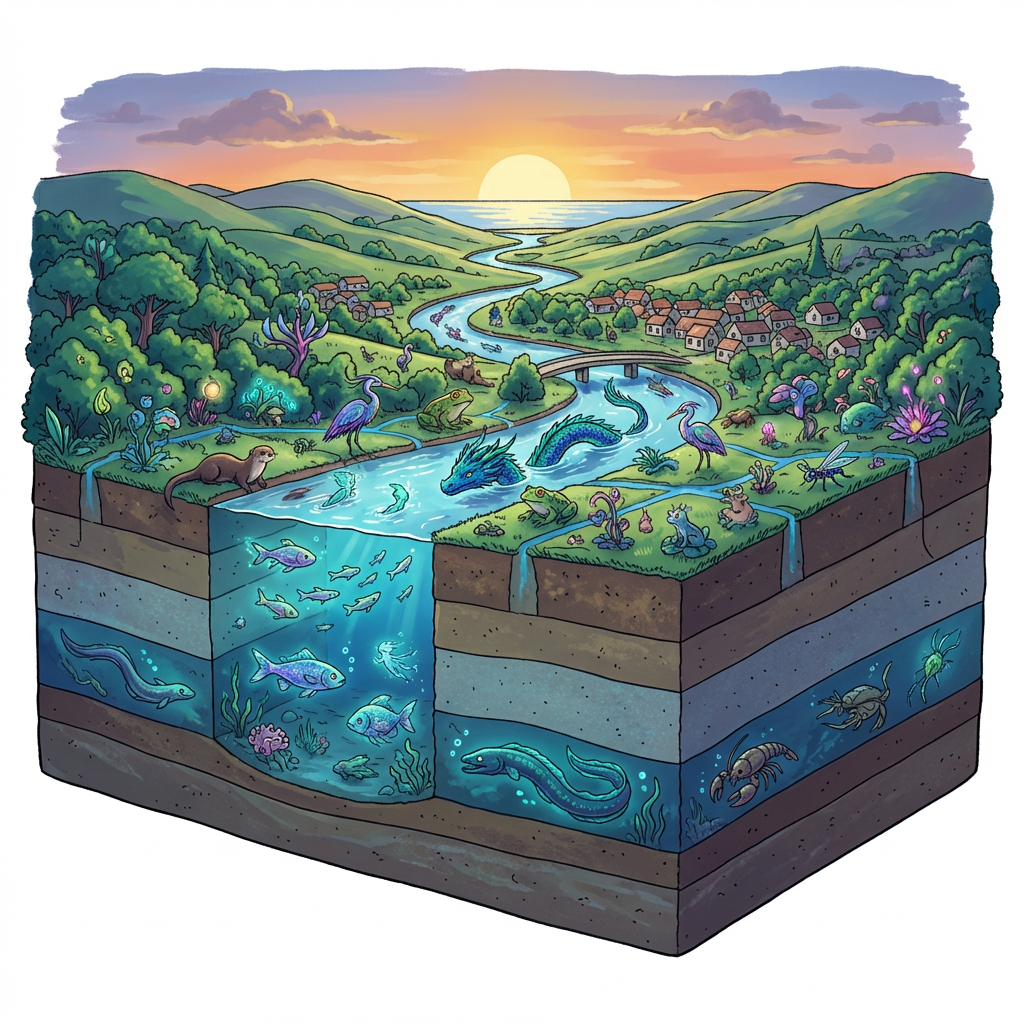
The Little Witch in the Woods
To the Water,
I’m sorry we forgot
Chapter One: The River That Drew Its First Line
The apprentices heard the river before they saw it.
They had followed the Little Witch through a stand of tall cottonwoods, their leaves whispering like a thousand tiny wings. The morning sun filtered through the branches in long, golden stripes, and the air smelled of wet earth and something bright and cold. When the trees finally opened, the apprentices stopped in their tracks.
The river lay before them like a long silver ribbon, moving with a quiet confidence. It wasn’t rushing or roaring. It wasn’t still. It was simply going—steady, sure, and full of purpose.
A girl with moss in her hair stepped closer to the bank. “It looks like it’s drawing,” she said.
The Little Witch nodded. “It is. Rivers draw their own paths. They carve, they wander, they change their minds. They are artists of the land.”
The apprentices watched the water curl around a bend, smooth on the inside edge and choppy on the outside. The river seemed to lean into the curve, as if it were thinking about where to go next.
A boy with a river pebble in his pocket crouched down. “Why does it bend like that?”
“Because water listens,” the Little Witch said. “It listens to the shape of the land. It listens to gravity. It listens to itself. And when it finds a place where the bank is soft or the ground dips just a little, it turns.”
The apprentices followed the curve with their eyes. The bend was gentle at first, then sharper, then gentle again. It looked like a question mark stretched out into a long, thoughtful sigh.
The girl with bright braids pointed to the outside of the bend. “The water is faster there.”
“Yes,” the Little Witch said. “On the outside of a bend, the river has more room to swing. It moves quickly, carving the bank. On the inside, the water slows down and drops what it carries—sand, pebbles, tiny bits of soil. That’s how bends grow.”
The apprentices leaned in, fascinated. The river wasn’t just moving. It was shaping. It was sculpting the land with every turn.
A quiet apprentice stepped onto a smooth stone near the water’s edge. “So the river is always changing?”
“Always,” the Little Witch said. “A river is never finished. It is always drawing, always redrawing, always learning the land and teaching it in return.”
The ground hummed softly beneath their feet, a familiar greeting from the earth. But today, the hum felt different—lighter, more fluid, as if the land itself were echoing the river’s motion.
The Little Witch knelt beside the water. “Today, you’ll learn how a river begins to bend. How it chooses its path. And you’ll learn a charm to help you see the places where the river is thinking about turning next.”
The apprentices gathered around her, the river’s quiet voice curling around them like a ribbon of sound.
The season of flowing had begun.
Chapter 1 Puzzle: The First Bend Charm
To help the apprentices understand how a river begins to curve, the Little Witch teaches them a charm that reveals where the water is moving fastest.
For one river bend, the charm needs:
- 6 current‑dust pinches
- 4 smooth‑stone markers
- 3 slow breaths
But the apprentices want to test three different bends along the river.
Your task: Multiply each ingredient by 3 so the charm can be cast at all three bends.
- How many current‑dust pinches are needed?
- How many smooth‑stone markers?
- How many slow breaths?
Write the full recipe for the three‑bend First Bend Charm.
Research Quest
What is a river bend, and why do rivers curve?
Find a diagram of a meander.
Draw the bend and label the fast water on the outside and the slow water on the inside.
Chapter Two: The Bank That Learned to Lean
The apprentices returned to the river the next morning, eager to see what new shapes the water had drawn overnight. Mist hovered above the surface like a thin silver blanket, drifting and curling as the sun began to warm the air. The river looked peaceful, but the Little Witch reminded them that even on quiet mornings, water was always at work.
They followed the path along the bank until they reached a place where the river curved sharply. The outside edge of the bend rose steeply, its soil dark and freshly exposed. Roots jutted out like fingers reaching for balance. The inside edge, by contrast, was low and gentle, covered in soft sand that sparkled in the early light.
A girl with moss in her hair crouched near the steep bank. “It looks like the river took a bite out of it.”
“In a way, it did,” the Little Witch said. “The river pushes hardest on the outside of a bend. It leans into the bank, carving it away little by little.”
The apprentices studied the steep wall of soil. It looked fragile, as if one more strong current might make it crumble.
A boy with a river pebble in his pocket tapped the exposed roots. “Are the trees in danger?”
“Not today,” the Little Witch said. “But over time, yes. Rivers reshape their banks constantly. Trees adapt by growing strong roots, but sometimes the river wins. And when it does, the tree becomes part of the river’s story.”
The apprentices imagined a tree slowly tipping into the water, its branches catching the current, its trunk becoming a home for fish and insects. The idea felt both sad and beautiful.
The girl with bright braids walked to the inside of the bend. “This side feels different.”
“It is,” the Little Witch said. “The inside of a bend is where the river slows down. When water slows, it drops what it carries—sand, silt, tiny stones. That’s why this bank is soft and low. It’s being built, not carved.”
The apprentices knelt and let the sand run through their fingers. It was warm from the sun and fine as flour.
A quiet apprentice looked from one side of the bend to the other. “So the river takes from one side and gives to the other.”
“Exactly,” the Little Witch said. “Rivers are always balancing themselves. They lean, they shift, they trade. Every bend is a conversation between water and land.”
The ground hummed beneath their feet, a soft, steady vibration that felt like agreement. The apprentices were beginning to understand that the river wasn’t just moving through the land—it was shaping it with intention.
The Little Witch stepped closer to the steep bank. “Today, you’ll learn how to read the signs of a leaning bank. Where the river is carving. Where it is building. And you’ll learn a charm to help you see which parts of the bank are strongest and which are ready to change.”
The apprentices gathered around her, the river’s voice whispering beside them, full of motion and meaning.
Chapter 2 Puzzle: The Leaning Bank Charm
To help the apprentices understand how the river shapes its banks, the Little Witch teaches them a charm that reveals where the soil is loosest.
For one riverbank section, the charm needs:
- 5 soil‑sense sprinkles
- 3 root‑markers
- 2 steady breaths
But the apprentices want to test four different sections along the bend.
Your task: Multiply each ingredient by 4 so the charm can be cast at all four sections.
- How many soil‑sense sprinkles are needed?
- How many root‑markers?
- How many steady breaths?
Write the full recipe for the four‑section Leaning Bank Charm.
Research Quest
What is erosion, and how does it change a riverbank?
Find a picture or diagram of riverbank erosion.
Draw the outside and inside of a bend and label where the river is carving and where it is depositing.
Chapter Three: The Riffle That Sang to the Stones
The apprentices followed the Little Witch along a narrow path that hugged the river’s edge. The morning was bright and cool, and the river seemed livelier than usual—its surface flickering with tiny flashes of light, its voice rising and falling in quick, playful bursts. The apprentices could feel the change before they understood it. The river wasn’t just flowing. It was singing.
They rounded a bend and stopped. The water ahead of them rushed over a shallow stretch filled with smooth stones of every size. The surface rippled and sparkled, breaking into dozens of tiny waves that danced in the sunlight. The sound was different here—higher, brighter, full of motion.
A girl with bright braids leaned forward. “It sounds like laughter.”
“It does,” the Little Witch said. “This is a riffle. A place where the river grows shallow and fast. The stones lift the water, and the water sings.”
The apprentices stepped closer, feeling the cool spray on their faces. The riffle stretched across the river like a long, uneven staircase made of stone. Water rushed over each step, tumbling and bubbling as it hurried downstream.
A boy with a river pebble in his pocket crouched near the edge. “Why does the river speed up here?”
“Because the riverbed rises,” the Little Witch said. “When the water becomes shallow, it has to squeeze through the spaces between the stones. That makes it move faster. And when water moves fast, it makes sound.”
The apprentices listened. The riffle’s voice was bright and busy, full of tiny splashes and swirling currents. It felt alive in a way the deeper parts of the river did not.
A girl with moss in her hair picked up a smooth stone from the bank. “Do the stones make the sound?”
“They help,” the Little Witch said. “Each stone changes the flow. Some lift the water. Some split it. Some make tiny whirlpools. Together, they create the riffle’s song.”
The apprentices watched the water swirl around the stones, forming patterns that shifted from moment to moment. The riffle seemed to be telling a story—quick, lively, full of movement.
A quiet apprentice stepped onto a flat rock near the edge. “It feels like the river is excited.”
The Little Witch smiled. “Riffles are full of energy. They mix the water, add air, and help the river stay healthy. Many creatures depend on riffles—fish, insects, even plants. A riffle is a busy neighborhood.”
The apprentices imagined tiny fish darting between the stones, insects clinging to the undersides of rocks, and plants swaying in the fast current. The riffle wasn’t just singing. It was bustling with life.
The ground hummed beneath their feet, but the hum felt different here—quicker, lighter, almost bouncing. The apprentices felt it in their legs, a rhythm that matched the riffle’s bright voice.
The Little Witch knelt beside the water. “Today, you’ll learn how to read a riffle. How to see where the water speeds up, where it slows, and where the stones shape its path. And you’ll learn a charm to help you hear the riffle’s song more clearly.”
The apprentices gathered around her, the river’s laughter curling around them like a ribbon of sound.
Chapter 3 Puzzle: The Riffle‑Song Charm
To help the apprentices understand how riffles form, the Little Witch teaches them a charm that reveals where the water is moving fastest.
For one riffle, the charm needs:
- 7 ripple‑dust pinches
- 5 stone‑markers
- 3 bright breaths
But the apprentices want to test two different riffles along the river.
Your task: Multiply each ingredient by 2 so the charm can be cast at both riffles.
- How many ripple‑dust pinches are needed?
- How many stone‑markers?
- How many bright breaths?
Write the full recipe for the two‑riffle Riffle‑Song Charm.
Research Quest
What is a riffle, and why is it important for river life?
Find a diagram or picture of a riffle.
Draw the riffle and label the fast water, shallow stones, and places where insects or fish might live.
Chapter Four: The Pool That Held Its Breath
The apprentices followed the Little Witch downstream, leaving behind the bright, laughing riffle. The river quieted as they walked, its voice softening into long, gentle murmurs. The air grew cooler, and the sunlight shimmered differently—slower, deeper, as if the river were thinking instead of speaking.
They reached a place where the water widened and darkened. The surface was smooth as glass, broken only by the occasional ring of a rising fish. The river here seemed to be holding still, though the apprentices knew it was always moving.
A girl with moss in her hair stepped to the edge. “It looks like the river is resting.”
“It is,” the Little Witch said. “This is a pool. A place where the river slows down and gathers itself.”
The apprentices peered into the water. It was so clear they could see smooth stones on the bottom, scattered like coins in a wishing well. Shadows drifted between them—fish gliding with slow, graceful movements.
A boy with a river pebble in his pocket crouched low. “Why does the river slow here?”
“Because the riverbed dips,” the Little Witch said. “When the ground sinks, the water deepens. Deep water moves more slowly. It becomes calm, quiet, thoughtful.”
The apprentices watched the pool. It felt different from the riffle—less excited, more patient. The surface barely moved, but beneath it, life was busy and bright.
A girl with bright braids pointed to a fish hovering near a log. “They like it here.”
“They do,” the Little Witch said. “Pools are safe places. The slow water gives fish a chance to rest. Insects drift down from the riffles above. Shade keeps the water cool. Everything here is balanced.”
The apprentices imagined the pool as a quiet room in the river’s long house—a place where creatures could breathe, hide, and wait.
A quiet apprentice stepped onto a flat stone at the edge. “It feels like the river is holding its breath.”
The Little Witch smiled. “Pools are the river’s deep breaths. They gather energy, store coolness, and hold stories. When the river slows, it remembers.”
The apprentices felt the truth of that. The pool seemed ancient, even though the river was always changing. It felt like a place where time moved differently.
The ground hummed beneath their feet, but the hum was low and steady, like a long exhale. The apprentices felt it in their chests, a calmness that matched the pool’s quiet heart.
The Little Witch knelt beside the water. “Today, you’ll learn how to read a pool. How to see where the water slows, where the shadows gather, and where the river keeps its secrets. And you’ll learn a charm to help you sense the depth of the water without stepping in.”
The apprentices gathered around her, the pool’s stillness settling around them like a soft blanket.
Chapter 4 Puzzle: The Deep‑Breath Charm
To help the apprentices understand how pools form, the Little Witch teaches them a charm that reveals the depth of the water.
For one pool, the charm needs:
- 8 depth‑dust sprinkles
- 4 shadow‑markers
- 2 long breaths
But the apprentices want to test three different pools along the river.
Your task: Multiply each ingredient by 3 so the charm can be cast at all three pools.
- How many depth‑dust sprinkles are needed?
- How many shadow‑markers?
- How many long breaths?
Write the full recipe for the three‑pool Deep‑Breath Charm.
Research Quest
What is a pool in a river, and why do fish gather there?
Find a diagram or picture of a pool.
Draw the pool and label the deep water, shaded areas, and places where fish might rest.
Chapter Five: The Meander That Changed Its Mind
The apprentices arrived at the river just as the sun was rising, turning the water into a long ribbon of gold. Birds flitted between the willows, calling to one another as the day began. The river seemed calm, but the Little Witch led them to a place where the calmness felt like a pause rather than a stillness—like the river was thinking.
They reached a wide bend where the river curved in a long, sweeping arc. The apprentices had seen bends before, but this one felt different. The curve was deep and dramatic, almost like the river had swung out too far and was now unsure whether to continue or turn back.
A girl with bright braids tilted her head. “It looks like the river changed its mind.”
The Little Witch smiled. “It did. Rivers do that. They wander. They shift. They try one path, then another. A meander is a river’s way of exploring.”
The apprentices stepped closer to the bank. The outside of the bend was tall and steep, carved into a clean wall of soil. The inside was low and sandy, forming a gentle beach where driftwood and small stones had gathered.
A boy with a river pebble in his pocket pointed to the steep bank. “This side looks like it’s falling apart.”
“It is,” the Little Witch said. “The river pushes hardest on the outside of a meander. It carves and carves, making the bend wider.”
The apprentices walked to the inside of the curve. The sand was soft beneath their feet, warm from the early sun.
A girl with moss in her hair scooped up a handful of sand. “And this side is growing.”
“Yes,” the Little Witch said. “The river slows on the inside of a meander. It drops what it carries—sand, silt, tiny stones. That’s how the inside of a bend builds up.”
The apprentices looked from one side to the other. The river was taking from one bank and giving to the other, like a careful artist shifting clay from one hand to the next.
A quiet apprentice traced the curve with their finger. “So the meander gets bigger over time.”
“Bigger and bigger,” the Little Witch said. “Until one day, the river decides the bend is too wide. It finds a shortcut. It cuts through the narrowest part of the curve and leaves the old bend behind.”
The apprentices gasped. “It just leaves it?”
“Not out of carelessness,” the Little Witch said. “Out of curiosity. Out of motion. Rivers are always looking for the easiest path. When a meander becomes too long, the river chooses a new way.”
The apprentices imagined the river suddenly rushing across the narrow neck of land, carving a new channel, leaving the old bend stranded like a forgotten question mark.
A boy with a river pebble in his pocket frowned thoughtfully. “What happens to the old bend?”
“It becomes something new,” the Little Witch said. “A quiet place. A curved lake. A memory of the river’s wandering.”
The ground hummed beneath their feet, but the hum felt stretched and looping, like the shape of the meander itself. The apprentices felt the river’s restlessness, its curiosity, its gentle insistence on movement.
The Little Witch knelt beside the water. “Today, you’ll learn how to read a meander. How to see where it’s growing, where it’s shrinking, and where the river might change its mind next. And you’ll learn a charm to help you trace the river’s wandering path.”
The apprentices gathered around her, the river’s long curve wrapping around them like an arm.
Chapter 5 Puzzle: The Wandering Path Charm
To help the apprentices understand how meanders grow, the Little Witch teaches them a charm that reveals where the river is carving and where it is building.
For one meander, the charm needs:
- 9 curve‑dust pinches
- 6 bank‑markers
- 3 wandering breaths
But the apprentices want to test two different meanders along the river.
Your task: Multiply each ingredient by 2 so the charm can be cast at both meanders.
- How many curve‑dust pinches are needed?
- How many bank‑markers?
- How many wandering breaths?
Write the full recipe for the two‑meander Wandering Path Charm.
Research Quest
What is a meander, and how does it change over time?
Find a diagram showing how a meander grows and eventually forms a cutoff.
Draw the meander and label the outside curve, inside curve, and the place where a shortcut might form.
Chapter Six: The Oxbow That Waited Patiently
The apprentices followed the Little Witch along a quiet stretch of river where the trees grew tall and the air felt heavy with stillness. The river here moved slowly, curving in a long, lazy arc that looked almost too wide for its own good. The apprentices recognized the shape from their lessons on meanders, but something about this bend felt different—older, quieter, as if it were holding a secret.
They walked until the bend grew so wide that the river seemed to hesitate, its path looping far out into the meadow before curling back toward itself. The apprentices stopped at the narrow strip of land between the two sides of the loop. It was thin—so thin that a strong rain or a determined river might cut straight through.
A girl with moss in her hair touched the ground with her foot. “This part feels soft.”
“It is,” the Little Witch said. “This is the neck of the meander. The river has carved the outside of the bend for a long time. Now the two sides are close enough to see each other.”
The apprentices looked across the narrow strip of land. The river on the far side shimmered in the sunlight, so close they could hear it whispering. It felt strange—like standing between two mirrors that reflected the same image from different angles.
A boy with a river pebble in his pocket frowned. “Is the river going to break through?”
“Someday,” the Little Witch said. “When the river grows tired of wandering so far, it will choose a shorter path. It will cut through this neck, and the old bend will be left behind.”
The apprentices imagined the moment: a heavy rain, a rising current, a sudden rush of water carving a new channel. The river would leap across the neck, leaving the long loop stranded like a forgotten question.
A girl with bright braids stepped closer to the inside of the bend. “What happens to the old loop?”
“It becomes an oxbow lake,” the Little Witch said. “A quiet, curved pool that remembers the river’s old path.”
The apprentices walked along the edge of the bend, tracing its long arc. The water here was calm, almost still, as if waiting for something. Dragonflies hovered above the surface, their wings catching the light. A heron stood in the shallows, perfectly still, watching the water with patient eyes.
A quiet apprentice knelt beside the bank. “It feels like the river is thinking about leaving.”
“It is,” the Little Witch said. “Rivers are always thinking. They listen to the land. They follow the easiest path. And when a bend becomes too wide, the river begins to look for a new way.”
The apprentices felt the truth of that. The bend was beautiful, but it also felt temporary—like a story nearing its final chapter.
The ground hummed beneath their feet, but the hum was slow and looping, echoing the shape of the bend. The apprentices felt the river’s patience, its long memory, its quiet readiness for change.
The Little Witch knelt beside the water. “Today, you’ll learn how to read an oxbow-in-the-making. How to see where the river is weakening the neck, where the bend is growing, and where the new channel might form. And you’ll learn a charm to help you sense the places where the river is waiting.”
The apprentices gathered around her, the river’s long curve wrapping around them like a gentle arm.
Chapter 6 Puzzle: The Waiting‑Water Charm
To help the apprentices understand how oxbows form, the Little Witch teaches them a charm that reveals where the river is closest to breaking through the neck.
For one oxbow‑forming bend, the charm needs:
- 10 neck‑dust sprinkles
- 6 curve‑markers
- 4 patient breaths
But the apprentices want to test two different bends along the river.
Your task: Multiply each ingredient by 2 so the charm can be cast at both bends.
- How many neck‑dust sprinkles are needed?
- How many curve‑markers?
- How many patient breaths?
Write the full recipe for the two‑bend Waiting‑Water Charm.
Research Quest
What is an oxbow lake, and how does it form?
Find a diagram showing a meander cutoff.
Draw the meander, the neck, and the new channel, and label the oxbow that remains.
Chapter Seven: The Floodplain That Remembered Everything
The apprentices reached a part of the river where the land suddenly opened wide. The trees stepped back, giving way to a broad, flat meadow that stretched far on either side of the water. The river here looked calm and ordinary, but the Little Witch stopped at the edge of the clearing with a seriousness the apprentices had learned to pay attention to.
“This,” she said softly, “is the floodplain. The river’s long memory.”
The apprentices looked around. The meadow didn’t look like a river place. It looked like a place for deer to graze or for wildflowers to bloom. But the Little Witch knelt and pressed her palm to the ground.
“This land belongs to the river,” she said. “Even when the river is far away.”
A girl with bright braids frowned. “But the river is all the way over there.”
“For now,” the Little Witch said. “But rivers rise. They spill. They wander. When the water grows high, it spreads across this whole plain. It leaves behind stories—sand, silt, seeds, driftwood, memories.”
The apprentices imagined the quiet meadow filled with rushing water, the river stretching wide like a great shining blanket. It was hard to picture, but the Little Witch’s voice made it feel real.
A boy with a river pebble in his pocket crouched and sifted the soil through his fingers. “It’s soft.”
“It is,” the Little Witch said. “Floodplains are made of the river’s gifts. Every time the river floods, it brings new soil. New nutrients. New life. That’s why the plants here grow so well.”
The apprentices noticed the tall grasses, the clusters of wildflowers, the thick, healthy trees along the edges. Everything looked vibrant, full of color and motion.
A girl with moss in her hair pointed to a fallen log half-buried in the ground. “Did the river bring that too?”
“Yes,” the Little Witch said. “Floods carry branches, logs, stones, even whole trees. When the water recedes, it leaves them behind. The floodplain keeps them as reminders.”
The apprentices walked farther into the meadow. They found smooth stones far from the riverbank, bits of shell, and patches of sand where no sand should be. Each discovery felt like a clue, a whisper from a past flood.
A quiet apprentice paused beside a shallow depression in the ground. “This looks like a path.”
“It was,” the Little Witch said. “A flood channel. When the river rises high enough, it carves temporary paths across the plain. Some last only a day. Some last a season. All of them tell the story of where the water has been.”
The apprentices followed the faint channel with their eyes. It curved gently, then disappeared into the grass. It felt like a ghost of the river—soft, subtle, but unmistakably real.
The ground hummed beneath their feet, but the hum felt wide and spacious, as if the land itself were breathing in long, slow waves. The apprentices felt the river’s presence everywhere, even though the water was far away.
The Little Witch stood in the center of the meadow. “Today, you’ll learn how to read the floodplain. How to see the signs of past floods, how to understand where the water spreads, and how to listen to the land’s long memory. And you’ll learn a charm to help you sense where the river will go when it rises.”
The apprentices gathered around her, the wide meadow stretching out like a quiet, waiting page.
Chapter 7 Puzzle: The Long‑Memory Charm
To help the apprentices understand how floodplains form, the Little Witch teaches them a charm that reveals where the river spreads during high water.
For one floodplain section, the charm needs:
- 12 memory‑dust sprinkles
- 8 drift‑markers
- 4 slow breaths
But the apprentices want to test three different sections along the floodplain.
Your task: Multiply each ingredient by 3 so the charm can be cast at all three sections.
- How many memory‑dust sprinkles are needed?
- How many drift‑markers?
- How many slow breaths?
Write the full recipe for the three‑section Long‑Memory Charm.
Research Quest
What is a floodplain, and why is it important for rivers and ecosystems?
Find a diagram showing how a river spreads during a flood.
Draw the river, the floodplain, and the high‑water line, and label where new soil is deposited.
Chapter Eight: The Wetland That Held the Sky
The apprentices noticed the change long before they reached it. The air grew thicker, softer, full of a quiet hum that seemed to come from everywhere at once. The ground beneath their boots felt springy, as if it were breathing. The river’s voice faded into a low whisper, replaced by the gentle chorus of insects, frogs, and rustling reeds.
They stepped out of the trees and into a wide, shimmering wetland. Water pooled in shallow sheets across the land, reflecting the sky so perfectly that the apprentices felt as if they were walking on clouds. Tall grasses swayed in slow, graceful arcs. Clusters of cattails stood like watchful sentinels. The whole place felt alive in a way that was different from the forest or the riverbank—quieter, deeper, more patient.
A girl with moss in her hair knelt beside a patch of reeds. “It feels like the sky is on the ground.”
“It is,” the Little Witch said. “Wetlands hold the sky. They catch rain, store water, and release it slowly. They are the river’s lungs.”
The apprentices looked around with new wonder. The wetland stretched far in every direction, a mosaic of water, grass, mud, and sky. Birds skimmed the surface, their wings brushing the mirrored water. Dragonflies darted like tiny sparks of blue and green. The air smelled of earth and sunlight and something ancient.
A boy with a river pebble in his pocket poked the ground with a stick. “It’s squishy.”
“It should be,” the Little Witch said. “Wetlands are made of water and soil mixed together. They soak up floods, filter the river’s water, and give homes to countless creatures.”
The apprentices watched a frog leap from one tuft of grass to another, sending ripples across the mirrored surface. The ripples bent the reflection of the sky, making the clouds wobble and dance.
A girl with bright braids pointed to a cluster of tall grasses. “Why does the river come here?”
“Because the river needs places to rest,” the Little Witch said. “Wetlands slow the water. They spread it out. They let the river breathe.”
The apprentices imagined the river arriving here after a long journey—tired, full, carrying bits of soil and leaves and seeds. The wetland would catch those things gently, letting the river lighten its load.
A quiet apprentice stepped onto a patch of mossy ground. It sank slightly under their weight, then rose again. “It feels alive.”
“It is,” the Little Witch said. “Wetlands are some of the most alive places in the world. Plants grow thick and strong. Animals hide and hunt. Insects buzz and hum. Everything here is connected.”
The apprentices listened. The wetland’s voice was soft but full—layers of sound woven together like threads in a tapestry. It felt like the land itself was singing.
The ground hummed beneath their feet, but the hum was slow and deep, like a heartbeat. The apprentices felt it in their bones, a steady rhythm that matched the quiet pulse of the wetland.
The Little Witch knelt beside a shallow pool. “Today, you’ll learn how to read a wetland. How to see where the water gathers, where the plants grow thickest, and where the land holds the sky. And you’ll learn a charm to help you sense the places where the wetland stores the river’s strength.”
The apprentices gathered around her, the mirrored sky rippling softly at their feet.
Chapter 8 Puzzle: The Sky‑Holder Charm
To help the apprentices understand how wetlands store water, the Little Witch teaches them a charm that reveals where the ground is holding the most moisture.
For one wetland patch, the charm needs:
- 11 water‑sense sprinkles
- 7 reed‑markers
- 3 deep breaths
But the apprentices want to test four different patches across the wetland.
Your task: Multiply each ingredient by 4 so the charm can be cast at all four patches.
- How many water‑sense sprinkles are needed?
- How many reed‑markers?
- How many deep breaths?
Write the full recipe for the four‑patch Sky‑Holder Charm.
Research Quest
What is a wetland, and why is it important for rivers and ecosystems?
Find a diagram showing how wetlands store water and filter it.
Draw the wetland and label the shallow pools, tall grasses, and places where water collects.
Chapter Nine: The Confluence That Shared Its Stories
The apprentices followed the Little Witch along a narrowing trail where the forest grew dense and the air felt charged with anticipation. The river beside them moved with a steady confidence, but something in its voice had changed. It sounded fuller, richer, as if it were humming a tune with more than one voice.
They walked until the trees opened into a wide clearing where two rivers met. One was the familiar river they had followed for days—broad, steady, silver‑blue. The other came rushing in from the left, narrower but faster, its water darker and flecked with bits of leaf and foam. The two rivers collided in a swirling dance of currents, colors, and sounds.
A girl with bright braids gasped. “It looks like they’re talking!”
“They are,” the Little Witch said. “This is a confluence. A place where two rivers meet and share their stories.”
The apprentices stepped closer. The meeting point was mesmerizing. The two rivers didn’t blend right away. For a long stretch, they flowed side by side—one light, one dark—twisting and weaving like two ribbons learning a new dance.
A boy with a river pebble in his pocket pointed. “Why don’t they mix right away?”
“Because each river carries its own history,” the Little Witch said. “Different temperatures. Different sediments. Different speeds. When they meet, they travel together before they become one.”
The apprentices watched the swirling patterns where the waters touched. It looked like the rivers were whispering secrets to each other—stories of mountains, forests, storms, and stones.
A girl with moss in her hair crouched near the edge. “It feels like the river is bigger here.”
“It is,” the Little Witch said. “A confluence adds strength. When two rivers join, they share their energy. They become something new—wider, deeper, more powerful.”
The apprentices imagined the two rivers traveling side by side, learning each other’s rhythms, carrying their combined stories downstream.
A quiet apprentice stepped onto a smooth rock overlooking the meeting point. “It feels like a friendship.”
The Little Witch smiled. “It is. Rivers join the way friends do—bringing their own experiences, their own paths, their own voices. Together, they create something neither could be alone.”
The apprentices felt the truth of that. The confluence hummed with a layered energy—two currents, two histories, two songs becoming one.
They walked along the bank, watching how the colors slowly blended. The dark water curled into the light, the light folded into the dark, until the river became a single, unified flow.
A heron stood at the edge of the confluence, perfectly still, watching the swirling water with patient eyes. Dragonflies darted above the surface, weaving between the two currents as if stitching them together.
The ground hummed beneath the apprentices’ feet, but the hum felt doubled—two rhythms overlapping, then slowly merging into one steady pulse. It felt like standing at the center of a great conversation.
The Little Witch knelt beside the water. “Today, you’ll learn how to read a confluence. How to see where each river comes from, how they meet, and how they blend. And you’ll learn a charm to help you sense the stories each river carries.”
The apprentices gathered around her, the two rivers whispering their histories beside them.
Chapter 9 Puzzle: The Meeting‑Waters Charm
To help the apprentices understand how confluences form, the Little Witch teaches them a charm that reveals the differences between two joining rivers.
For one confluence, the charm needs:
- 14 current‑sense sprinkles
- 9 swirl‑markers
- 5 listening breaths
But the apprentices want to test two different confluences along the river.
Your task: Multiply each ingredient by 2 so the charm can be cast at both confluences.
- How many current‑sense sprinkles are needed?
- How many swirl‑markers?
- How many listening breaths?
Write the full recipe for the two‑confluence Meeting‑Waters Charm.
Research Quest
What is a confluence, and why do rivers sometimes stay separate for a while before mixing?
Find a picture or diagram of a confluence.
Draw the two rivers meeting and label the different colors, currents, and the place where they begin to blend.
Chapter Ten: The Braided River That Wove Its Way Home
The apprentices felt the change long before they understood it. The river’s voice, once steady and singular, began to split into many smaller voices—soft trickles, quick whispers, sudden splashes. The air felt open and bright, and the ground beneath their feet grew wide and gravelly, as if the land itself were loosening its grip on the water.
They stepped out of the trees and gasped.
Before them stretched a wide, shimmering plain of water and stone. But it wasn’t one river anymore. It was many. Thin channels wove across the gravel like silver threads, splitting and rejoining, crossing and parting, never still, never certain. Some channels were deep and swift. Others were shallow enough to walk across. All of them glittered in the sunlight like strands of a living tapestry.
A girl with bright braids whispered, “It looks like the river fell apart.”
“It didn’t fall apart,” the Little Witch said. “It braided itself.”
The apprentices stared. The channels twisted and curved, weaving around bars of gravel and sand. No single path lasted for long. A channel that was wide one moment narrowed the next. A channel that was shallow deepened suddenly. The whole river seemed to be in motion—not just flowing, but rearranging itself.
A boy with a river pebble in his pocket stepped onto a gravel bar. “Why does it do this?”
“Because the river is carrying more than it can hold,” the Little Witch said. “When a river has too much sediment—sand, gravel, stones—it spreads out. It splits into many channels so it can move everything along.”
The apprentices watched the water swirl around their boots. The gravel bar hummed softly beneath them, vibrating with the river’s restless energy.
A girl with moss in her hair crouched beside a shallow channel. “It feels like the river is choosing.”
“It is,” the Little Witch said. “Braided rivers are full of choices. They shift constantly. They test new paths. They abandon old ones. They weave themselves again and again.”
The apprentices followed one channel as it curved around a bar, then suddenly split into two. One branch rushed forward, bright and fast. The other slowed and spread into a thin sheet of water that shimmered like glass.
A quiet apprentice stepped carefully between the channels. “It feels like the river is making a map.”
The Little Witch nodded. “A map that changes every day. Braided rivers are never the same twice. They are always rewriting themselves.”
The apprentices felt the truth of that. The braided river was alive in a way that felt different from the meanders, riffles, pools, and wetlands they had seen. It was restless, creative, full of motion and possibility.
They walked along the gravel bars, watching the channels weave and unweave. They saw places where the water had recently shifted, leaving behind fresh piles of stones. They saw new channels forming, cutting through the gravel with bright determination. They saw old channels drying into quiet, glistening threads.
A heron stalked through one of the deeper channels, its long legs moving with careful grace. Tiny fish darted between the stones. Insects skimmed the surface. Even in all the shifting, life found its place.
The ground hummed beneath the apprentices’ feet, but the hum felt scattered and lively, like many small voices speaking at once. It was the hum of choices, of movement, of constant becoming.
The Little Witch stood at the center of the braided plain. “Today, you’ll learn how to read a braided river. How to see where the channels split, where they join, and where the river is carrying the most weight. And you’ll learn a charm to help you sense which paths the river might choose next.”
The apprentices gathered around her, the many‑voiced river weaving its bright threads all around them.
Chapter 10 Puzzle: The Many‑Paths Charm
To help the apprentices understand how braided rivers form, the Little Witch teaches them a charm that reveals which channels are carrying the most sediment.
For one braided section, the charm needs:
- 15 path‑dust sprinkles
- 10 gravel‑markers
- 5 shifting breaths
But the apprentices want to test three different braided sections along the river.
Your task: Multiply each ingredient by 3 so the charm can be cast at all three sections.
- How many path‑dust sprinkles are needed?
- How many gravel‑markers?
- How many shifting breaths?
Write the full recipe for the three‑section Many‑Paths Charm.
Research Quest
What is a braided river, and why does it form?
Find a diagram showing how multiple channels weave around gravel bars.
Draw the braided channels and label the gravel bars, fast channels, and shallow channels.
Conclusion: The River That Kept Moving
The apprentices stood at the edge of the braided river, watching the many channels weave and shimmer in the afternoon light. They had followed the river through bends and banks, riffles and pools, meanders and oxbows, floodplains and wetlands, and finally to this wide, restless place where the river split into countless paths. Each chapter of the river’s journey had taught them something new—about motion, about patience, about change, about the quiet ways water shapes the land.
The Little Witch stood beside them, her cloak stirring in the breeze. “You’ve learned how the river bends,” she said. “How it listens to the land. How it carves and builds. How it wanders and waits. How it remembers. How it chooses.”
The apprentices looked back along the river’s long path. They could almost see the places they had visited—the steep banks, the soft sandbars, the laughing riffles, the deep pools, the looping meanders, the waiting oxbows, the wide floodplain, the sky‑holding wetland, the meeting of rivers. Each place felt alive inside them now, like a map drawn not on paper but in memory.
A girl with moss in her hair whispered, “It feels like the river is still teaching us.”
“It always will,” the Little Witch said. “Rivers never stop moving. They never stop changing. And if you listen, they never stop speaking.”
The apprentices felt the truth of that. The braided channels shimmered and shifted, choosing new paths even as they watched. The river was not finished. It would never be finished. It would keep bending, keep wandering, keep shaping the land long after they had gone home.
A quiet apprentice stepped forward, letting the cool water wash over their boots. “I think the river wants us to keep learning.”
The Little Witch nodded. “And you will. Every river you meet will have its own story. Its own bends. Its own voice. You know how to listen now.”
The apprentices stood together, feeling the hum of the ground beneath their feet—the hum of motion, of memory, of water finding its way. They felt small and strong at the same time, like part of something ancient and alive.
The Little Witch lifted her staff. “Come,” she said. “The river continues. And so do you.”
The apprentices followed her, leaving the braided channels behind as the river flowed on, bending and unbending, weaving its bright path through the world.
Riparian Reality
- Riparian zones are the green ribbons of life that grow along rivers, streams, and creeks.
- These zones are some of the most biodiverse places on Earth, even when they look narrow or small.
- Riparian plants have deep, flexible roots that help hold riverbanks together.
- When a river floods, riparian zones slow the water and protect the land from erosion.
- Many animals—like beavers, otters, herons, and frogs—depend on riparian habitats for food and shelter.
- Riparian soils are rich because rivers leave behind fresh nutrients every time they rise.
- Shade from riparian trees keeps the water cool, which is essential for fish like trout and salmon.
- Fallen logs and branches create hiding places and resting spots for aquatic creatures.
- Riparian zones act like natural filters, trapping sediment and cleaning the water as it flows.
- The shape of a river—its bends, riffles, pools, and channels—is strongly influenced by riparian vegetation.
- Beavers are considered “ecosystem engineers” because their dams create new riparian habitats.
- Birds use riparian corridors as travel routes during migration because they provide food and shelter.
- Many insects begin their lives underwater in riparian zones before emerging into the air.
- Floodplains, wetlands, and oxbows are all part of the riparian system.
- Riparian plants grow in layers—grasses, shrubs, and tall trees—each supporting different species.
- When a river changes course, the riparian zone slowly shifts with it, creating new habitats.
- Healthy riparian zones help recharge groundwater by allowing water to soak into the soil.
- Roots from riparian trees create tiny tunnels that become homes for fish and aquatic insects.
- Riparian areas connect land and water, making them essential pathways for wildlife.
- Even small streams have riparian zones, and protecting them helps the entire watershed stay healthy.
Riparian Riffs
- Why did the river sit next to the trees at lunch? Because it wanted to eat on the bank!
- What do you call a frog who loves riparian zones? A stream enthusiast!
- Why do rivers make great storytellers? They always have a good current event to share.
- What did the pebble say when it rolled into the river? “I’m just trying to make a splash!”
- Why did the heron bring a notebook to the riverbank? To take shore notes!
- What’s a beaver’s favorite kind of music? Anything with a good log beat.
- Why did the river bend? Because it didn’t want to go straight to the point!
- What do you call a fish who studies riparian plants? A fin‑botanist.
- Why are wetlands so good at keeping secrets? Because they’re great at staying marsh‑mellow.
- What did the river say to the tributary? “You confluence me!”
Apple Music
YouTube Music
Amazon Music
Spotify Music


Explore Mini-Topics
Leave a Reply