The Little Witch in the Woods
To the rocks,
Thanks for the memories.
Chapter One: Home in a Tree
The apprentices arrived at dawn.
Some came by fox trail, some by river path, and one very determined chipmunk led a pair of them straight through the bramble tunnel because he insisted it was the scenic route. By the time the sun reached the tops of the pines, a small circle of children stood beneath the Little Witch’s oak tree, blinking up at the home grown lovingly around its trunk.
The tree welcomed them with a soft creak, as if stretching after a long sleep.
The Little Witch stepped out onto her wooden porch, brushing pine dust from her sleeves. “You made it,” she said, smiling. “All of you.”
The apprentices beamed. Some held notebooks. Some carried baskets. One had a pocket full of interesting rocks that clinked with every step.
“You’ve learned much about the forest above,” she said. “The roots, the wind, the water, the stars. But this season, we’re going deeper.”
The oak tree rustled its leaves in agreement.
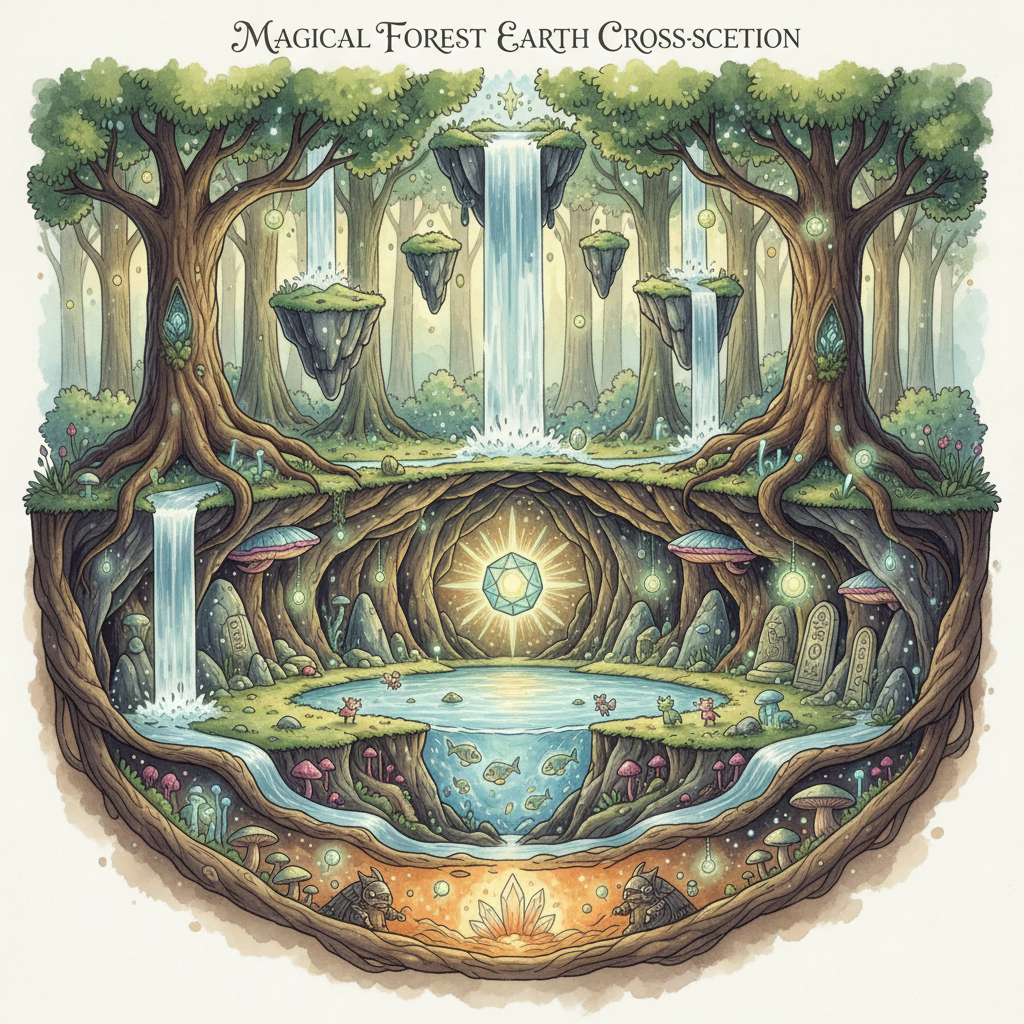
The Little Witch tapped the ground with her staff. “Everything you see—every hill, every stone, every path—has a story beneath it. The earth remembers. It keeps records. It holds questions.”
A girl with moss in her hair raised her hand. “What kind of questions?”
“Old ones,” the Little Witch said. “Slow ones. Questions written in layers and pressure and time.”
The apprentices leaned in.
The Little Witch knelt and placed her palm on the soil. “The forest has been whispering to me. Something is shifting below us. Something wants to be understood.”
A boy with a river pebble in his pocket swallowed hard. “Is it dangerous?”
“Not dangerous,” she said gently. “Just curious.”
The ground hummed softly beneath their feet, like a cat settling into a warm lap.
The apprentices looked at one another—wide-eyed, excited, and a little nervous.
The Little Witch stood. “This season, you will learn to read the land. To listen to stone. To follow the stories written in everything beneath.”
She paused, letting the forest breathe around them.
“Are you ready?”
The apprentices nodded as one.
The Little Witch smiled. “Then our work begins.”
Chapter 1 Puzzle: The Stone-Listening Charm
To begin learning earth-reading, the Little Witch teaches the apprentices a simple charm for sensing what lies beneath the soil.
For one small patch of ground, the charm needs:
- 3 echo-pebbles
- 2 handfuls of soft soil
- 1 quiet breath
But there are four apprentices practicing together.
Your task: Multiply each ingredient by 4 so every apprentice can make their own charm.
- How many echo-pebbles are needed?
- How many handfuls of soft soil?
- How many quiet breaths?
Write the full recipe for the four-apprentice Stone-Listening Charm.
Research Quest
What are the three main types of rocks?
Find one example of each near where you live or in a book or online.
Draw one rock and label its texture or pattern.
Chapter Two: Everything Beneath
The tremor came just after breakfast.
It was small—so small that the spoons only rattled a little in their wooden cups—but every apprentice felt it. The ground gave a soft shiver, like something deep below had stretched in its sleep.
The Little Witch paused mid‑stir of her pine‑needle tea. “There it is again,” she murmured.
The apprentices exchanged wide‑eyed looks.
A girl with moss in her hair crouched low and pressed her palm to the soil. “It feels… curious,” she said.
“Exactly,” the Little Witch replied. “Not frightened. Not warning us. Just asking to be noticed.”
The apprentices followed her outside, gathering beneath the oak tree. The forest was calm. Birds chattered. Sunlight filtered through the branches. Nothing looked unusual.
But the ground hummed—just once, like a single heartbeat.
The Little Witch knelt and brushed aside a thin layer of leaves. Beneath them, the soil was patterned with faint lines—curves, swirls, and tiny ridges.
“What are those?” asked a boy with a river pebble in his pocket.
“Layers,” she said. “Stories. The earth keeps memories stacked on top of one another. Every season, every storm, every fallen leaf adds a new page.”
The apprentices leaned closer.
The Little Witch smiled. “Today, you begin learning how to read them.”
She handed each apprentice a small wooden tool shaped like a crescent moon. “These are layer‑lifters. They help you peel back the earth gently, without disturbing the stories beneath.”
A girl with bright braids traced the lines in the soil. “So the tremor was… the earth talking?”
“In its own way,” the Little Witch said. “It’s telling us something is shifting below. Something old. Something patient.”
The ground gave another tiny hum, softer this time, like a whisper.
The Little Witch stood. “Come. We’ll start with a simple charm to help you feel the layers more clearly.”
The apprentices followed, hearts thumping with excitement.
They were finally beginning to understand everything beneath.
Chapter 2 Puzzle: The Layer‑Sensing Charm
To help the apprentices feel the layers in the soil, the Little Witch teaches them a charm that reveals the subtle differences between each one.
For one small patch of ground, the charm needs:
- 4 layer‑dust sprinkles
- 2 crescent‑moon scoops of soil
- 3 patient breaths
But today the apprentices will examine three different patches of ground.
Your task: Multiply each ingredient by 3 so the charm can be cast on all three patches.
- How many layer‑dust sprinkles are needed?
- How many crescent‑moon scoops of soil?
- How many patient breaths?
Write the full recipe for the three‑patch Layer‑Sensing Charm.
Research Quest
What is a sediment layer?
Find a picture of layered rock or soil.
Draw the layers and label which ones look older and which look newer.
Chapter Three: The River That Remembers
The apprentices followed the Little Witch down the winding path toward the river, their boots brushing through ferns still heavy with morning dew. The forest felt calm, but the ground beneath their feet held a quiet tension, as if listening.
When they reached the riverbank, the apprentices gasped.
The river had shifted.
Not wildly, not dangerously — but enough that the curve of the bank was different. A gentle bend had become a sharper one. A patch of pebbles had appeared where yesterday there had been smooth sand.
The Little Witch crouched beside the water. “The river has been busy,” she said.
A boy with a river pebble in his pocket knelt beside her. “Did the tremor move it?”
“Not exactly,” she replied. “Rivers are always moving. They carry stories with them — stones, soil, memories. But sometimes they reveal something new.”
The apprentices scanned the bank.
A girl with moss in her hair pointed. “Those rocks weren’t here before.”
The Little Witch nodded. “Good eye. Let’s take a closer look.”
They gathered around the cluster of stones. Some were smooth and round. Others were sharp-edged. One was striped with colors none of them recognized.
“These stones don’t match the forest,” the Little Witch said. “They came from somewhere else.”
“Far away?” asked a girl with bright braids.
“Very far,” the Little Witch said. “Rivers carry things for miles. Sometimes for lifetimes.”
The apprentices touched the stones gently, as if greeting travelers.
The Little Witch smiled. “Today, you’ll learn how rivers remember. How they carve, carry, and reveal the stories of the land.”
A soft rumble passed beneath their feet — not a tremor this time, but the steady pulse of water moving through earth.
The Little Witch stood. “The river is telling us something. Let’s listen.”
Chapter 3 Puzzle: The River‑Reading Charm
To understand how the river has changed, the Little Witch teaches the apprentices a charm that helps them track what the water carries.
For one section of riverbank, the charm needs:
- 6 drift‑stones
- 3 scoops of river sand
- 2 flowing breaths
But the apprentices will study two sections of the river today.
Your task: Multiply each ingredient by 2 so the charm can be cast on both sections.
- How many drift‑stones are needed?
- How many scoops of river sand?
- How many flowing breaths?
Write the full recipe for the two‑section River‑Reading Charm.
Research Quest
What is erosion?
Find a picture of a riverbank, canyon, or cliff shaped by moving water.
Draw the shape and label where the water has carved or carried material away.
Chapter Four: The Hill That Grew Overnight
The apprentices woke to a strange sight.
Just beyond the oak tree, where yesterday there had been a flat stretch of moss and mushrooms, a small hill now rose from the forest floor. It wasn’t tall—no bigger than a sleeping bear—but it definitely hadn’t been there before.
A girl with bright braids rubbed her eyes. “Did… did the forest grow a bump?”
The Little Witch stepped outside, her cloak still wrapped around her shoulders. She blinked at the hill, then nodded slowly. “It seems the land has been busy.”
The apprentices circled the new rise in the earth. The moss was fresh, the soil still damp, and tiny stones glittered on its surface like scattered stars.
A boy with a river pebble in his pocket crouched down. “It’s warm.”
“Not warm,” the Little Witch corrected gently. “New.”
She knelt beside the hill and brushed her fingers across the soil. “Sometimes the earth rearranges itself. Wind brings dust. Water carries sand. Leaves fall and break down. Bit by bit, the land builds.”
“But overnight?” asked the girl with moss in her hair.
The Little Witch smiled. “Overnight to you. But the forest has been working on this for a long time. Last night was simply when it decided to show itself.”
The apprentices leaned closer, studying the layers of soil, the mix of stones, the way the hill curved gently toward the roots of a nearby pine.
“What does it mean?” asked a quiet apprentice who rarely spoke.
“It means,” the Little Witch said, “that the earth is shifting. Not in fear. Not in warning. But in story.”
The ground gave a soft, familiar hum beneath their feet.
The Little Witch stood. “Today, you’ll learn how hills form—slowly, patiently, with the help of wind, water, and time. And you’ll learn a charm to help you see what the land is building.”
The apprentices gathered their tools, excitement buzzing through them like bees in spring.
The forest was changing, and they were finally beginning to understand why.
Chapter 4 Puzzle: The Hill‑Making Charm
To understand how the new hill formed, the Little Witch teaches the apprentices a charm that reveals how much material has been added to the land.
For one small hill, the charm needs:
- 5 scoops of surface soil
- 4 wind‑caught dust sprinkles
- 2 steady breaths
But the apprentices want to compare three different parts of the hill.
Your task: Multiply each ingredient by 3 so the charm can be cast on all three sections.
- How many scoops of surface soil are needed?
- How many wind‑caught dust sprinkles?
- How many steady breaths?
Write the full recipe for the three‑section Hill‑Making Charm.
Research Quest
What is deposition?
Find a picture of a sand dune, river delta, or hillside formed by deposited material.
Draw the shape and label where the material has gathered over time.
Chapter Five: The Cave of Whispering Walls
The entrance hadn’t been there yesterday.
The apprentices stood in a half‑circle, staring at the narrow opening in the hillside. It was framed by roots and ferns, as if the forest had gently pulled them aside to reveal a secret.
A girl with moss in her hair whispered, “Did the hill… open?”
The Little Witch nodded. “Sometimes the earth reveals what it’s been shaping in silence.”
A cool breath of air drifted from the cave, carrying the scent of stone, water, and something faintly metallic. The apprentices shivered—not from fear, but from the feeling that they were standing at the doorway of a very old story.
The Little Witch lit a small glow‑orb and stepped inside. “Stay close. Caves remember everything.”
The apprentices followed, their footsteps soft on the damp ground. The walls shimmered with mineral crystals—some clear as ice, others glowing faintly blue or green. When the apprentices spoke, their voices bounced back in gentle echoes.
A boy with a river pebble in his pocket laughed. “It sounds like the cave is talking.”
“In a way, it is,” the Little Witch said. “Echoes tell us about shape, space, and the minerals that line the walls. Every sound is a clue.”
She tapped the wall lightly with her staff. The echo returned with a soft, musical ring.
A girl with bright braids touched a cluster of crystals. “Why do they grow like this?”
“Pressure,” the Little Witch said. “Heat. Time. Water carrying minerals drop by drop. Caves are patient artists.”
The apprentices walked deeper until the tunnel widened into a chamber. The walls here were covered in long, rippling patterns—like frozen waves.
“What made these?” asked a quiet apprentice.
“Water,” the Little Witch said. “Long ago, this chamber was filled with it. As the water moved, it carved these shapes. When it left, the shapes remained.”
The ground hummed softly beneath their feet—familiar now, like a heartbeat they were learning to recognize.
The Little Witch knelt and placed her hand on the stone floor. “The earth is showing us its memory. Let’s listen carefully.”
The apprentices stood in stillness, letting the cave speak in echoes, crystals, and ancient patterns.
They were beginning to understand that the land didn’t just hold stories—it told them.
Chapter 5 Puzzle: The Echo‑Reading Charm
To help the apprentices understand how sound reveals the shape of a cave, the Little Witch teaches them a charm that measures echoes.
For one chamber, the charm needs:
- 4 crystal‑dust pinches
- 3 echo‑stones
- 2 slow breaths
But the apprentices want to test four different spots in the cave.
Your task: Multiply each ingredient by 4 so the charm can be cast at all four locations.
- How many crystal‑dust pinches are needed?
- How many echo‑stones?
- How many slow breaths?
Write the full recipe for the four‑location Echo‑Reading Charm.
Research Quest
What is a stalactite and what is a stalagmite?
Find a picture of each.
Draw them and label which one grows from the ceiling and which grows from the ground.
Chapter Six: The Boulder That Walked Away
The apprentices found the empty space before they found the boulder.
They were on their way to gather pine needles for tea when the girl with moss in her hair stopped suddenly. “Something’s wrong,” she said, pointing to a wide, flat patch of earth.
The ground was smooth and pale, shaped like a shallow bowl. Ferns leaned inward around the edges, as if peering into a missing memory.
A boy with a river pebble in his pocket frowned. “Wasn’t there a huge boulder here?”
“There was,” the Little Witch said, stepping forward. “A very old one.”
The apprentices stared at the empty space. The boulder had been taller than any of them, covered in lichen and soft moss. It had been part of the forest for as long as they could remember.
“Where did it go?” asked a quiet apprentice.
“That,” the Little Witch said, “is the question.”
They followed a trail of disturbed soil—small scrapes, crushed leaves, and a faint groove in the earth. It wound between the trees like a wandering thought.
The girl with bright braids gasped. “It really did walk away.”
“Not walk,” the Little Witch said gently. “But move.”
They followed the trail until they reached a clearing. There, resting beside a fallen log, was the boulder. It looked perfectly content, as if it had simply decided to sit somewhere new.
The apprentices circled it, touching its cool surface.
“But how?” asked the boy with the river pebble.
“Long ago,” the Little Witch said, “this forest was covered in ice. Thick, heavy ice that carried stones across the land. When the ice melted, the stones stayed where they were set down.”
“So this boulder came from somewhere else?” asked the girl with moss in her hair.
“Very far away,” the Little Witch said. “And sometimes, when the ground shifts or softens, a stone remembers how to move.”
The apprentices pressed their palms to the boulder. It hummed faintly—an echo of ancient journeys.
The Little Witch smiled. “Today, you’ll learn about glacial erratics—stones carried by ice, left behind as clues to the past. And you’ll learn a charm to help you trace where this boulder once traveled.”
The apprentices leaned closer, ready to listen to the long memory of stone.
Chapter 6 Puzzle: The Journey‑Tracing Charm
To understand where the boulder came from, the Little Witch teaches the apprentices a charm that reveals the direction and distance of a stone’s ancient travels.
For one boulder, the charm needs:
- 7 trail‑dust pinches
- 3 direction‑stones
- 2 deep breaths
But the apprentices want to test two different stones in the clearing.
Your task: Multiply each ingredient by 2 so the charm can be cast on both stones.
- How many trail‑dust pinches are needed?
- How many direction‑stones?
- How many deep breaths?
Write the full recipe for the two‑stone Journey‑Tracing Charm.
Research Quest
What is a glacial erratic?
Find a picture of one from your region or another part of the world.
Draw the stone and label where scientists think it originally came from.
Chapter Seven: The Map Written in Fire
The apprentices smelled the warmth before they saw it.
They were gathering fallen branches for the evening fire when a faint scent drifted through the trees—something like warm stone after sunlight, or the inside of a hearth long after the flames have gone out.
A girl with bright braids paused. “Do you smell that?”
The Little Witch lifted her head, eyes narrowing thoughtfully. “Yes. The earth is warm today.”
They followed the scent to a clearing where the ground shimmered faintly. A patch of soil—no bigger than a blanket—glowed with a soft, ember‑colored light. Thin wisps of steam curled upward, disappearing into the cool forest air.
A boy with a river pebble in his pocket whispered, “Is it… burning?”
“No,” the Little Witch said gently. “But something deep below is remembering heat.”
The apprentices knelt around the glowing patch. The soil wasn’t hot enough to hurt, but it radiated a steady warmth, like a stone that had been sitting in the sun for hours.
The girl with moss in her hair brushed aside a layer of leaves. Beneath them, the soil was streaked with dark lines—twisting, branching, curling like roots made of shadow.
“What are those?” she asked.
“Old fire,” the Little Witch said. “Not the kind that burns trees. The kind that shapes mountains.”
The apprentices stared.
“Long ago,” she continued, “this land was alive with molten rock. It rose and cooled, rose and cooled, over and over. Those lines are the memory of that movement.”
The ground gave a soft hum—lower than before, deeper, like a drumbeat from far below.
A quiet apprentice traced one of the dark lines with a fingertip. “It looks like a map.”
“It is,” the Little Witch said. “A map written in fire. A record of how the land once flowed.”
The apprentices leaned closer, studying the branching patterns.
“Today,” the Little Witch said, “you’ll learn how to read these fire‑lines. And you’ll learn a charm to help you sense the warmth of stone shaped by ancient heat.”
The apprentices gathered around her, hearts thumping with excitement.
The earth was telling a story older than the forest itself.
Chapter 7 Puzzle: The Fire‑Line Sensing Charm
To help the apprentices understand the warm patch of ground, the Little Witch teaches them a charm that reveals how heat once moved through stone.
For one fire‑line patch, the charm needs:
- 5 ember‑dust pinches
- 4 cooled‑stone chips
- 3 slow, grounding breaths
But the apprentices want to test three different fire‑line patterns in the clearing.
Your task: Multiply each ingredient by 3 so the charm can be cast on all three patterns.
- How many ember‑dust pinches are needed?
- How many cooled‑stone chips?
- How many slow, grounding breaths?
Write the full recipe for the three‑pattern Fire‑Line Sensing Charm.
Research Quest
What is magma, and how is it different from lava?
Find a diagram of a volcano or magma chamber.
Draw the diagram and label where the heat comes from and where the molten rock travels.
Chapter Eight: The Fossil That Didn’t Belong
The apprentices were sorting stones along the riverbank when the quiet apprentice let out a small gasp.
“I found something,” they whispered.
The others hurried over. In the apprentice’s hands lay a flat, pale stone with a dark shape pressed into its surface. It looked like the shadow of a creature—long, delicate, and curled like a sleeping fern.
A girl with moss in her hair leaned closer. “Is that… a leaf?”
“No,” said the Little Witch, who had appeared beside them without a sound. “Look at the pattern. Those are ribs.”
The apprentices stared. The shape was unmistakable now—tiny bones, arranged in a graceful curve, ending in a fan of thin, branching lines.
A boy with a river pebble in his pocket whispered, “It’s a creature.”
“But not from here,” the Little Witch said softly.
The apprentices exchanged puzzled looks.
“This forest has never had animals shaped like this,” she continued. “This fossil is from another time. Another world of weather, water, and life.”
The girl with bright braids traced the outline gently. “How did it get here?”
“Rivers carry stories,” the Little Witch said. “And sometimes they carry memories from far older lands.”
The apprentices gathered around the fossil, feeling the weight of deep time in their hands. The stone was cool, but the story inside it felt warm—alive, somehow.
The Little Witch knelt beside them. “Fossils are the earth’s photographs. They show us who lived here long before the forest grew. They remind us that the land has changed many times.”
The ground hummed softly beneath their feet, as if agreeing.
The quiet apprentice looked up. “So the earth is telling us about its past?”
“Yes,” the Little Witch said. “And today, you’ll learn a charm to help you read the age of a stone’s memory.”
The apprentices leaned in, eager to understand the creature who had traveled across time to meet them.
Chapter 8 Puzzle: The Memory‑Layer Charm
To help the apprentices understand how old the fossil is, the Little Witch teaches them a charm that reveals the number of layers a stone has lived through.
For one fossil stone, the charm needs:
- 8 memory‑dust sprinkles
- 4 drops of river water
- 2 steady breaths
But the apprentices want to test five stones they found along the riverbank.
Your task: Multiply each ingredient by 5 so the charm can be cast on all five stones.
- How many memory‑dust sprinkles are needed?
- How many drops of river water?
- How many steady breaths?
Write the full recipe for the five‑stone Memory‑Layer Charm.
Research Quest
What is a fossil, and how does one form?
Find a picture of a fossil from a creature that no longer lives today.
Draw the fossil and label the parts you can identify.
Chapter Nine: The Mountain’s Quiet Question
The apprentices felt the humming before they heard it.
They were returning from the river, baskets full of driftwood and smooth stones, when a low vibration brushed through the soles of their boots. It wasn’t sharp like the tremor from earlier in the season. It was deeper, slower—like a long, thoughtful breath.
A girl with moss in her hair stopped walking. “Did you feel that?”
The Little Witch turned toward the distant ridge. “Yes. The mountain is speaking.”
The apprentices followed her gaze. The ridge rose above the forest like a sleeping giant, its slopes covered in pines and old stone. It had always been quiet—steady, dependable, a familiar shape on the horizon.
But today, something was different.
A soft hum drifted through the air again, so low it felt more like a feeling than a sound.
A boy with a river pebble in his pocket frowned. “Is it… waking up?”
“Not waking,” the Little Witch said. “Asking.”
They walked toward the ridge, following the hum as it pulsed gently through the ground. The closer they came, the more the apprentices noticed small changes—stones tilted at new angles, cracks in the soil that hadn’t been there before, pine needles gathered in strange swirling patterns.
The girl with bright braids knelt beside a long, thin crack. “Why is the ground splitting?”
“Because the land is moving,” the Little Witch said. “Mountains rise and fall, though so slowly we rarely notice. But sometimes, when the earth shifts deep below, the mountain asks a question.”
“What kind of question?” asked the quiet apprentice.
“A question about balance,” the Little Witch said softly. “About pressure. About how much weight the land can hold.”
The hum came again—steady, patient, almost musical.
The apprentices stood in silence, listening.
The Little Witch placed her hand on the ground. “Today, you’ll learn how mountains grow. How they fold and lift. And you’ll learn a charm to help you sense the direction of the mountain’s movement.”
The apprentices gathered around her, hearts steadying to the rhythm of the mountain’s quiet question.
They were beginning to understand that even the tallest, stillest places were alive with motion.
Chapter 9 Puzzle: The Mountain‑Lifting Charm
To help the apprentices sense how the mountain is moving, the Little Witch teaches them a charm that reveals the direction and strength of uplift.
For one ridge point, the charm needs:
- 6 ridge‑dust pinches
- 3 pressure‑stones
- 2 grounding breaths
But the apprentices want to test four points along the mountain’s base.
Your task: Multiply each ingredient by 4 so the charm can be cast at all four points.
- How many ridge‑dust pinches are needed?
- How many pressure‑stones?
- How many grounding breaths?
Write the full recipe for the four‑point Mountain‑Lifting Charm.
Research Quest
What causes mountains to form?
Find a diagram of plate movement or mountain uplift.
Draw the diagram and label where the land is pushing upward.
Chapter Ten: The Earth’s Long Memory
The apprentices gathered beneath the oak tree at dusk, their pockets full of stones, soil samples, and notes from every corner of the forest. The air felt different tonight—still, expectant, as if the land itself were holding its breath.
The Little Witch stepped onto the porch, her lantern glowing softly. “You’ve listened well this season,” she said. “To rivers, hills, caves, fire‑lines, and mountains. Now it’s time to listen to the earth as a whole.”
The apprentices exchanged excited glances.
A gentle hum rose beneath their feet—familiar now, steady and warm. It wasn’t a tremor or a warning. It was a greeting.
The Little Witch knelt and placed her palm on the soil. “The earth remembers everything. Every shift, every storm, every creature that has ever walked across it. Tonight, we weave those memories together.”
She handed each apprentice a small stone—smooth, round, and faintly glowing.
“These are memory‑stones,” she said. “They hold the stories you’ve learned. When we place them together, they will help the forest understand its own deep history.”
The apprentices formed a circle around the oak tree. One by one, they placed their stones in the center. As each stone touched the ground, a soft light spread outward, tracing patterns in the soil—river paths, hill lines, cave echoes, fire‑branches, mountain folds.
The patterns intertwined, forming a glowing map of everything they had discovered.
A girl with moss in her hair whispered, “It’s beautiful.”
“It’s true,” the Little Witch said. “And truth is always beautiful.”
The ground hummed again—stronger this time, resonant, like a long sigh of recognition.
A boy with a river pebble in his pocket stepped forward. “It feels… grateful.”
The Little Witch nodded. “The earth is always grateful when we listen.”
The glowing patterns slowly faded into the soil, sinking deep into the land’s memory. The forest grew quiet, peaceful, whole.
The Little Witch stood. “You have learned to read the land. To hear its questions. To honor its stories. This is the heart of earth‑reading.”
The apprentices felt taller somehow—steadier, grounded like stones shaped by time.
The Little Witch smiled. “Your season of learning is complete. But the earth’s story continues. And now, you are part of it.”
The ground gave one final, gentle hum.
The apprentices hummed back.
Chapter 10 Puzzle: The Earth‑Reading Charm
To weave all the season’s lessons together, the Little Witch teaches the apprentices a charm that combines every type of earth memory they’ve studied.
For one earth‑reading circle, the charm needs:
- 3 river‑stones
- 3 hill‑soils
- 3 cave‑crystals
- 3 fire‑line chips
- 3 mountain‑dust pinches
- 3 deep, steady breaths
But the apprentices want to create two circles: one for the oak tree, and one for the riverbank.
Your task: Multiply each ingredient by 2 so the charm can be cast in both places.
- How many river‑stones are needed?
- How many hill‑soils?
- How many cave‑crystals?
- How many fire‑line chips?
- How many mountain‑dust pinches?
- How many deep, steady breaths?
Write the full recipe for the two‑circle Earth‑Reading Charm.
Research Quest
What is “deep time,” and why is it important in geology?
Find a timeline or diagram that shows major events in Earth’s history.
Draw your own simplified timeline and label at least three events that happened long before humans existed.
Conclusion: The Path Ahead
The forest was quiet in the days that followed, as if settling into a deeper breath. The apprentices moved through the woods with new steadiness, noticing things they had never seen before—tiny shifts in soil, the curve of a stone, the way the riverbank changed after rain. The land felt different now, not because it had changed, but because they had.
One evening, the Little Witch gathered them beneath the oak tree. The last light of day filtered through the branches, painting the ground in soft gold.
“You’ve learned to listen,” she said. “Not just to the forest above, but to everything beneath. You’ve heard the stories written in stone and soil, in heat and pressure, in time itself.”
The apprentices sat quietly, letting her words settle like dust on still water.
“The earth is old,” she continued. “Older than any of us can imagine. But it is also alive. It shifts, it remembers, it asks questions. And now, you know how to answer.”
A gentle hum rose from the ground—familiar, steady, welcoming. The apprentices smiled.
“You are ready for what comes next,” the Little Witch said. “There are more stories waiting. More mysteries hidden in the world around you. And you will meet them with curiosity, patience, and care.”
The apprentices stood, feeling the weight and warmth of the season behind them. They had learned to read the land. They had learned to listen to deep time. And they had become part of the earth’s long memory.
The Little Witch looked toward the horizon, where the first stars were beginning to appear.
“Come,” she said softly. “A new season is beginning.”
And together, they stepped forward.
20 Nifty Geology Facts
- Earth is about 4.54 billion years old, and we know this from dating ancient minerals.
- The oldest known minerals on Earth are zircon crystals from Australia, about 4.4 billion years old.
- The Grand Canyon exposes nearly 2 billion years of Earth’s history in its rock layers.
- Diamonds form more than 90 miles below Earth’s surface under extreme pressure.
- Most of Earth’s volcanoes are underwater along mid‑ocean ridges.
- The Himalayas are still growing because the Indian Plate is pushing into the Eurasian Plate.
- Earth’s crust is broken into about a dozen major tectonic plates that constantly move.
- Earthquakes happen when stress builds up along faults and is suddenly released.
- Fossils only form under special conditions, usually when organisms are quickly buried.
- The deepest part of the ocean, the Mariana Trench, is deeper than Mount Everest is tall.
- Basalt is the most common rock in Earth’s crust, especially under the oceans.
- Sedimentary rocks often contain visible layers that record ancient environments.
- Igneous rocks form from cooled magma or lava; granite and basalt are two common examples.
- Metamorphic rocks form when existing rocks are changed by heat and pressure.
- The Earth’s magnetic field is recorded in cooling lava, helping scientists track plate movement.
- Glaciers carve U‑shaped valleys as they move slowly downhill.
- Desert sand dunes migrate over time as wind pushes grains from one side to the other.
- Geysers erupt when underground water is heated by magma and builds up pressure.
- Petrified wood forms when minerals replace the original organic material, turning it to stone.
- The rock cycle shows how rocks continuously transform between igneous, sedimentary, and metamorphic forms.
- Earth’s inner core is solid iron and nickel, but the outer core around it is liquid metal.
- Some mountains, like the Appalachians, were once as tall as the Himalayas but have eroded over hundreds of millions of years.
- The African continent is slowly splitting along the East African Rift, creating a new ocean basin.
- Obsidian, a volcanic glass, can form razor‑sharp edges sharper than steel.
- The Earth’s crust floats on the mantle below it, similar to how icebergs float on water.
Geo Jokes
- Why are geologists great friends? They really rock.
- What did the volcano say to the mountain? “I lava you!”
- Why did the geologist take a pillow to the dig site? In case they needed to nap‑peal layers.
- What do you call a rock that never goes to school? A skipping stone!
- Why was the sedimentary rock so cheap? It was on shale!
- How do geologists throw parties? They make the earth move.
- Why did the geologist break up with the boulder? It took them for granite.
- What’s a geologist’s favorite music? Hard rock.
- Why did the fossil go to the doctor? It felt a little crumby.
- What do you call a rock that’s always getting into trouble? A little boulder than the rest.
Apple Music
YouTube Music
Amazon Music
Spotify Music


Explore Mini-Topics
Leave a Reply