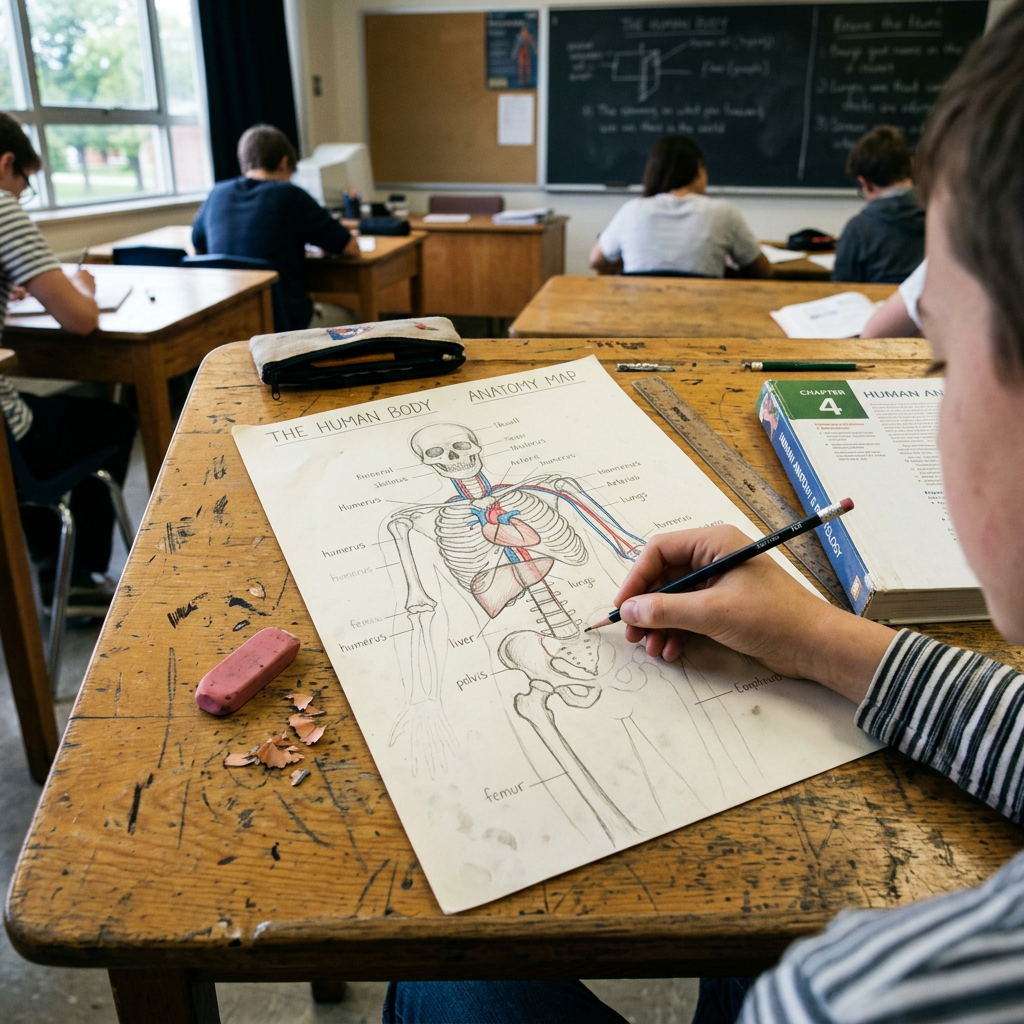
The Institutional Fantasy of the Pre‑Pubescent Child
Schools do not merely delay reproductive education — they behave as if children do not change until the institution is ready to teach them. This is the institutional fantasy of the pre‑pubescent child: the belief that children remain biologically static, sexually inert, and developmentally frozen until ninth grade, when the curriculum finally acknowledges their bodies. For survivors, this fantasy is not abstract. It is the landscape we grew up inside. Our bodies changed years before adults admitted they were changing. This chapter critiques the institutional fantasy that children remain pre‑pubescent until curriculum permits otherwise — and shows how this fantasy produces real, measurable harm.
Framing the harm: why limiting body literacy is violence
Structural violence emerges when institutions create harm through omission, denial, or neglect. The fantasy of the pre‑pubescent child is one of its most dangerous forms. When schools pretend children are not changing, they deny the reality of puberty, the urgency of autonomy, and the necessity of body literacy. This denial is not neutral. It is violent.
The fantasy protects institutions from controversy. It does not protect children from harm.
Empirical evidence: children change years before curriculum does
Biology does not wait for policy.
Puberty onset
- Breast development often begins around 8–10.
- Testicular enlargement often begins around 9–11.
- Menarche typically occurs between 10–13, but earlier onset is increasingly common.
- Hormonal shifts begin years before visible changes.
Curriculum timing
- Many U.S. districts introduce reproductive anatomy in 5th–6th grade.
- Avoidance-based districts delay until 9th grade.
- Abstinence-leaning districts may omit anatomy entirely until high school biology.
The institutional fantasy pretends that children remain pre‑pubescent until the district is ready to teach them. Biology proves otherwise.
The biology gap becomes a fantasy gap
The biology gap — the 3–6 year delay between bodily change and instructional acknowledgment — becomes a fantasy gap. Schools behave as if:
- Children do not menstruate until ninth grade.
- Children do not experience erections until ninth grade.
- Children do not experience hormonal shifts until ninth grade.
- Children do not experience curiosity, confusion, or vulnerability until ninth grade.
This fantasy is contradicted by every biological study, every pediatric dataset, and every survivor’s memory.
Children change. Curriculum does not.
Shame as a tool of control
The institutional fantasy produces shame. When schools refuse to acknowledge bodily change, children learn that their bodies are taboo, embarrassing, or “too adult” to discuss. Shame becomes a mechanism of control.
Children learn:
- “My body is wrong.”
- “My body is dirty.”
- “My body should not be talked about.”
- “My body is not supposed to be changing.”
Shame suppresses questions, suppresses disclosure, and suppresses autonomy. Shame is not protective. Shame is a vector for exploitation.
Bodies without maps: autonomy denied
Autonomy requires literacy. Children cannot defend bodies they cannot name. They cannot report harm they cannot describe. They cannot assert boundaries they have never been taught to recognize.
The institutional fantasy denies children the vocabulary required for autonomy. It denies them the map required to navigate their own bodies.
Educational omission is not neutral. It is structural violence enacted through fantasy.
TSD Case Study: The Fantasy in Local Practice
Thompson School District embodies the institutional fantasy of the pre‑pubescent child. TSD delays reproductive anatomy until 9th grade biology, long after puberty begins. Middle school science covers cell division, genetics, and ecology — but not human reproductive systems, not consent, not bodily autonomy, not the mechanics of puberty.
This creates a local fantasy:
- A child who menstruates at 10 is treated as if she is still pre‑pubescent.
- A child who experiences erections at 9 is treated as if he is still pre‑pubescent.
- A child who experiences hormonal shifts at 8–10 receives no vocabulary for consent or boundaries.
- Middle school students are treated as if they have no reproductive organs, no sexual development, and no vulnerability.
This fantasy is contradicted by biology, by public health data, and by lived experience. Larimer County’s youth STI and teen pregnancy patterns reflect statewide trends: silence correlates with harm.
TSD’s curriculum does not merely omit information — it denies reality.
Colorado Context: A Statewide Fantasy
Colorado’s “local control” model allows districts to decide how — or whether — to teach reproductive anatomy. This variability produces a statewide fantasy: children in some districts are acknowledged as developing beings, while children in others are treated as pre‑pubescent until high school.
Districts that delay instruction create environments where:
- Puberty is experienced in secrecy.
- Bodily changes are interpreted as shameful.
- Consent and autonomy are not taught during the years they are most needed.
- Disclosure rates are lower.
Districts with early, comprehensive programs show:
- Higher autonomy.
- Higher disclosure.
- Lower teen pregnancy and STI rates.
- Greater safety outcomes.
Colorado’s fantasy landscape is shaped by policy, not biology.
National Landscape: The U.S. Fantasy of the Pre‑Pubescent Child
Nationally, the U.S. has long upheld the fantasy that children remain pre‑pubescent until institutions decide otherwise.
Historical roots
- Mid‑20th century moral panic framed reproductive knowledge as dangerous.
- Abstinence-only funding required schools to pretend children were sexually inert.
- Parental rights movements insisted children were “too young” for information they biologically needed.
Modern consequences
- Abstinence-only states show higher teen pregnancy and STI rates.
- Comprehensive states show lower rates and higher autonomy.
- International comparisons show that countries teaching reproductive anatomy in elementary school have dramatically lower sexual violence and teen pregnancy.
The U.S. fantasy is not cultural. It is political.
Policy, politics, and the fantasy of neutrality
Districts often claim neutrality: “We don’t take a position.” But pretending children are not changing is a position. It is a decision with measurable consequences. Avoidance protects institutions, not children.
Neutrality is a fantasy that hides structural violence.
Survivor literacy: teaching what institutions deny
Survivors, parents, and communities build parallel systems of body literacy when institutions fail. A survivor-informed framework includes:
- Accuracy
- Autonomy
- Consent
- Safety
- Non-shame
These principles counteract the institutional fantasy by teaching what biology already demands.
Conclusion: the fantasy is violence
The curriculum that pretends children are not changing is not neutral. It is a fantasy that produces shame, secrecy, vulnerability, and measurable harm. Children change before curriculum does. Children deserve acknowledgment before ninth grade. Children deserve literacy before danger.
We deserved to know our bodies before they were harmed. The children in our care still do.
Visit the Series Archive to view the rest of the Series.


Apple Music
YouTube Music
Amazon Music
Spotify Music
Structural Violence of Limiting Body Literacy in Education
- The Violence of Silence
- Puberty Begins Before Curriculum
- How Schools Learned to Look Away
- What Happens When Kids Don’t Know
- When Knowledge is Forbidden
- Bodies Without Maps
- The Institutional Fantasy of the Pre-Pubescent Child
- The Violence of “Neutrality”
- What Silence Costs Us
- How Silence Reproduces Itself
- Teaching What Was Withheld
- A Survivor Literacy Model for Reproductive Education
- Ending the Violence of Shame
- Case Studies of Harm
- The Economics of Abstinence Education
- How Districts Justify Silence
- Who “Benefits” from Abstinence-Only Education?
- The Geography of Silence
Leave a Reply