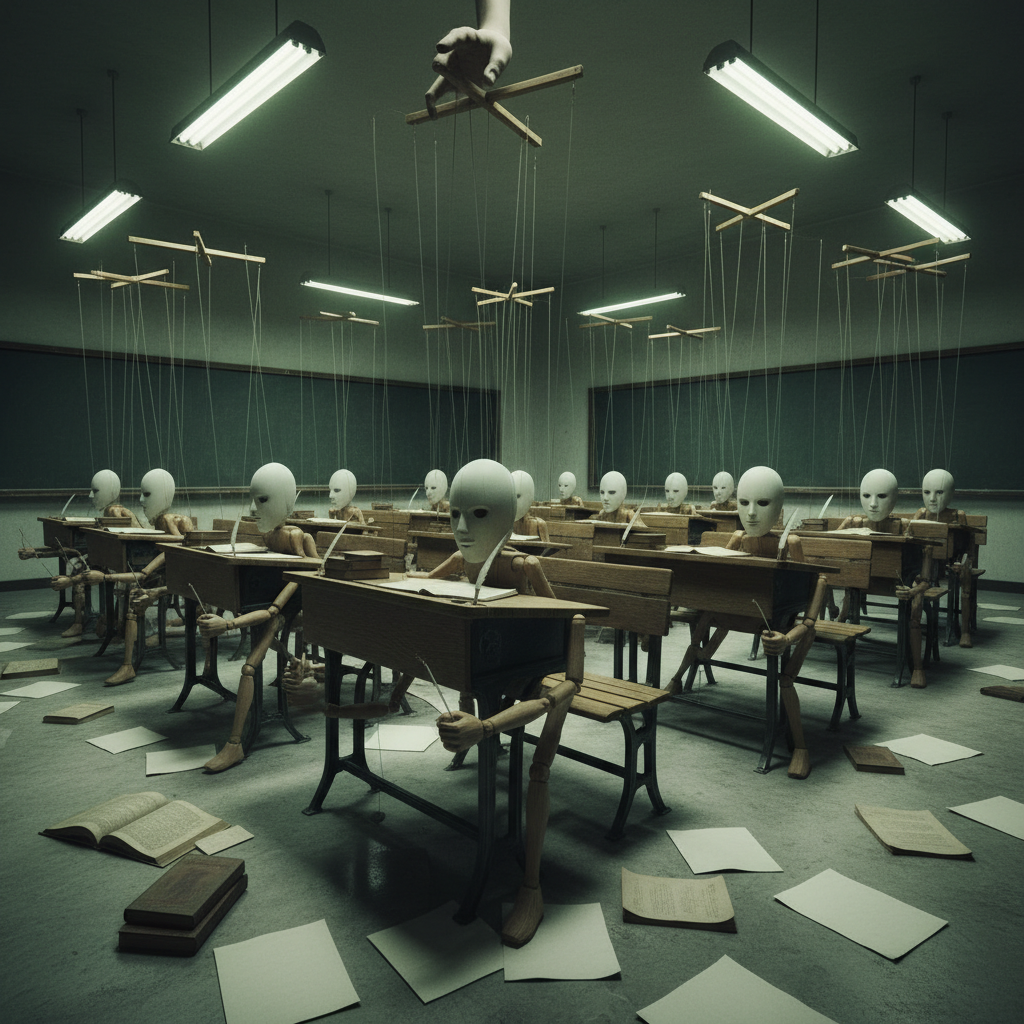
Hostage‑Pledge Analysis of State Testing Season
The annual ritual where the state measures itself by measuring children
1. The Core Hostage Structure
State testing is not an assessment of learning — it is a sovereignty ritual.
The hostages:
- Student time
- Student bodies
- Teacher autonomy
- Curriculum integrity
- School funding and reputation
- Community narratives about intelligence
The pledge extracted:
- Compliance with state‑defined metrics
- Silence about structural inequity
- Acceptance of standardized identity scripts
- Demonstrated willingness to sacrifice learning time for state optics
This mirrors the Presidential Fitness Test:
The state performs strength by forcing children to perform strength.
Testing season is the academic version of the international performance ritual — a symbolic demonstration of national competitiveness, not a pedagogical tool.
2. The Presidential Fitness Test Lineage
The PFT was never about health. It was about:
- Cold War anxiety
- National virility
- Bodily conformity
- Public humiliation as discipline
- Sorting children into “fit” and “unfit”
State testing inherits the same logic:
| Presidential Fitness Test | State Academic Testing |
|---|---|
| Measures “fitness” for national strength | Measures “readiness” for economic competitiveness |
| Public ranking of children | Public ranking of schools/districts |
| Humiliation as motivator | Fear of sanctions as motivator |
| Time stolen from real PE | Time stolen from real learning |
| Teachers as ritual enforcers | Teachers as ritual enforcers |
Both are ritualized demonstrations of national anxiety disguised as assessment.
3. Time Theft as a Mechanism of Control
Testing season is one of the largest state‑sanctioned curriculum interruptions.
What gets stolen:
- Weeks of instructional time
- Teacher planning bandwidth
- Classroom culture
- Student attention and regulation
- Electives, arts, recess, enrichment
- Special education support
- Schoolwide routines
Time is the hostage.
The state takes it, then demands gratitude for “accountability.”
4. Faculty as Custodial Enforcers
Teachers become the custodial enforcers of the state’s ritual:
- Forced to proctor instead of teach
- Forced to maintain silence, compliance, surveillance
- Forced to pretend the test matters
- Forced to absorb student stress
- Forced to justify the ritual to families
- Forced to accept evaluation tied to scores
The state creates the harm, then blames teachers for the outcomes.
5. Psychological Capture of Students
Testing season trains children in:
- Obedience under surveillance
- Performing calm under pressure
- Accepting that adults cannot protect them from state demands
- Believing their worth is quantifiable
- Internalizing that learning is secondary to performance
It reinforces:
- Racialized achievement gaps
- Disability‑based exclusion
- ELL marginalization
- Socioeconomic sorting
The test doesn’t measure inequity — it produces it.
6. The State’s Real Objectives
State testing is about:
1. Narrative Control
Declaring which schools and communities are “failing.”
2. Resource Justification
Using scores to rationalize funding decisions, closures, interventions.
3. Political Theater
Claiming to “raise standards” without addressing poverty or segregation.
4. Market Creation
Feeding testing companies, curriculum vendors, and ed‑tech platforms.
5. National Competitiveness Signaling
A performance for international comparison charts.
7. Additional Layers Often Missed
A. Surveillance State Creep
Testing season normalizes:
- Device lockdowns
- Keystroke monitoring
- AI proctoring
- Data extraction from minors
Children learn privacy is optional when the state wants performance.
B. Ritualized Stress
The only time of year schools intentionally induce anxiety.
C. Erasure of Local Knowledge
Standardized tests enforce monoculture curriculum and standardized identity.
D. Annual Reassertion of State Ownership
A reminder of whose metrics matter and whose authority is unquestionable.
The Impact of State Testing Rituals on Diverse Children
1. Children with Disabilities
- Sensory overwhelm from silence, stillness, and rigid protocols
- Loss of accommodations normally available
- Reinforcement that their learning style is “nonstandard”
- Shame when regulation needs conflict with test rules
- Quiet exclusion to protect school scores
2. Neurodivergent Children
- Routine disruption destabilizes executive functioning
- Surveillance triggers masking, shutdown, dissociation
- Single‑answer thinking contradicts pattern‑based cognition
- Emotional labor increases as they perform “calm”
- Internalization that their brain is a problem
3. Marginalized Racial and Cultural Communities
- Dominant‑culture language and framing penalize them
- Home knowledge is rendered irrelevant
- Scores justify resource deprivation
- Stress intensifies when the test feels like a referendum on their community
4. English Language Learners
- Tests measure English, not content mastery
- Forced to think academically in a developing language
- Cultural references create invisible penalties
- Linguistic diversity becomes a liability
- ELL staff reassigned, removing relational anchors
5. Children in Poverty or Housing Instability
- Sleep, food, and transportation instability directly affect performance
- Tests measure poverty, not learning
- Schools serving them face harshest sanctions
- Students internalize being “behind” instead of under‑resourced
6. Creative, Divergent, or Gifted Children
- Creativity suppressed in favor of conformity
- Boredom and disengagement increase
- Value tied to performance, not curiosity
- Optimization for external validation replaces exploration
7. Trauma‑Impacted Children
- Silent, controlled environments mirror threat
- Hypervigilance increases
- Stress responses misread as misbehavior
- Adults enforce compliance over safety
8. Children with Strong Cultural or Community Identities
- Community knowledge excluded
- Cultural selves must be compartmentalized
- Assimilation becomes prerequisite for legitimacy
- Identity dissonance emerges
9. Relational Learners
- Teachers shift from mentors to monitors
- Warmth replaced with procedural coldness
- Loss of relational cues harms regulation
- Connection becomes optional; compliance mandatory
10. Universal Harm: Field Incoherence
- Children sense contradictions between adult words and actions
- Environment becomes unpredictable and emotionally thin
- System needs override developmental needs
- Learning becomes secondary to performance, performance secondary to optics
Summary
State testing does not measure children; it reshapes the learning environment in ways that disproportionately harm those who rely on stability, relational safety, cultural coherence, and adaptive supports. The ritual amplifies inequity by demanding uniformity from a population defined by diversity.
Clean Thesis
State testing is the modern academic expression of the same Cold War sovereignty ritual that produced the Presidential Fitness Test: a national performance of strength enacted on children’s bodies, time, and identities, where the state measures itself by taking hostages and calling it accountability.
We Believe You
Visit the Series Archive for more!!


Apple Music
YouTube Music
Amazon Music
Spotify Music
U.S. Education
- The Hostage‑Pledge History of U.S. Education
- Hostage‑Pledge Analysis of State Testing Season
- The Impact of State Testing Rituals on Diverse Children
- The Narrative Rewrite: Blaming the Vulnerable
- The Long Tail: Structural Memory and Lingering Rupture
- The Teacher‑Side Burnout and Misattribution
- Mapping the States: Identity Policing, Captivity, Sorting, and Truth
- How State Testing Reshapes Experiences, Outcomes, and Relationships
- School Photos and the Risk Vector Revealed
Leave a Reply