Tool for Reading the Nervous System of a Room
How to Sense the Collective Physiology, Emotional Weather, and Field Dynamics of Any Group
Purpose
To help you read the “nervous system” of a room — the collective emotional field created by the bodies, histories, hierarchies, and unspoken dynamics present. This tool teaches you to perceive group physiology as structural information, not intuition or guesswork.
When to Use It
- You walk into a room and immediately feel something shift in your body.
- You sense tension, pressure, or incoherence without knowing why.
- The group feels unpredictable, fragile, or volatile.
- You want to understand the emotional architecture beneath the surface.
- You need to know whether the environment is safe, regulated, or extractive.
How It Works
Every room has a collective nervous system — a shared field shaped by:
- power dynamics
- emotional suppression
- unspoken conflict
- hierarchy
- safety or lack thereof
- relational history
- cultural norms
- the presence or absence of regulation
This tool helps you read that field in real time.
Step 1 — Start With Your Body’s First Impression
Your body is the most accurate sensor in the room.
Ask: What happens in my body the moment I enter?
Common signals:
- tightening
- holding your breath
- scanning
- shrinking
- speeding up
- slowing down
- feeling watched
- feeling invisible
- feeling responsible
Your body is reading the field before your mind interprets it.
Step 2 — Track the Dominant Emotional Tone
Every room has an emotional “temperature.”
Look for tones such as:
- tense
- flat
- brittle
- chaotic
- performative
- warm
- avoidant
- vigilant
- resigned
- hopeful
The tone reveals the room’s baseline regulation.
Step 3 — Identify the Power Centers
Ask: Whose nervous system sets the pace of the room?
Power centers may be:
- the loudest person
- the quietest person
- the most fragile person
- the leader
- the person everyone watches before speaking
- the person whose mood dictates the group’s behavior
Power centers regulate the room’s emotional gravity.
Step 4 — Observe the Regulation Pattern
Ask: Is the room regulated, dysregulated, or pseudo‑regulated?
Regulated rooms:
- steady breathing
- grounded voices
- shared attention
- flexible pacing
Dysregulated rooms:
- rapid speech
- tension
- emotional spikes
- unpredictability
Pseudo‑regulated rooms:
- forced calm
- tight smiles
- polite suppression
- “walking on eggshells” energy
Pseudo‑regulation is the most common in dysfunctional systems.
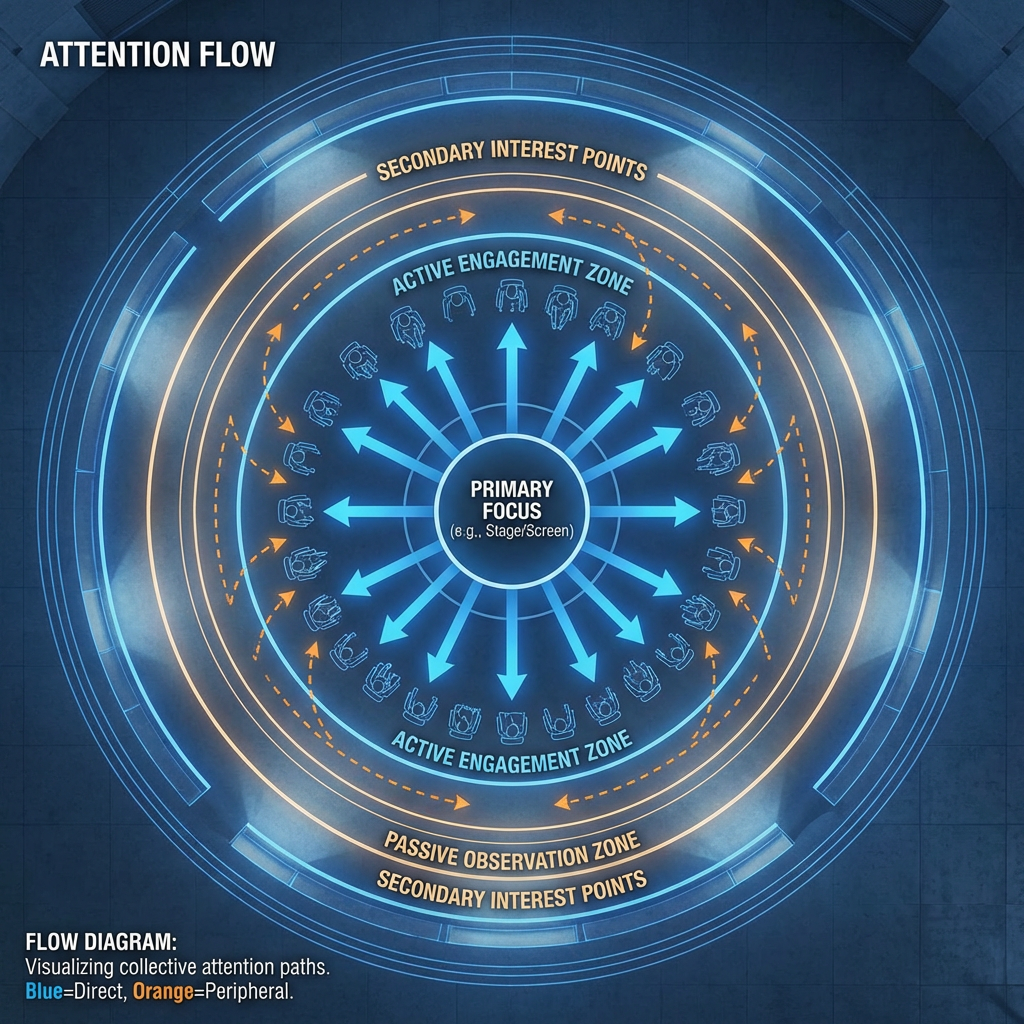
Step 5 — Track the Flow of Attention
Ask: Where does the room’s attention go?
Attention may flow toward:
- the most volatile person
- the most fragile person
- the authority figure
- the person who might erupt
- the person who keeps the peace
Attention reveals the room’s emotional priorities.
Step 6 — Identify the Unspoken Rules
Every room has shadow rules that govern behavior.
Common shadow rules include:
- “Don’t upset them.”
- “Don’t name the real issue.”
- “Stay agreeable.”
- “Don’t outshine the leader.”
- “Keep the peace at all costs.”
- “Don’t show too much emotion.”
Shadow rules reveal the room’s survival logic.
Step 7 — Observe the Role Distribution
Ask: Who is doing what job in the emotional economy?
Common roles include:
- The Regulator
- The Scapegoat
- The Buffer
- The Translator
- The Performer
- The Invisible One
- The Fragile One
- The Authority
- The Pressure Valve
Roles reveal the room’s relational architecture.
Step 8 — Track the Conversational Geometry
Ask: Who speaks? Who interrupts? Who defers? Who collapses?
Geometry reveals:
- hierarchy
- safety
- permission
- power
- emotional dominance
- who must shrink for the room to stay stable
Conversational geometry is the nervous system in motion.
Step 9 — Identify the Field Trigger
Ask: What destabilizes the room?
Common triggers include:
- truth
- boundaries
- silence
- disagreement
- vulnerability
- direct questions
- accountability
- unpredictability
Triggers reveal the room’s unresolved wounds.
Step 10 — Name the Nervous System of the Room
Articulate the structural truth:
- “This room is organized around fragility.”
- “This room is regulated by fear.”
- “This room is pseudo‑calm but tightly controlled.”
- “This room is warm and genuinely regulated.”
- “This room is chaotic and leaderless.”
- “This room is organized around one person’s mood.”
Naming the nervous system restores clarity.
Step 11 — Apply the Field‑Safe Boundary
Your job is not to fix the room — it is to stay intact within it.
Effective boundaries include:
- slowing your pace
- grounding your breath
- refusing urgency
- declining emotional labor
- staying in your own body
- not taking on the room’s regulation
- stepping out if the field is unsafe
Your regulation is not the room’s responsibility.
What This Diagnostic Reveals
- Rooms have nervous systems just like people.
- Your body is the most accurate diagnostic instrument.
- Power, fragility, and suppression shape the field.
- Emotional labor is distributed through predictable roles.
- Shadow rules govern behavior more than stated rules.
- Safety is structural, not sentimental.
Field Impact
Reading the nervous system of a room:
- protects you from absorbing collective dysregulation
- restores your sense of reality
- reveals the architecture beneath group behavior
- strengthens your boundaries and autonomy
- helps you choose where to invest your energy
- allows you to stay regulated in environments that are not
Once you can read the room’s nervous system, you stop mistaking its instability for your inadequacy.
Apple Music
YouTube Music
Amazon Music
Spotify Music

Expanded Toolkit
Explore more topics in the Series Archive.

Leave a Reply