Denied Accommodations
Disabled students routinely face outright denial of legally protected accommodations.
Common denials include:
- extended time on exams
- flexible deadlines
- note‑taking support
- accessible seating
- reduced‑distraction testing rooms
- remote participation options
These aren’t luxuries.
They’re basic access — and institutions still say no.
Delayed Accommodations
Even when accommodations are approved, they often arrive:
- weeks late
- mid‑semester
- after major assignments
- after exams
- after harm has already occurred
A delayed accommodation is functionally a denied accommodation.
Students lose grades, opportunities, and stability while waiting for paperwork to move.
Punitive Implementation
Some accommodations are granted — but implemented in ways that punish the student:
- professors publicly announce accommodations
- students are forced to “prove” disability repeatedly
- extended time requires separate scheduling hoops
- testing centers are far from classrooms
- students must remind instructors every week
- accommodations are framed as burdens
Access becomes a negotiation instead of a right.
Excessive Documentation Demands
Disabled students are asked for:
- new evaluations every semester
- expensive medical letters
- proof of “severity”
- proof of “continuity”
- proof of “impact”
- documentation from specialists they cannot afford
These demands disproportionately harm poor, rural, and chronically ill students.
The system treats disability as something to be doubted, not supported.
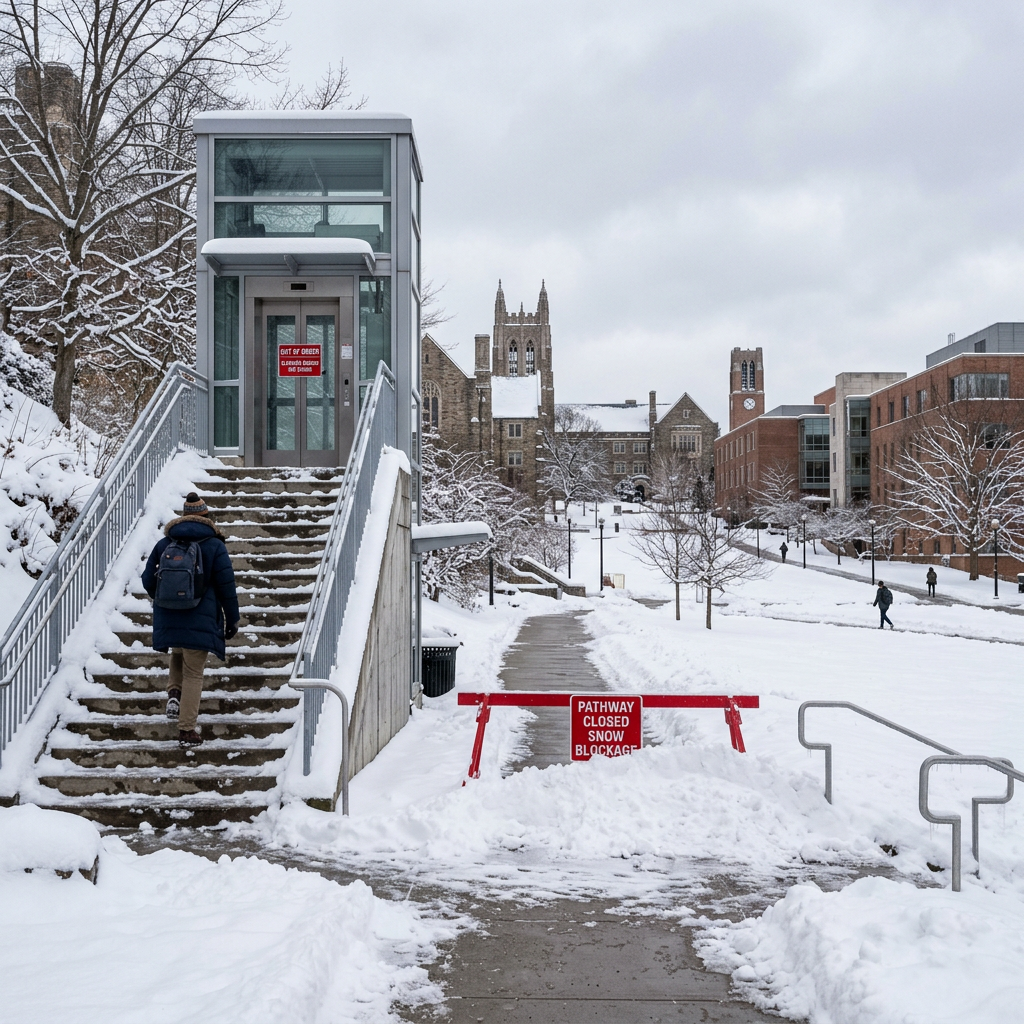
Inaccessible Buildings & Infrastructure
Many campuses still have:
- no elevators
- broken elevators
- inaccessible bathrooms
- steep ramps
- long distances between buildings
- inaccessible emergency procedures
- snow and ice removal failures
Students are told to “just manage,” even when the environment is unsafe.
Professor Noncompliance
Even when accommodations are approved, professors may:
- refuse to implement them
- claim they “don’t believe in accommodations”
- ignore emails
- reduce grades as retaliation
- accuse students of cheating
- shame students for needing support
Students are forced to choose between access and conflict with authority.
The Emotional & Academic Toll
Access failures cause:
- lower grades
- missed deadlines
- increased absences
- worsened symptoms
- burnout
- withdrawal from courses
- dropping out entirely
Disabled students aren’t failing.
They’re being failed.
Who Gets Hurt
These failures disproportionately impact:
- chronically ill students
- neurodivergent students
- mobility‑impaired students
- psychiatric‑disabled students
- students with invisible disabilities
- students without financial or family support
The students who need stability the most face the most instability.
The Result
Disability access failures:
- deny legal rights
- delay support
- punish students
- reinforce stigma
- create academic harm
- increase dropout rates
- protect institutions instead of people
Accommodations are supposed to level the playing field.
Instead, they often become another barrier — another gate — another way the system decides who gets to stay and who gets pushed out.
We Believe You


Apple Music
YouTube Music
Amazon Music
Spotify Music


Explore Mini-Topics


Leave a Reply