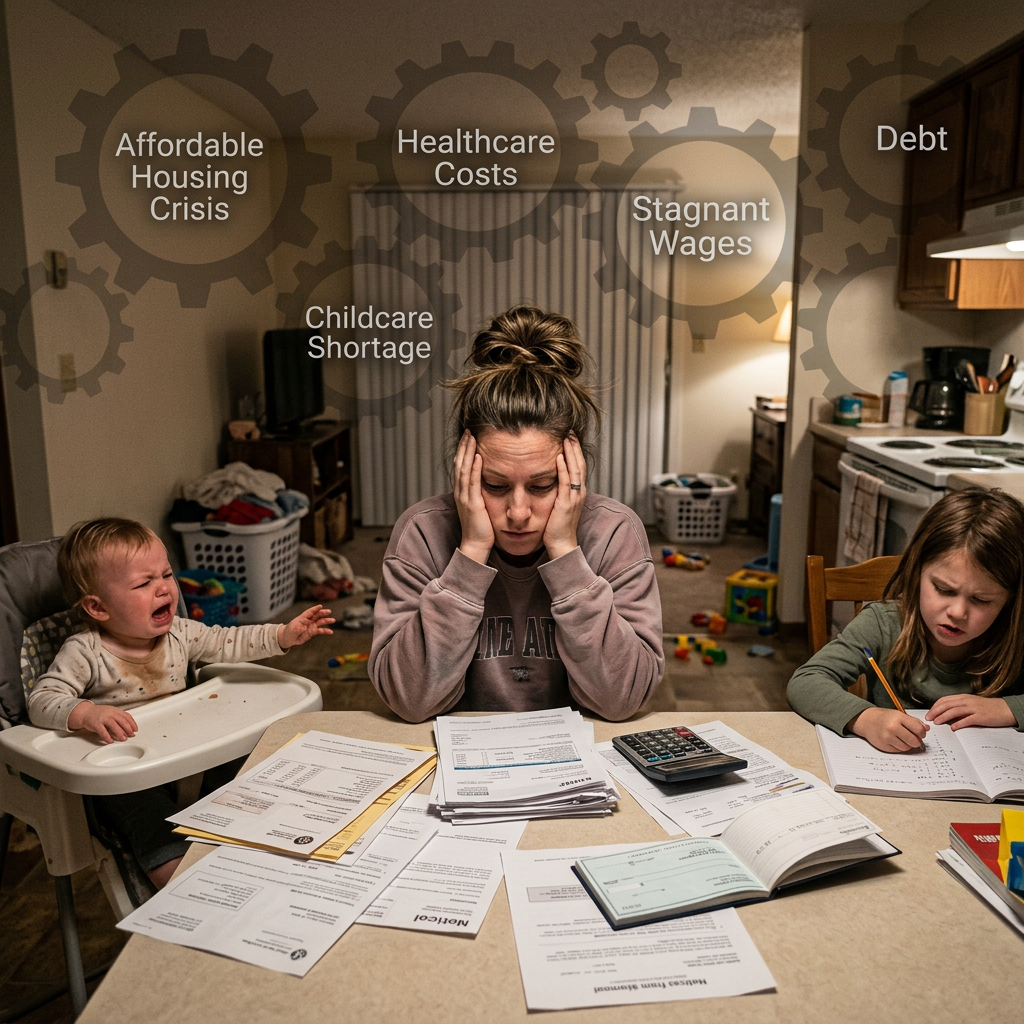

(Why families feel like they’re drowning — and why it’s not a coincidence)
Across this mini‑arc, one truth has become unmistakable:
Parents are not overwhelmed because they’re disorganized, irresponsible, or “bad at parenting.” They’re overwhelmed because the system is designed to keep them vulnerable.
Every mechanism we’ve mapped — ideological, economic, historical, and psychological — points to the same structural architecture.
This is the synthesis.
🧩 1. Ideology Sets the Trap
“Family First” language defines only one family as legitimate:
- heterosexual
- Christian‑coded
- male‑headed
- two‑parent
- financially stable
Everyone else is stigmatized, surveilled, or punished.
This ideology justifies withholding infrastructure by pretending the “ideal family” can absorb everything.
It cannot.
🧩 2. The Third Shift Finishes the Job
Parents already working two full shifts are expected to:
- reteach school
- run interventions
- manage IEPs
- fill academic gaps
- coach regulation
- scaffold executive function
This is clinical labor, offloaded onto exhausted parents at night.
It’s not “engagement.”
It’s outsourcing.
🧩 3. The Cruel Paradox: Repairing Children You Weren’t Allowed to Raise
Parents are expected to fix:
- attachment disruptions
- regulation gaps
- learning delays
- behavioral overwhelm
But these are the same children parents were not allowed to raise because the system forced:
- early separation
- unstable childcare
- survival‑mode households
- chronic stress
The system breaks the foundation, then blames parents for the cracks.
🧩 4. Scarcity Turns Parents Into Enforcers
When every moment is high‑stakes, parents are forced into:
- urgency
- pressure
- compliance
- rushing
- coercion
Not because they want control.
Because the system punishes anything else.
Scarcity steals the conditions required for mentorship and replaces them with enforcement.
🧩 5. The Feminized Captive Labor Pool Holds the Whole System Up
The entire childcare architecture rests on the assumption that women’s labor is:
- free
- infinite
- morally obligated
- expandable
- always available
This is not cultural drift.
It is policy lineage.
When systems collapse, the fallback is always:
“The mother will figure it out.”
This is exploitation disguised as expectation.
🧩 6. Monetizing Children Distorts the Moral Logic of Childhood
Children become:
- funding units
- attendance metrics
- risk profiles
- liabilities
- cost centers
- productivity variables
Childhood becomes:
- a performance
- a compliance test
- an economic calculation
Not a protected developmental stage.
🧩 7. Someone Always Benefits From Parental Vulnerability
Scarcity is not neutral.
It is profitable.
It benefits:
- employers (through labor discipline)
- the state (through unpaid care labor)
- private childcare markets (through desperation)
- insurers (through risk coding)
- schools (through unpaid parental labor)
- grant systems (through pathologizing families)
- patriarchal norms (through maternal overload)
Parental vulnerability is not a side effect.
It is a resource.
🧵 The Human Reality
Parents describe:
- feeling like they’re failing
- feeling like they’re drowning
- feeling like they’re raising children inside a countdown clock
- feeling like collapse always lands on them
- feeling like institutions treat them as liabilities
- feeling like they’re repairing damage they didn’t cause
But the truth is simple:
This is not a parenting crisis. It is a scarcity system — engineered, enforced, and profitable.
📌 Final Closing Line
Families are not collapsing because they’re weak. They’re collapsing because the system is built on their collapse — and calls it “family first.”
We Believe You


Apple Music
YouTube Music
Amazon Music
Spotify Music


Explore Mini-Topics
Leave a Reply