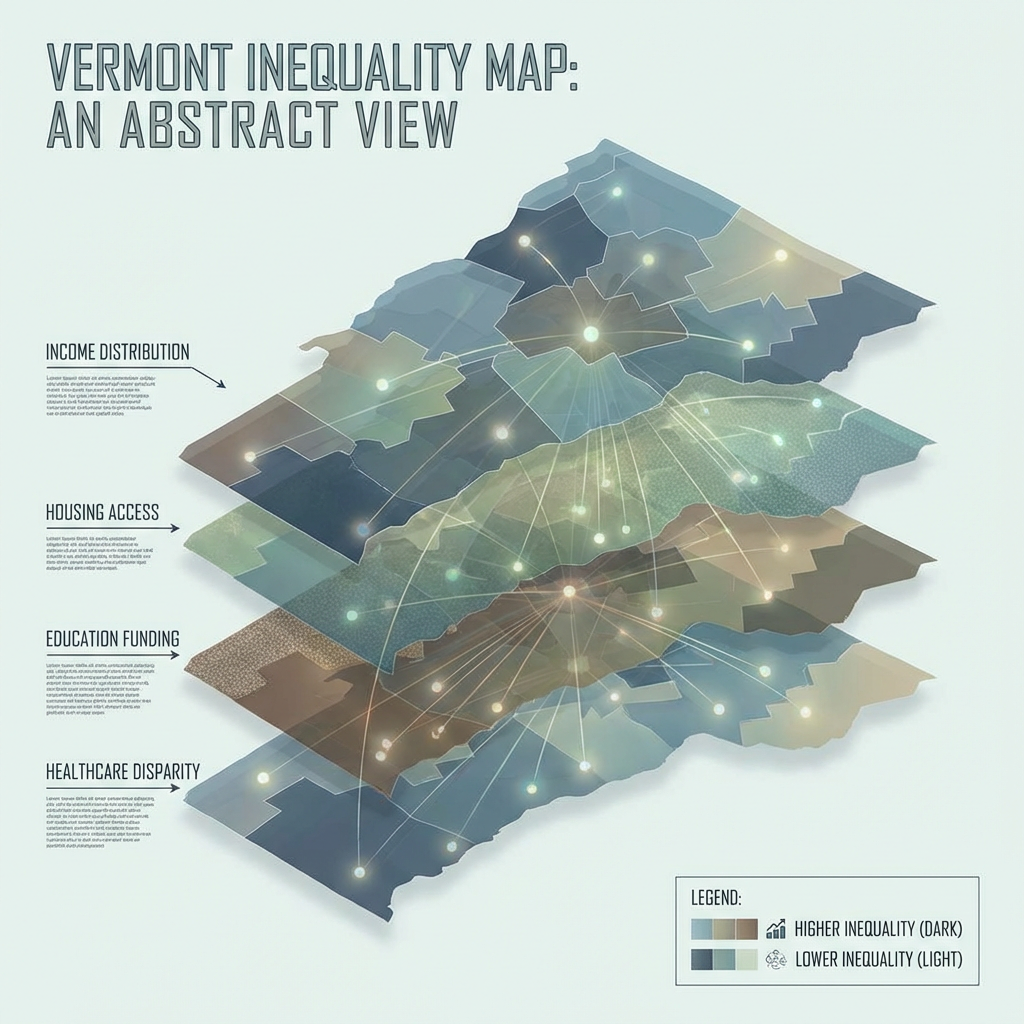
A Structural Profile of Educational Sovereignty
Vermont is defined by three sovereignties:
- Burlington + Chittenden County — liberal‑market governance, suburban technocracy, demographic change
- Small‑Town Vermont (the majority) — white, rural, austerity‑driven, culturally insular
- Northeast Kingdom + Rural North — deep poverty, isolation, conservative‑leaning despite progressive branding
The result is an educational system that is progressive in rhetoric, racially homogeneous in practice, and profoundly shaped by rural austerity and small‑town sovereignty.
1. Identity Policing Index — MEDIUM
Vermont has strong legal protections, but cultural identity policing persists in rural and small‑town districts.
Key Features
- Statewide protections for LGBTQ+ students
- Inclusive curriculum guidance
- Bathroom access aligned with gender identity
- BUT:
- rural districts quietly resist or ignore protections
- teachers face community pressure to avoid LGBTQ+ topics
- book challenges emerging in conservative pockets
- racialized students and queer students report isolation, not explicit policy harm
Structural Meaning
Identity is protected in law, but social homogeneity enforces conformity.
Pledge demanded:
“You may be yourself — but don’t disrupt the town’s sense of itself.”
2. Captivity & Punishment Index — MEDIUM
Vermont’s discipline system is shaped by rural norms, small‑town social control, and racialized disparities despite low diversity.
Key Features
- Police presence lower than national average, but still present in many districts
- Black and immigrant students disproportionately disciplined despite small numbers
- Zero‑tolerance policies persist in rural areas
- Truancy enforcement tied to courts in some counties
- Alternative programs limited, often punitive
- Behavioral issues framed as moral or community‑fit problems
Structural Meaning
Captivity in Vermont is social, not carceral — enforced through community surveillance and exclusion rather than overt policing.
Sovereign: the town, not the state.
3. Social Sorting Index — HIGH
Vermont is one of the most segregated states in the country — not by law, but by demography, housing, and rural geography.
Key Features
- Burlington suburbs operate as quiet fortress districts
- Rural districts face extreme resource disparities
- Gifted programs dominated by white, affluent students
- Tracking embedded in middle and high schools
- Special education over‑identification for immigrant and low‑income students
- Northeast Kingdom deeply underfunded
- Housing patterns reinforce educational caste lines
Structural Meaning
Sorting in Vermont is class + geography + whiteness, engineered through rural austerity and small‑town autonomy.
Pledge demanded:
“Your future is determined by your town’s tax base and your family’s social position.”
4. Curriculum Truthfulness Index — HIGH (on paper), MEDIUM in practice
Vermont’s curriculum standards are strong, but implementation varies by region and cultural comfort.
Key Features
- Mandated teaching of:
- ethnic studies
- Indigenous history
- LGBTQ+ history
- civil rights
- BUT:
- rural districts soften content to maintain community comfort
- Indigenous history taught without sovereignty or land‑back context
- whiteness rarely named as a structure
- teachers self‑censor to avoid conflict in small towns
Structural Meaning
Vermont tells accurate truths, but avoids structural truths that implicate whiteness, land, or rural power.
Truth is allowed when it is cultural, not political.
5. Vermont’s Structural Type
Using your typology, Vermont fits into:
Type 2–3 Hybrid: Progressive‑Facade + Rural‑Austerity Technocracy
- Medium identity policing
- Medium captivity
- High sorting
- High‑on‑paper, medium‑in‑practice curriculum truthfulness
Vermont is a New England rural‑market state, where inequality is engineered through small‑town sovereignty, demographic homogeneity, and resource disparities.
6. What Vermont Reveals About the National System
Vermont exposes the rural‑liberal version of the hostage‑pledge architecture:
- Identity protections exist, but belonging is conditional
- Punishment is social, not always carceral
- Sorting is extreme despite progressive branding
- Curriculum truth is symbolic, not transformative
- Small towns operate as sovereign enclaves
- Burlington carries the burden of demographic and political diversity
- Rural austerity shapes educational opportunity
Vermont is not the progressive haven it markets itself as — it is a rural‑white governance system with a liberal veneer.
7. Vermont’s Hostage‑Pledge Profile (Summary)
| Axis | Rating | Structural Meaning |
|---|---|---|
| Identity Policing | Medium | Legal protections, cultural conformity |
| Captivity & Punishment | Medium | Social exclusion + rural punitive norms |
| Social Sorting | High | Geography + class + whiteness determine futures |
| Curriculum Truthfulness | High/Medium | Strong standards, softened implementation |
8. Narrative Summary
Vermont’s educational system is a New England rural sovereignty regime.
It governs through:
- symbolic inclusion
- social discipline
- geographic and class sorting
- partial truth‑telling
- small‑town autonomy
- rural austerity
- demographic homogeneity
The hostage is the child’s future, shaped by town boundaries and social conformity.
The pledge is compliance with rural norms and the myth of progressive exceptionalism.
The sovereign is the fusion of town governance, suburban wealth, and white‑liberal cultural authority.
Vermont shows what happens when a state markets itself as “progressive” while enacting structural control through geography, whiteness, and small‑town sovereignty.
Apple Music
YouTube Music
Amazon Music
Spotify Music


Explore Mini-Topics
Leave a Reply