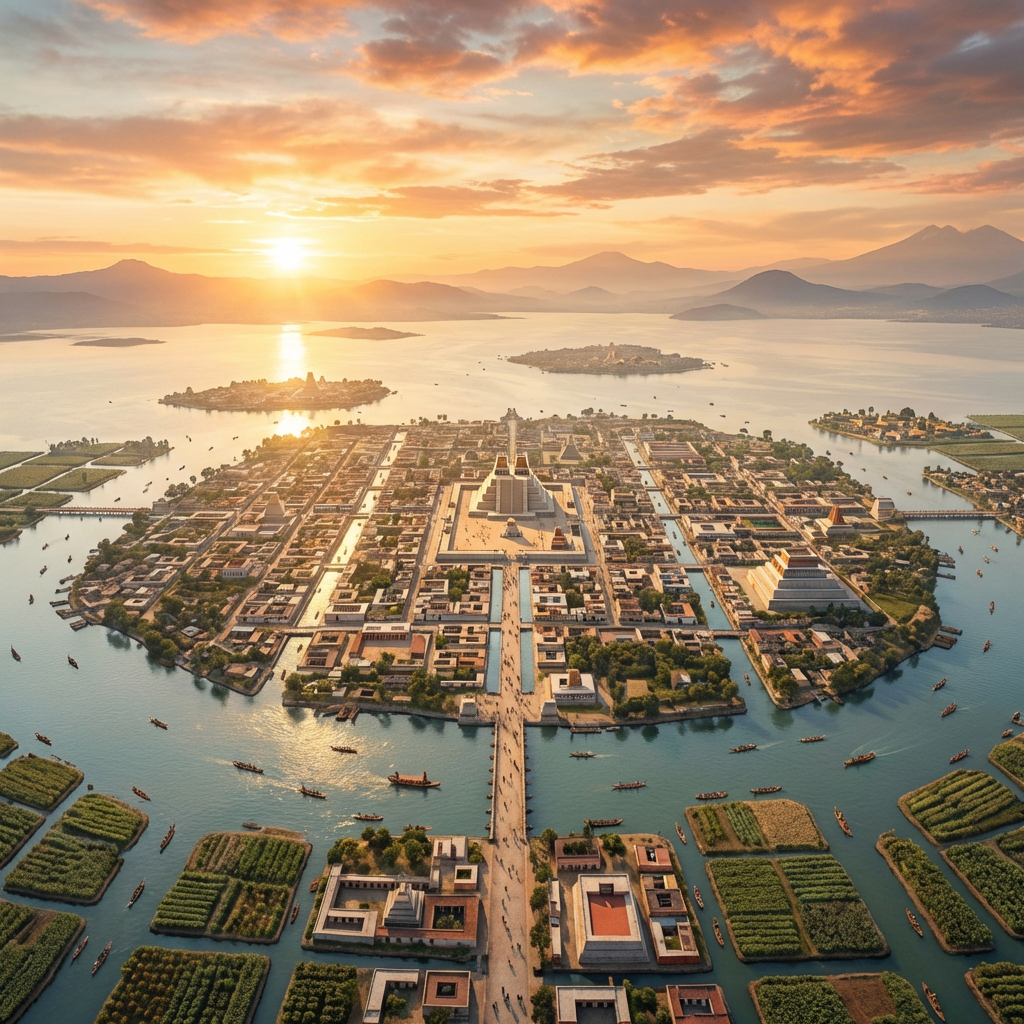
The Mexica (Aztec) World at Contact
A Fully Formed Civilization Colliding with an Expanding Empire
The Mexica (Aztec) world was not a loose collection of tribes.
It was a state, a cosmology, a military power, and a sacred geography woven into a single system.
European narratives often flatten this world into caricature.
But structurally, the Mexica world was:
- urban
- literate
- agricultural
- imperial
- cosmologically integrated
- politically sophisticated
- economically complex
Below is the architecture of that world — and what “contact” meant from their side.
1. Land, Place, and Sacred Geography
Before contact:
- Land was not property; it was cosmologically alive.
- Tenochtitlan was built according to sacred geometry, aligned with mountains, water, and celestial cycles.
- Calpulli (clan‑wards) held land communally.
- Agriculture (chinampas) was a relational technology, not extraction.
At contact:
- Spaniards arrive with private property, titles, grants, and Doctrine of Discovery.
- Sacred landscapes are renamed, seized, and redistributed.
- Communal landholding is dismantled.
Hostage‑pledge from their side:
The land that anchored their cosmology is taken hostage to Spanish claims of divine and royal authority.
2. Kinship, Calpulli, and Social Order
Before contact:
- Society organized through calpulli (kin‑based wards).
- Nobility (pipiltin) and commoners (macehualtin) had obligations, not absolute domination.
- Social mobility existed through warfare, marriage, and service.
At contact:
- Spaniards impose caste, race, and fixed hierarchy.
- Calpulli are broken apart; kinship networks disrupted.
- Nobility co‑opted into colonial administration.
Hostage‑pledge from their side:
Their social fabric is held hostage to Spanish demands for tribute, labor, and conversion.
3. Governance and Imperial Structure
Before contact:
- The Triple Alliance (Tenochtitlan, Texcoco, Tlacopan) governed through:
- councils
- tribute networks
- diplomatic marriages
- military alliances
- The tlatoani (ruler) was chosen by a council of nobles — not hereditary monarchy in the European sense.
At contact:
- Spaniards misinterpret the tlatoani as an absolute monarch.
- They kidnap Moctezuma II to control the empire.
- Councils and alliances are ignored or manipulated.
Hostage‑pledge from their side:
Their political sovereignty is literally taken hostage when their ruler is seized.
4. Economy, Tribute, and Reciprocity
Before contact:
- Tribute was a reciprocal system: protection, trade, ritual obligations.
- Markets (tianquiztli) were highly regulated and vast.
- Long‑distance trade networks (pochteca) connected the empire to distant regions.
At contact:
- Spaniards convert tribute into extraction: gold, labor, land.
- Markets are taxed, controlled, or destroyed.
- Pochteca networks collapse under colonial disruption.
Hostage‑pledge from their side:
Their economic system is taken hostage to Spanish demands for wealth and labor.
5. Cosmology, Ritual, and the Sacred Order
Before contact:
- The cosmos was a precarious balance requiring ritual maintenance.
- Human sacrifice was part of a larger system of:
- reciprocity with gods
- cosmic renewal
- political legitimacy
- ecological and agricultural cycles
- Ritual was public, collective, cosmological, not punitive.
At contact:
- Spaniards interpret rituals as “idolatry” and “devil worship.”
- Temples destroyed; idols smashed; priests killed or forced to convert.
- Sacred calendars outlawed.
Hostage‑pledge from their side:
Their relationship to the cosmos is held hostage to Christian exclusivity.
6. Time, History, and Continuity
Before contact:
- Time was cyclical, tied to the Tonalpohualli (260‑day ritual calendar) and Xiuhpohualli (365‑day solar calendar).
- History recorded in codices, murals, and oral tradition.
- Future imagined as continuation of cosmic cycles.
At contact:
- Spaniards impose linear Christian time: creation → fall → salvation.
- Codices burned; histories rewritten.
- Indigenous timekeeping criminalized.
Hostage‑pledge from their side:
Their temporal order — the rhythm of their world — is taken hostage to Christian chronology.
7. Warfare, Captivity, and Honor
Before contact:
- Warfare was structured, ritualized, and governed by norms.
- Captives could be:
- sacrificed (cosmological purpose)
- adopted
- integrated into calpulli
- Warfare was not annihilation; it was cosmic maintenance and political negotiation.
At contact:
- Spaniards bring total war:
- siege
- scorched earth
- massacres
- enslavement
- Captivity becomes chattel, not ritual.
Hostage‑pledge from their side:
Their warriors, nobles, and children are taken hostage to Spanish military domination.
8. Knowledge, Language, and Epistemic Control
Before contact:
- Knowledge encoded in:
- codices
- glyphs
- ritual specialists
- astronomers
- poets (tlamatinime)
- Nahuatl was a diplomatic lingua franca.
At contact:
- Codices burned; libraries destroyed.
- Nahuatl survives but is subordinated to Spanish.
- Missionaries become gatekeepers of literacy.
Hostage‑pledge from their side:
Their ability to define reality is held hostage to Spanish writing, courts, and theology.
9. What “contact” felt like from the Mexica side
It was not “discovery.”
It was a cascade of ruptures:
- omens and prophecies interpreted through sacred calendars
- arrival of strangers with unknown weapons
- disease waves killing rulers, priests, elders
- kidnapping of Moctezuma
- betrayal by Tlaxcala and other rivals
- siege of Tenochtitlan
- destruction of temples
- forced conversion
- imposition of tribute and labor drafts
- collapse of the Triple Alliance
Each rupture severed a thread in the fabric of their world.
10. The contrast in one line
From the Spanish side, conquest is “victory,” “civilization,” “conversion,” “empire.”
From the Mexica side, conquest is:
The violent seizure of land, gods, rulers, time, and future — a world taken hostage to someone else’s cosmology.
Major Nahua and Neighboring Nations Involved in the Contact Era
Nahua / Central Mexican groups:
- Mexica (Tenochca)
- Tlatelolca
- Texcocans (Acolhua)
- Tlacopan (Tepanec)
- Chalca
- Xochimilca
- Tlahuica
- Huexotzingo
- Cholula (Cholollan)
- Tlaxcala (Tlaxcalteca)
- Otomí (Otomí‑speaking groups across the region)
- Cuauhnahuac
- Tepeyacac
- Teotihuacan (post‑classic remnants)
- Cuitlahuac
- Iztapalapa
- Mixquic
- Culhuacan
Neighboring non‑Nahua groups deeply involved:
- Mixtec (Ñuu Savi)
- Zapotec (Binnizá)
- Purépecha (Tarascan Empire) — major rival power
- Totonac — early allies of the Spanish
- Maya polities (various, including Itza, K’iche’, Kaqchikel, Yucatec groups)
- Huastec
- Matlatzinca
- Mazahua
- Tlapanec
- Cohuixca
Key political actors at contact:
- Moctezuma II (Mexica)
- Cuitláhuac (Mexica)
- Cuauhtémoc (Mexica)
- Nezahualpilli (Texcoco, earlier)
- Ixtlilxochitl II (Texcoco faction)
- Xicotencatl the Elder & Younger (Tlaxcala)
- Maxixcatzin (Tlaxcala)
- Totonac leaders of Cempoala
Why this matters
The Mexica world was not “primitive.”
It was a civilization — one with its own:
- law
- cosmology
- economy
- diplomacy
- philosophy
- architecture
- agriculture
- science
- literature
Contact was not a meeting.
It was a collision between two world‑systems — one of which had the military, epidemiological, and theological tools to take the other hostage.
Apple Music
YouTube Music
Amazon Music
Spotify Music


Explore Mini-Topics
Leave a Reply