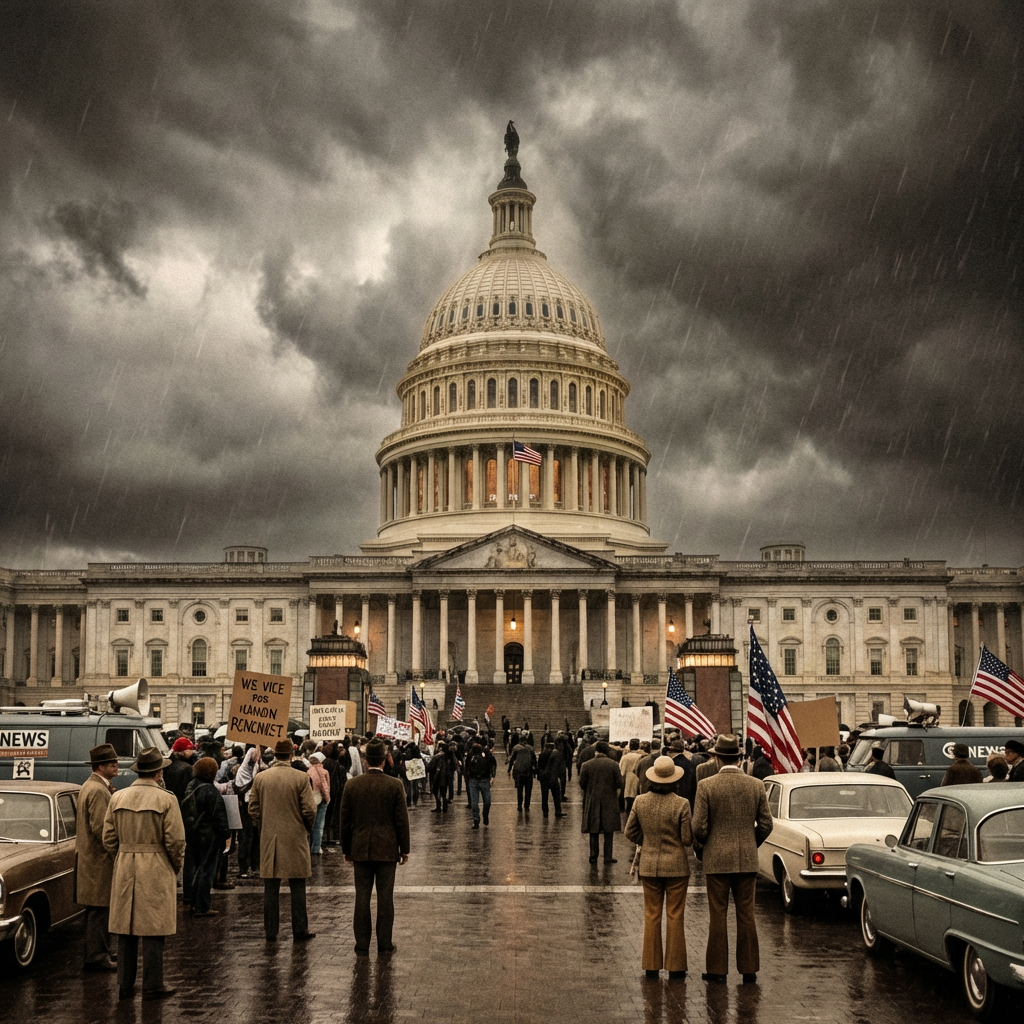
Part XXXIII — The Lyndon B. Johnson Administration: The Great Society, the Second Reconstruction, and the Fracture of the American Project
Lyndon B. Johnson (1963–1969) presided over the most ambitious expansion of American democracy since Reconstruction — and the most catastrophic foreign policy failure in U.S. history.
He inherited Kennedy’s unfinished agenda and attempted to complete it with overwhelming force, legislative mastery, and moral urgency.
Johnson believed government could:
- end poverty
- dismantle segregation
- expand opportunity
- protect the vulnerable
- secure justice
And domestically, he succeeded on a scale unmatched before or since.
But he also escalated the Vietnam War into a national trauma that:
- shattered public trust
- divided the country
- drained resources
- undermined his domestic achievements
Johnson’s presidency is the moment when the founding contradiction — liberty for some, captivity for others — reappears in its most explosive modern form:
A nation that finally attempted to extend full citizenship to all its people simultaneously waged a devastating war abroad and unleashed new forms of inequality and division at home.
To understand Johnson’s presidency, we have to map the forces shaping the era.
The Major Social Forces at Play (1963–1969)
1. The Civil Rights Revolution
Black Americans demanded:
- desegregation
- voting rights
- economic justice
- federal protection
Grassroots movements reshaped national politics.
2. The Persistence of Jim Crow
In the South:
- segregation remained entrenched
- violence escalated
- white resistance hardened
Federal intervention became unavoidable.
3. The War on Poverty
Millions lived in:
- rural poverty
- urban deprivation
- educational inequality
Johnson sought structural solutions.
4. The Vietnam War
Cold War ideology drove:
- escalation
- intervention
- military buildup
The war became a national crisis.
5. The Rise of Youth and Antiwar Movements
A new generation demanded:
- peace
- justice
- cultural transformation
The 1960s were erupting.
6. The Expansion of the Federal State
The Great Society created:
- new agencies
- new programs
- new rights
The federal government became guarantor of social citizenship.
The Contradiction Johnson Inherited
Johnson inherited the same contradiction as his predecessors — but in its mid‑century form:
The United States claimed to be a democracy for all, but millions were excluded by race, poverty, and violence — and the Cold War demanded global projection of power that undermined domestic reform.
Johnson believed government could fix everything.
But the nation’s fractures were deeper than policy.
The Key Events That Exposed the Tension
1. The Civil Rights Act (1964)
Johnson pushed through the most sweeping civil rights law since Reconstruction.
It:
- banned segregation
- outlawed discrimination
- enforced equal access
This was a structural transformation of American law.
2. The Voting Rights Act (1965)
After Selma, Johnson addressed Congress:
“We shall overcome.”
The law:
- ended literacy tests
- authorized federal oversight
- enfranchised millions
This was the Second Reconstruction.
3. The War on Poverty
Johnson launched:
- Medicare
- Medicaid
- Head Start
- food stamps
- federal education funding
- community action programs
This redefined economic citizenship.
4. The Immigration and Nationality Act (1965)
Johnson abolished the racist national‑origins quota system.
This:
- transformed U.S. demographics
- opened immigration from Asia, Africa, Latin America
- redefined national identity
It was one of the most consequential laws of the century.
5. The Vietnam War Escalation
Johnson expanded U.S. involvement dramatically:
- Gulf of Tonkin Resolution (1964)
- troop deployments
- bombing campaigns
The war consumed his presidency.
6. The Antiwar Movement
Students, clergy, veterans, and activists protested:
- the draft
- civilian casualties
- government deception
The nation polarized.
7. The Urban Uprisings (1965–1968)
Cities erupted in response to:
- police brutality
- poverty
- segregation
- broken promises
Johnson’s domestic agenda collided with structural racism.
8. The Kerner Commission (1968)
The commission concluded:
“Our nation is moving toward two societies, one black, one white — separate and unequal.”
Johnson ignored the report.
9. The Assassinations of 1968
The murders of:
- Martin Luther King Jr.
- Robert F. Kennedy
shattered national hope.
10. Johnson’s Withdrawal
In 1968, Johnson announced he would not seek reelection.
The presidency had broken him.
What Johnson’s Administration Reveals
Johnson’s presidency exposes a new dimension of the founding contradiction:
A nation that finally attempted to extend full citizenship to all its people simultaneously waged a war that undermined its moral authority, fractured its society, and destabilized its political order.
His administration reveals:
- civil rights as structural transformation
- poverty as political problem
- war as destroyer of democracy
- federal power as both liberating and coercive
- racial inequality as enduring national structure
Johnson did not resolve the contradiction.
He expanded the promise of American democracy — and exposed the limits of American power.
Why This Matters for the Series
Johnson adds a new layer to the pattern:
- Washington built federal power.
- Adams used federal power to suppress dissent.
- Jefferson used federal power to expand the nation while deepening inequality.
- Madison discovered the limits of constitutional compromise.
- Monroe created the illusion of unity while contradictions intensified.
- John Quincy Adams saw the contradictions clearly but lacked the power to resolve them.
- Andrew Jackson expanded democracy for the majority while intensifying captivity for everyone else.
- Martin Van Buren inherited the consequences — economic collapse and political realignment.
- Harrison & Tyler exposed constitutional ambiguity and accelerated sectional crisis.
- James K. Polk expanded the nation through war, pushing the slavery question to the breaking point.
- Zachary Taylor confronted the crisis directly but died before the nation chose its path.
- Millard Fillmore enforced compromise through coercion, deepening the contradictions.
- Franklin Pierce attempted unity through appeasement, unleashing violence and accelerating collapse.
- James Buchanan presided over the final breakdown of the political system.
- Abraham Lincoln confronted the contradiction directly and transformed the meaning of freedom.
- Andrew Johnson attempted to reverse that transformation, revealing the fragility of freedom.
- Ulysses S. Grant fought to secure Reconstruction against violent resistance.
- Rutherford B. Hayes ended Reconstruction, enabling a new racial order.
- Garfield & Arthur modernized the state while new exclusions emerged.
- Grover Cleveland (First Term) governed as a conservative reformer in an age of corporate power.
- Benjamin Harrison expanded federal authority to confront industrial inequality.
- Grover Cleveland (Second Term) faced economic collapse with tools that no longer fit a modern economy.
- William McKinley ushered in American empire and corporate consolidation.
- Theodore Roosevelt built the modern presidency and expanded federal power.
- William Howard Taft struggled to define the limits of Progressive governance.
- Woodrow Wilson expanded democracy abroad while restricting it at home.
- Harding & Coolidge presided over corporate conservatism and the illusion of stability.
- Herbert Hoover confronted systemic collapse with an ideology built for a different world.
- Franklin D. Roosevelt rebuilt the American state and redefined economic citizenship.
- Harry S. Truman built the national security state and globalized American power.
- Dwight D. Eisenhower consolidated Cold War order and presided over suburban prosperity.
- John F. Kennedy embodied the optimism and contradictions of the early 1960s.
- Lyndon B. Johnson attempted the most ambitious expansion of American democracy since Reconstruction — and simultaneously escalated a war that fractured the nation.
Each administration inherits the fault line.
Each administration reshapes it.
None escape it.
Next comes Richard Nixon — the president who will weaponize the fracture, transform the political landscape, and redefine the relationship between the American people and their government.
Apple Music
YouTube Music
Amazon Music
Spotify Music


Explore Mini-Topics
Leave a Reply