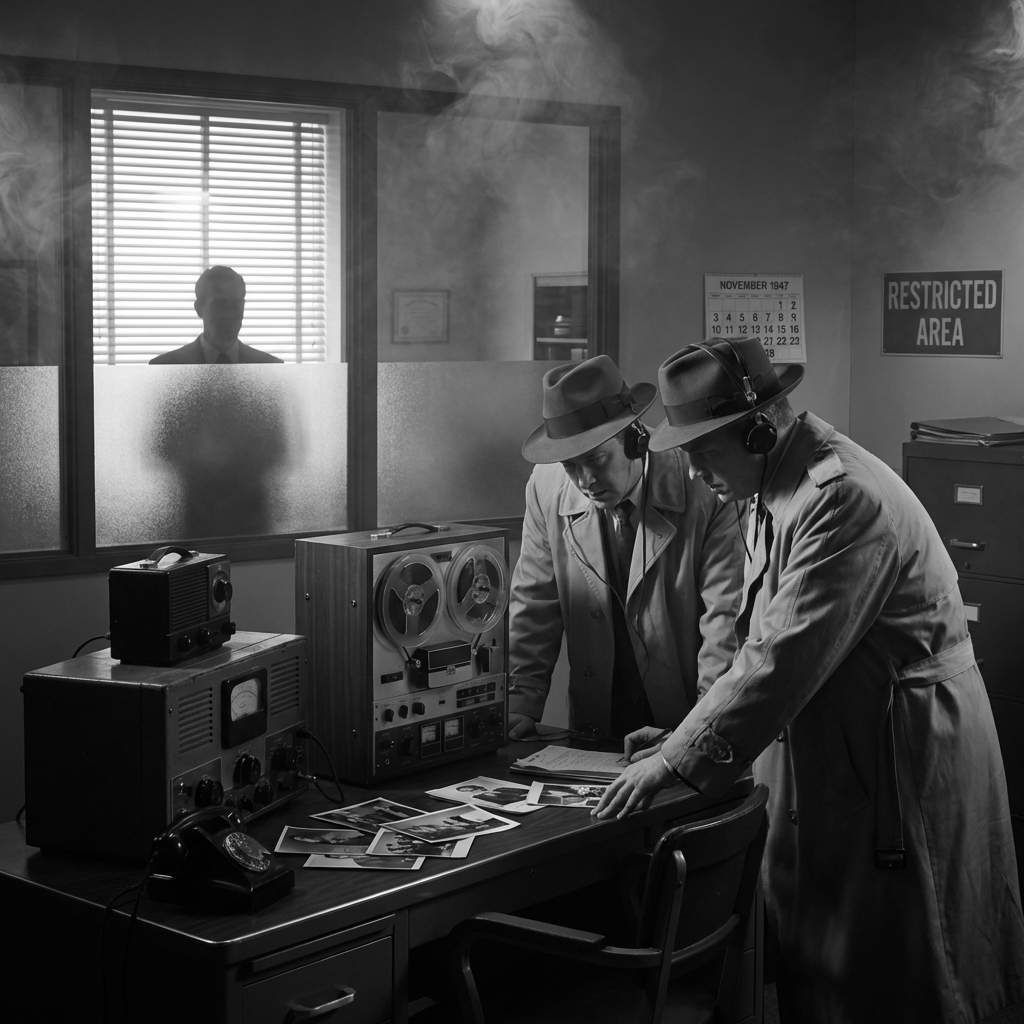
Part XXX — The Harry S. Truman Administration: The Birth of the National Security State and the Racial Fault Lines of Postwar Democracy
Harry S. Truman (1945–1953) inherited the presidency at one of the most consequential moments in world history.
He entered office suddenly, after FDR’s death, with:
- World War II still raging
- the atomic bomb nearly ready
- the global order collapsing
- the New Deal coalition fracturing
- racial tensions rising
- the Cold War beginning
Truman’s presidency is the moment when the founding contradiction — liberty for some, captivity for others — reappears in its Cold War form:
A nation that claimed to lead the “free world” maintained segregation, tolerated racial violence, and built a national security state that restricted civil liberties at home.
To understand Truman’s presidency, we have to map the forces shaping the era.
The Major Social Forces at Play (1945–1953)
1. The End of World War II
The war’s end brought:
- demobilization
- economic transition
- returning veterans
- global devastation
The U.S. emerged as a superpower.
2. The Dawn of the Nuclear Age
The atomic bomb introduced:
- existential threat
- new military strategy
- moral crisis
- global fear
The U.S. held unprecedented destructive power.
3. The Beginning of the Cold War
The U.S. and the Soviet Union competed over:
- ideology
- influence
- military power
- global order
Containment became national doctrine.
4. The Rise of the National Security State
The U.S. created:
- the CIA
- the National Security Council
- the Department of Defense
- permanent military infrastructure
This transformed governance.
5. The Entrenchment of Jim Crow
In the South:
- segregation remained law
- racial violence continued
- Black veterans demanded rights
The contradiction between Cold War rhetoric and domestic reality sharpened.
6. Labor Unrest and Economic Transition
Postwar America saw:
- massive strikes
- inflation
- corporate pushback
- political realignment
The New Deal coalition was fracturing.
The Contradiction Truman Inherited
Truman inherited the same contradiction as his predecessors — but in its Cold War form:
The United States claimed to defend freedom globally while denying full freedom domestically and expanding state surveillance at home.
Truman believed in democracy — but governed in a world that demanded secrecy, militarization, and compromise.
The Key Events That Exposed the Tension
1. The Atomic Bombings of Hiroshima and Nagasaki (1945)
Truman authorized the use of atomic weapons.
This:
- ended the war
- killed hundreds of thousands
- began the nuclear age
The moral and strategic implications were immense.
2. The Truman Doctrine (1947)
Truman declared the U.S. would support nations resisting communism.
This:
- globalized American responsibility
- justified intervention
- framed the Cold War as moral struggle
Freedom became geopolitical.
3. The Marshall Plan (1948)
The U.S. invested billions to rebuild Europe.
This:
- stabilized economies
- contained communism
- expanded U.S. influence
It was economic statecraft on a global scale.
4. The National Security Act (1947)
This law created:
- the CIA
- the NSC
- the Department of Defense
The national security state was institutionalized.
5. Desegregation of the Armed Forces (1948)
Truman issued Executive Order 9981.
This:
- ended segregation in the military
- marked the first major federal civil rights action since Reconstruction
- signaled a shift in national identity
It was a breakthrough — and a political risk.
6. The Fair Deal
Truman proposed:
- national health insurance
- expanded Social Security
- civil rights legislation
- housing programs
Congress blocked much of it.
7. The Taft–Hartley Act (1947)
Congress passed a law restricting labor unions.
Truman vetoed it.
Congress overrode his veto.
The New Deal labor order was weakening.
8. The Berlin Airlift (1948–1949)
The U.S. supplied West Berlin by air during a Soviet blockade.
This:
- demonstrated U.S. resolve
- solidified Cold War divisions
- elevated Truman’s stature
9. The Recognition of Israel (1948)
Truman recognized the new state of Israel.
This reshaped:
- Middle Eastern politics
- U.S. foreign policy
- global alliances
10. The Korean War (1950–1953)
The U.S. intervened under the UN flag.
The war:
- expanded the Cold War
- militarized containment
- normalized permanent mobilization
It also exposed limits of presidential power.
11. McCarthyism and Loyalty Programs
Truman established loyalty reviews for federal employees.
This:
- expanded surveillance
- legitimized suspicion
- fueled anti‑communist hysteria
McCarthy exploited the environment Truman helped create.
What Truman’s Administration Reveals
Truman’s presidency exposes a new dimension of the founding contradiction:
A nation that claimed to lead the free world built a national security state that restricted freedom at home and maintained racial hierarchy even as it began dismantling it.
His administration reveals:
- democracy as global project
- militarization as permanent condition
- civil rights as emerging national priority
- surveillance as tool of governance
- racial inequality as unresolved fault line
Truman did not resolve the contradiction.
He globalized it — and began the long struggle to reconcile American ideals with American realities.
Why This Matters for the Series
Truman adds a new layer to the pattern:
- Washington built federal power.
- Adams used federal power to suppress dissent.
- Jefferson used federal power to expand the nation while deepening inequality.
- Madison discovered the limits of constitutional compromise.
- Monroe created the illusion of unity while contradictions intensified.
- John Quincy Adams saw the contradictions clearly but lacked the power to resolve them.
- Andrew Jackson expanded democracy for the majority while intensifying captivity for everyone else.
- Martin Van Buren inherited the consequences — economic collapse and political realignment.
- Harrison & Tyler exposed constitutional ambiguity and accelerated sectional crisis.
- James K. Polk expanded the nation through war, pushing the slavery question to the breaking point.
- Zachary Taylor confronted the crisis directly but died before the nation chose its path.
- Millard Fillmore enforced compromise through coercion, deepening the contradictions.
- Franklin Pierce attempted unity through appeasement, unleashing violence and accelerating collapse.
- James Buchanan presided over the final breakdown of the political system.
- Abraham Lincoln confronted the contradiction directly and transformed the meaning of freedom.
- Andrew Johnson attempted to reverse that transformation, revealing the fragility of freedom.
- Ulysses S. Grant fought to secure Reconstruction against violent resistance.
- Rutherford B. Hayes ended Reconstruction, enabling a new racial order.
- Garfield & Arthur modernized the state while new exclusions emerged.
- Grover Cleveland (First Term) governed as a conservative reformer in an age of corporate power.
- Benjamin Harrison expanded federal authority to confront industrial inequality.
- Grover Cleveland (Second Term) faced economic collapse with tools that no longer fit a modern economy.
- William McKinley ushered in American empire and corporate consolidation.
- Theodore Roosevelt built the modern presidency and expanded federal power.
- William Howard Taft struggled to define the limits of Progressive governance.
- Woodrow Wilson expanded democracy abroad while restricting it at home.
- Harding & Coolidge presided over corporate conservatism and the illusion of stability.
- Herbert Hoover confronted systemic collapse with an ideology built for a different world.
- Franklin D. Roosevelt rebuilt the American state and redefined economic citizenship.
- Harry S. Truman built the national security state, globalized American power, and exposed the contradiction between Cold War ideals and domestic inequality.
Each administration inherits the fault line.
Each administration reshapes it.
None escape it.
Next comes Dwight D. Eisenhower — the president who will consolidate the Cold War order, expand the middle class, and preside over the quiet but seismic beginnings of the civil rights movement.
Apple Music
YouTube Music
Amazon Music
Spotify Music


Explore Mini-Topics
Leave a Reply