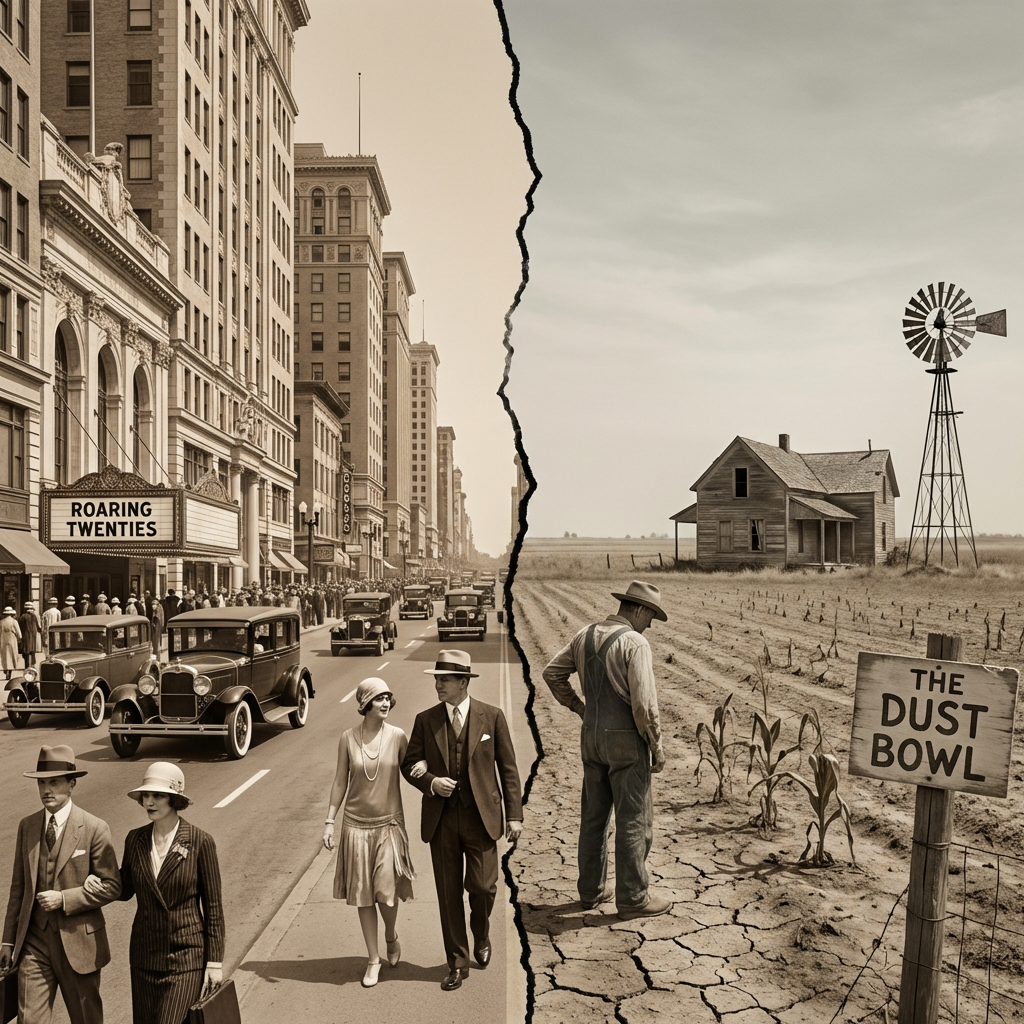
Part XXVII — The Harding & Coolidge Administrations: Normalcy, Corporate Conservatism, and the Illusion of Stability
The presidencies of Warren G. Harding (1921–1923) and Calvin Coolidge (1923–1929) define the political character of the 1920s — an era of economic expansion, cultural transformation, racial violence, and deep structural inequality.
Harding promised a “return to normalcy” after the upheavals of Progressivism and World War I.
Coolidge promised that “the business of America is business.”
Together, they presided over a decade that appeared prosperous on the surface but was riddled with contradictions beneath.
Their administrations are the moment when the founding contradiction — liberty for some, captivity for others — reappears in its modern economic form:
A nation that celebrated individual freedom and consumer prosperity built an economic order that concentrated wealth, suppressed labor, and entrenched racial hierarchy.
To understand the Harding–Coolidge era, we have to map the forces shaping the decade.
The Major Social Forces at Play (1921–1929)
1. Postwar Disillusionment
After World War I, Americans sought:
- stability
- predictability
- economic growth
- cultural retreat
Harding’s “normalcy” captured this mood.
2. Corporate Ascendancy
The 1920s economy was dominated by:
- industrial giants
- financial conglomerates
- mass production
- consumer credit
Corporate power shaped national life.
3. The Entrenchment of Jim Crow
In the South:
- segregation was total
- Black disenfranchisement was complete
- racial violence continued
Federal silence remained policy.
4. The Great Migration and Northern Racism
Black Americans moved north seeking opportunity.
White backlash followed.
The 1920s saw:
- race riots
- housing segregation
- employment discrimination
The racial order adapted to new geography.
5. The Rise of the Second Ku Klux Klan
The Klan expanded nationally, fueled by:
- nativism
- white supremacy
- anti‑Catholic and anti‑Jewish sentiment
It became a political force.
6. Immigration Restriction
The U.S. imposed:
- national quotas
- racialized exclusions
- eugenic logic
The nation defined itself through exclusion.
7. Cultural Transformation
The 1920s saw:
- jazz
- cinema
- mass advertising
- women’s changing roles
Modernity collided with tradition.
The Contradiction Harding & Coolidge Inherited
They inherited the same contradiction as their predecessors — but in its 1920s form:
The United States celebrated freedom and prosperity while building an economic and racial order that excluded millions from both.
Harding and Coolidge believed government should be small.
The modern economy required something else.
The Key Events That Exposed the Tension
1. Harding’s “Return to Normalcy”
Harding promised:
- limited government
- business cooperation
- reduced regulation
This was a retreat from Progressive reform.
2. The Budget and Accounting Act (1921)
Harding created:
- the Bureau of the Budget
- the modern federal budgeting process
This strengthened administrative capacity even as he preached small government.
3. The Teapot Dome Scandal
Harding’s administration was rocked by:
- bribery
- corruption
- secret oil leases
This exposed the dangers of business‑government intimacy.
4. Immigration Restriction (1921 & 1924)
The Emergency Quota Act (1921) and the Immigration Act (1924):
- imposed national quotas
- favored Northern Europeans
- excluded Asians
- institutionalized racial hierarchy
This was eugenics as national policy.
5. The Klan’s Political Influence
The Klan:
- elected governors
- influenced Congress
- shaped local politics
Harding and Coolidge did not confront it.
6. Coolidge’s Ascension and Philosophy
After Harding’s death, Coolidge became president.
He believed:
- government should be minimal
- markets should be free
- business was the nation’s engine
He embodied 1920s conservatism.
7. Tax Cuts and Corporate Power
Coolidge:
- slashed taxes on the wealthy
- reduced corporate regulation
- encouraged business expansion
This fueled economic growth — and inequality.
8. The Farm Crisis
While cities prospered, farmers faced:
- falling prices
- rising debt
- foreclosures
Coolidge vetoed farm relief bills.
9. The Stock Market Boom
Speculation soared due to:
- easy credit
- weak regulation
- investor optimism
The seeds of the Great Depression were planted.
What the Harding–Coolidge Era Reveals
This era exposes a new dimension of the founding contradiction:
A nation that celebrated prosperity and freedom built an economic order that was unstable, unequal, and exclusionary — and a racial order that remained violently hierarchical.
Their administrations reveal:
- conservatism as ideology of stability
- prosperity as illusion
- racial hierarchy as national structure
- corporate power as governing force
- small government as inadequate for modern complexity
Harding and Coolidge did not resolve the contradiction.
They presided over its transformation into economic fragility.
Why This Matters for the Series
Harding & Coolidge add a new layer to the pattern:
- Washington built federal power.
- Adams used federal power to suppress dissent.
- Jefferson used federal power to expand the nation while deepening inequality.
- Madison discovered the limits of constitutional compromise.
- Monroe created the illusion of unity while contradictions intensified.
- John Quincy Adams saw the contradictions clearly but lacked the power to resolve them.
- Andrew Jackson expanded democracy for the majority while intensifying captivity for everyone else.
- Martin Van Buren inherited the consequences — economic collapse and political realignment.
- Harrison & Tyler exposed constitutional ambiguity and accelerated sectional crisis.
- James K. Polk expanded the nation through war, pushing the slavery question to the breaking point.
- Zachary Taylor confronted the crisis directly but died before the nation chose its path.
- Millard Fillmore enforced compromise through coercion, deepening the contradictions.
- Franklin Pierce attempted unity through appeasement, unleashing violence and accelerating collapse.
- James Buchanan presided over the final breakdown of the political system.
- Abraham Lincoln confronted the contradiction directly and transformed the meaning of freedom.
- Andrew Johnson attempted to reverse that transformation, revealing the fragility of freedom.
- Ulysses S. Grant fought to secure Reconstruction against violent resistance.
- Rutherford B. Hayes ended Reconstruction, enabling a new racial order.
- Garfield & Arthur modernized the state while new exclusions emerged.
- Grover Cleveland (First Term) governed as a conservative reformer in an age of corporate power.
- Benjamin Harrison expanded federal authority to confront industrial inequality.
- Grover Cleveland (Second Term) faced economic collapse with tools that no longer fit a modern economy.
- William McKinley ushered in American empire and corporate consolidation.
- Theodore Roosevelt built the modern presidency and expanded federal power.
- William Howard Taft struggled to define the limits of Progressive governance.
- Woodrow Wilson expanded democracy abroad while restricting it at home.
- Harding & Coolidge presided over corporate conservatism, racial exclusion, and the illusion of economic stability that preceded collapse.
Each administration inherits the fault line.
Each administration reshapes it.
None escape it.
Next comes Herbert Hoover — the president who will face the collapse of the 1920s order and the limits of American individualism.
Apple Music
YouTube Music
Amazon Music
Spotify Music


Explore Mini-Topics
Leave a Reply