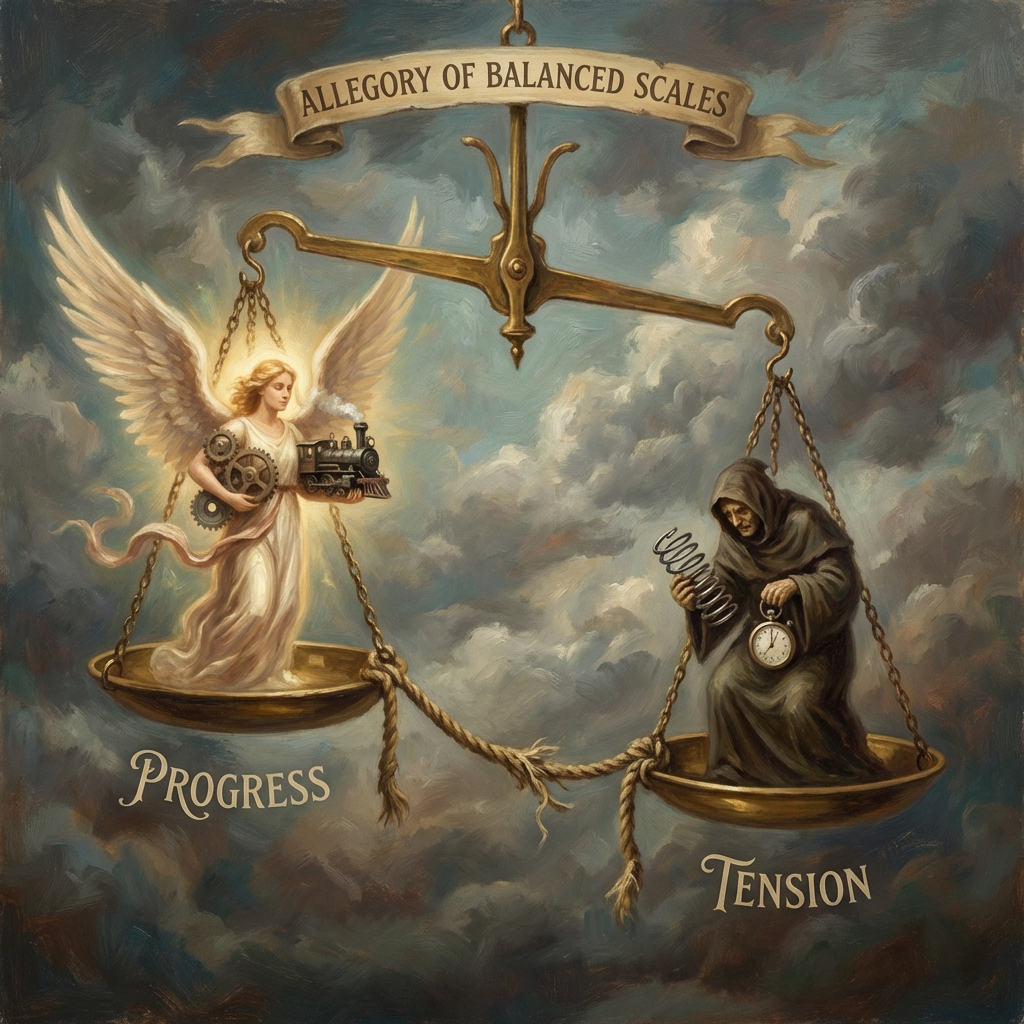
Part XXIX — The Franklin D. Roosevelt Administration: The Reconstruction of the American State and the Rewriting of Economic Citizenship
Franklin D. Roosevelt (1933–1945) presided over the most sweeping transformation of American governance since the Civil War.
He inherited a nation in ruins — economically shattered, politically disillusioned, socially fractured — and he responded by building a new architecture of federal power, economic security, and democratic identity.
FDR’s presidency is the moment when the founding contradiction — liberty for some, captivity for others — reappears in its modern social‑democratic form:
A nation that claimed to guarantee freedom discovered that freedom required economic security, public investment, and collective action — but extended these guarantees unevenly across racial and social lines.
To understand Roosevelt’s presidency, we have to map the forces shaping the era.
The Major Social Forces at Play (1933–1945)
1. The Great Depression
The crisis involved:
- mass unemployment
- bank failures
- hunger and homelessness
- collapsing demand
- deflation
The old economic order had failed.
2. The Collapse of Laissez‑Faire Governance
The federal government lacked:
- social insurance
- labor protections
- regulatory capacity
- public welfare systems
The crisis demanded a new state.
3. The Rise of Organized Labor
Workers demanded:
- collective bargaining
- fair wages
- workplace protections
Labor became a central political force.
4. The Entrenchment of Jim Crow
In the South:
- segregation was total
- Black workers were excluded from many New Deal programs
- racial violence continued
The New Deal was built on a racial compromise.
5. The Growth of Federal Administration
The New Deal created:
- new agencies
- new regulatory powers
- new social programs
The modern administrative state was born.
6. The Rise of Fascism and World War II
Global forces reshaped:
- the economy
- national identity
- foreign policy
- the meaning of democracy
The U.S. became a global superpower.
The Contradiction FDR Inherited
FDR inherited the same contradiction as his predecessors — but in its social‑democratic form:
The United States claimed to guarantee freedom, but millions lacked the economic security necessary to exercise it.
FDR believed government must secure the conditions of freedom.
But he built this new order through compromises that preserved racial hierarchy.
The Key Events That Exposed the Tension
1. The First New Deal (1933–1935)
FDR launched a wave of emergency programs:
- bank holiday
- FDIC
- public works (CCC, PWA)
- agricultural supports
- industrial codes (NRA)
This stabilized the economy and restored confidence.
2. The Second New Deal (1935–1938)
This phase created the core of the modern welfare state:
- Social Security
- unemployment insurance
- the Wagner Act (labor rights)
- the Works Progress Administration
This redefined economic citizenship.
3. The Racial Architecture of the New Deal
To secure Southern support, FDR:
- excluded agricultural and domestic workers from Social Security
- allowed local control of relief programs
- tolerated segregation in federal programs
The New Deal expanded freedom — but unevenly.
4. The Rise of Organized Labor
The Wagner Act empowered unions.
The CIO organized millions.
Labor became a pillar of the Democratic coalition.
5. The Court‑Packing Plan (1937)
FDR attempted to reshape the Supreme Court after it struck down New Deal laws.
The plan failed politically but succeeded indirectly:
- the Court shifted
- New Deal legislation survived
This revealed the limits of presidential power.
6. The Four Freedoms (1941)
FDR articulated a new vision of democracy:
- freedom of speech
- freedom of worship
- freedom from want
- freedom from fear
This was a moral redefinition of American identity.
7. World War II Mobilization
The war required:
- full employment
- industrial planning
- rationing
- federal coordination
The Depression ended through public mobilization.
8. Japanese American Incarceration
FDR authorized the internment of 120,000 Japanese Americans.
This was:
- racialized
- unconstitutional
- a profound violation of civil liberties
The contradiction of wartime democracy was exposed.
9. The Arsenal of Democracy
The U.S. became:
- the world’s industrial engine
- the leader of the Allied coalition
- the architect of postwar order
The nation emerged transformed.
10. The GI Bill (1944)
This law:
- expanded education
- subsidized homeownership
- built the middle class
But it was administered locally, reinforcing racial inequality.
What FDR’s Administration Reveals
FDR’s presidency exposes a new dimension of the founding contradiction:
A nation that sought to guarantee freedom discovered that freedom required economic security — but extended that security unevenly, reinforcing racial hierarchy even as it expanded opportunity.
His administration reveals:
- the rise of the social state
- the limits of racial compromise
- the power of collective action
- the fragility of civil liberties
- the emergence of the U.S. as global leader
FDR did not resolve the contradiction.
He built the architecture through which later generations would confront it.
Why This Matters for the Series
FDR adds a new layer to the pattern:
- Washington built federal power.
- Adams used federal power to suppress dissent.
- Jefferson used federal power to expand the nation while deepening inequality.
- Madison discovered the limits of constitutional compromise.
- Monroe created the illusion of unity while contradictions intensified.
- John Quincy Adams saw the contradictions clearly but lacked the power to resolve them.
- Andrew Jackson expanded democracy for the majority while intensifying captivity for everyone else.
- Martin Van Buren inherited the consequences — economic collapse and political realignment.
- Harrison & Tyler exposed constitutional ambiguity and accelerated sectional crisis.
- James K. Polk expanded the nation through war, pushing the slavery question to the breaking point.
- Zachary Taylor confronted the crisis directly but died before the nation chose its path.
- Millard Fillmore enforced compromise through coercion, deepening the contradictions.
- Franklin Pierce attempted unity through appeasement, unleashing violence and accelerating collapse.
- James Buchanan presided over the final breakdown of the political system.
- Abraham Lincoln confronted the contradiction directly and transformed the meaning of freedom.
- Andrew Johnson attempted to reverse that transformation, revealing the fragility of freedom.
- Ulysses S. Grant fought to secure Reconstruction against violent resistance.
- Rutherford B. Hayes ended Reconstruction, enabling a new racial order.
- Garfield & Arthur modernized the state while new exclusions emerged.
- Grover Cleveland (First Term) governed as a conservative reformer in an age of corporate power.
- Benjamin Harrison expanded federal authority to confront industrial inequality.
- Grover Cleveland (Second Term) faced economic collapse with tools that no longer fit a modern economy.
- William McKinley ushered in American empire and corporate consolidation.
- Theodore Roosevelt built the modern presidency and expanded federal power.
- William Howard Taft struggled to define the limits of Progressive governance.
- Woodrow Wilson expanded democracy abroad while restricting it at home.
- Harding & Coolidge presided over corporate conservatism and the illusion of stability.
- Herbert Hoover confronted systemic collapse with an ideology built for a different world.
- Franklin D. Roosevelt rebuilt the American state, redefined economic citizenship, and created a new social contract — while preserving racial hierarchy within it.
Each administration inherits the fault line.
Each administration reshapes it.
None escape it.
Next comes Harry S. Truman — the president who will confront the dawn of the nuclear age, the Cold War, and the unfinished business of the New Deal.
Apple Music
YouTube Music
Amazon Music
Spotify Music


Explore Mini-Topics
Leave a Reply