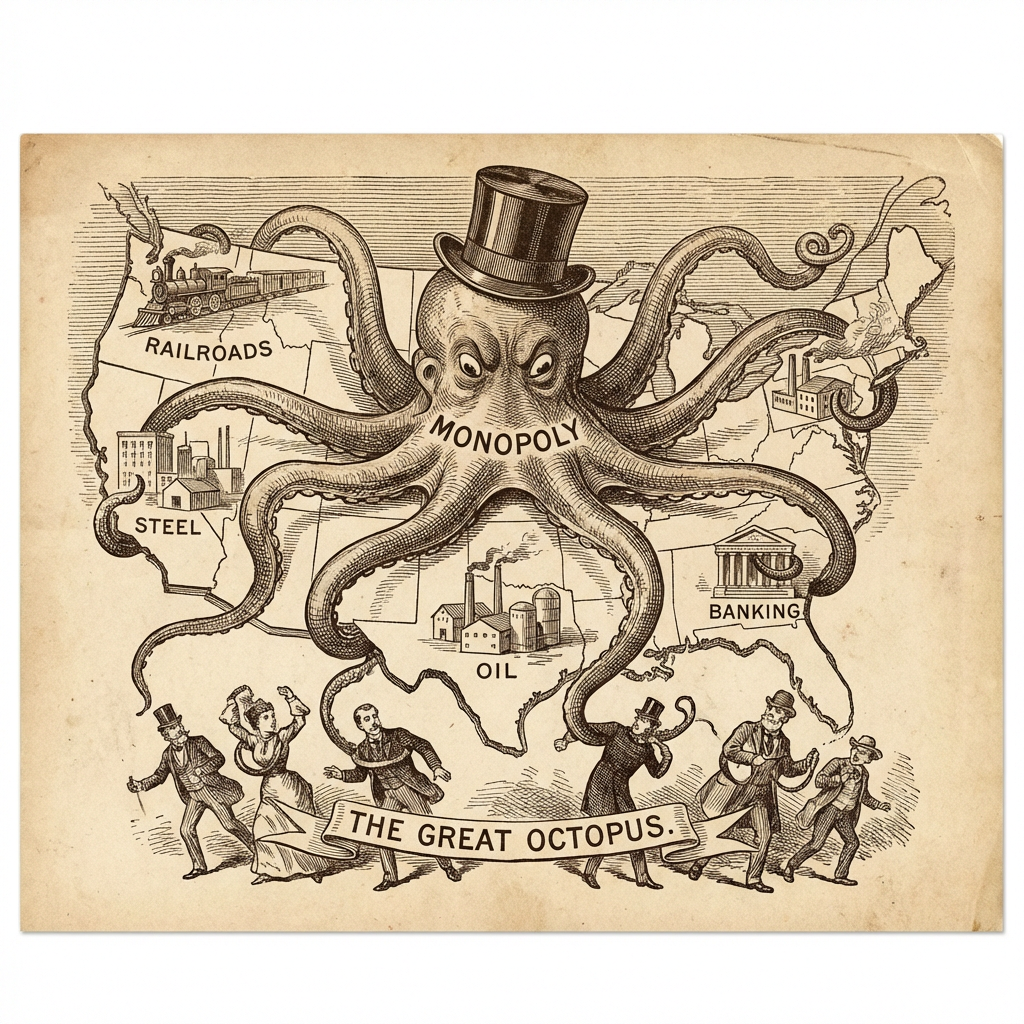
Part XXI — The Benjamin Harrison Administration: The Rise of the Regulatory State and the Deepening of Industrial Inequality
Benjamin Harrison (1889–1893) governed at a moment when the United States was transforming from a post‑Civil War republic into an industrial empire.
The old political questions of slavery and Reconstruction had given way to new questions about corporate power, labor rights, racial exclusion, and the role of the federal government in a modern economy.
Harrison’s presidency is the moment when the federal government first attempted to regulate the new industrial order — even as the social and racial hierarchies of the post‑Reconstruction era hardened.
To understand Harrison’s administration, we have to map the forces shaping the era.
The Major Social Forces at Play (1889–1893)
1. The Rise of Industrial Monopolies
The Gilded Age economy was dominated by:
- railroad conglomerates
- steel trusts
- oil monopolies
- financial syndicates
Corporate power was eclipsing state power.
2. The Consolidation of Jim Crow
In the South:
- segregation laws expanded
- Black voting collapsed
- racial violence intensified
- federal oversight was absent
The racial order built after Reconstruction was now fully entrenched.
3. Labor Unrest and Class Conflict
Workers faced:
- long hours
- dangerous conditions
- low wages
- corporate repression
Strikes were becoming national crises.
4. The Rise of Populism
Farmers and workers demanded:
- monetary reform
- railroad regulation
- anti‑trust action
- political representation
A new political movement was emerging.
5. Immigration and Urban Growth
Cities were swelling with:
- European immigrants
- industrial laborers
- overcrowded tenements
- ethnic tensions
Urban America was becoming the nation’s center of gravity.
6. The Expansion of Federal Authority
The federal government was beginning to:
- regulate commerce
- intervene in labor disputes
- manage economic policy
The modern administrative state was taking shape.
The Contradiction Harrison Inherited
Harrison inherited the same contradiction as his predecessors — but in its industrial form:
The United States claimed to be a democracy of equal citizens, but its economy was producing unprecedented concentrations of wealth and power.
Harrison believed the federal government had a role in addressing this — but only within the limits of 19th‑century constitutionalism.
The Key Events That Exposed the Tension
1. The Sherman Antitrust Act (1890)
Harrison signed the first federal law aimed at:
- breaking up monopolies
- regulating corporate power
- protecting competition
It was a landmark — but weakly enforced.
The federal government had taken its first step into economic regulation.
2. The Sherman Silver Purchase Act (1890)
To appease Western and Southern interests, Congress passed a law requiring the government to purchase silver.
This:
- expanded the money supply
- pleased silver miners
- worried Eastern bankers
- destabilized financial markets
Monetary policy became a political battleground.
3. The McKinley Tariff (1890)
This tariff:
- raised rates to historically high levels
- protected industrial interests
- increased consumer prices
- triggered public backlash
It contributed to Republican losses in the midterms.
4. The Rise of the Populist Movement
Farmers and workers organized around:
- anti‑
Apple Music
YouTube Music
Amazon Music
Spotify Music


Explore Mini-Topics
Leave a Reply