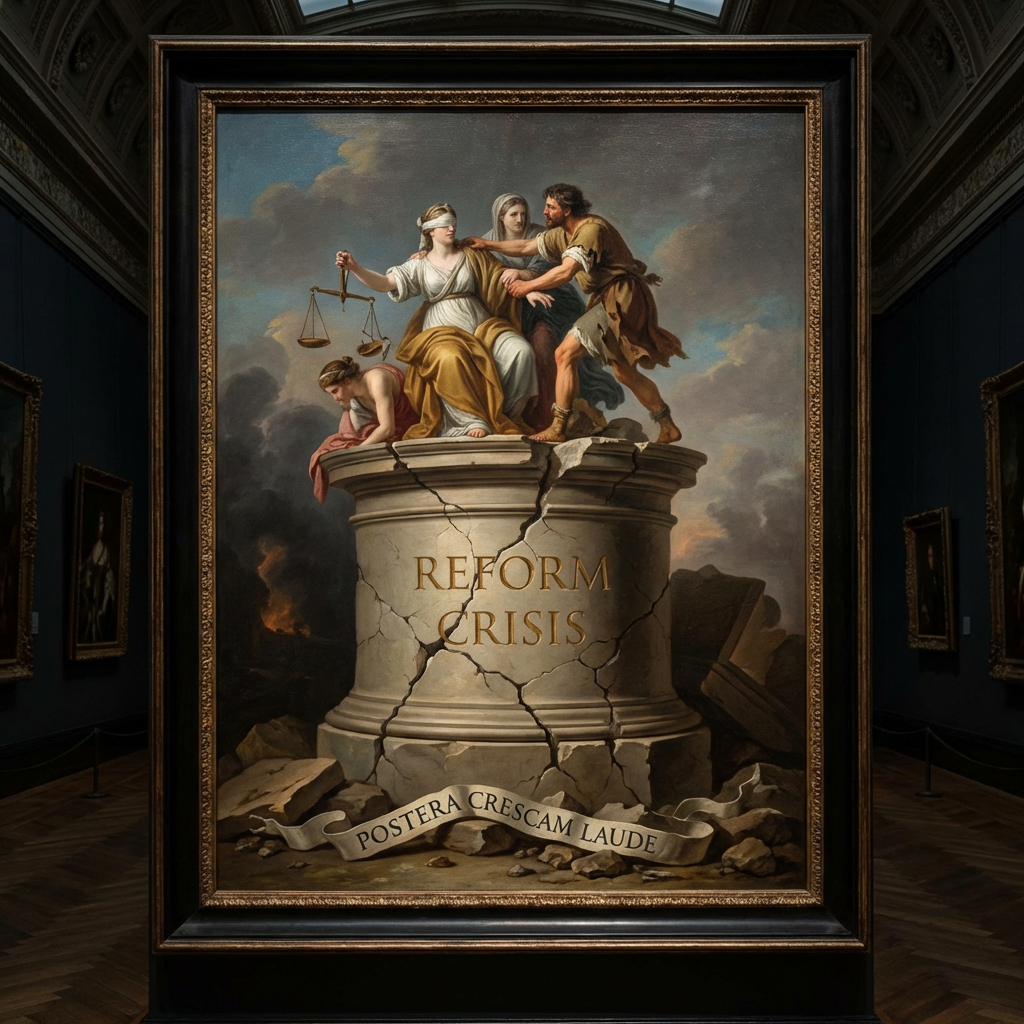
Part XIX — The Garfield & Arthur Administrations: Reform, Assassination, and the Slow Turn Toward the Modern State
The period from 1881 to 1885 — spanning the brief presidency of James A. Garfield and the unexpected presidency of Chester A. Arthur — marks a transition between two political worlds.
It is the moment when:
- the Civil War generation is fading
- Reconstruction has ended
- industrial capitalism is accelerating
- political patronage is collapsing
- the federal government is beginning to modernize
Garfield enters office as a reform-minded Republican determined to challenge the patronage system.
Arthur enters office as a product of that system — and ends up dismantling it.
This era reveals a new dimension of the American contradiction:
A nation that expanded freedom through constitutional amendments was now building an economic order that produced new forms of inequality and dependency.
To understand this period, we have to map the forces shaping the era.
The Major Social Forces at Play (1881–1885)
1. The End of Reconstruction
Federal withdrawal had allowed:
- Jim Crow laws to expand
- Black voting to collapse
- white supremacist rule to consolidate
The South was building a new racial order.
2. The Rise of Industrial Capitalism
The nation was experiencing:
- rapid industrial growth
- railroad expansion
- corporate consolidation
- urbanization
Economic power was shifting from land to capital.
3. The Patronage System (“The Spoils System”)
Government jobs were distributed through:
- party loyalty
- factional alliances
- political machines
This system dominated national politics.
4. Republican Party Factionalism
The party was split between:
- Stalwarts (pro‑patronage, pro‑machine)
- Half‑Breeds (pro‑reform, anti‑patronage)
Garfield and Arthur came from opposite sides.
5. Immigration and Urban Growth
Cities were expanding rapidly due to:
- European immigration
- industrial jobs
- urban poverty
New social tensions were emerging.
6. Indigenous Dispossession Continues
Federal policy continued:
- forced assimilation
- reservation confinement
- suppression of resistance
The frontier remained a site of coercion.
The Contradiction Garfield & Arthur Inherited
They inherited the same contradiction as their predecessors — but in its Gilded Age form:
The United States claimed to be a democracy of equal citizens, but its political system was dominated by patronage and its economy by concentrated capital.
Reconstruction had ended.
A new struggle over corruption, reform, and economic power had begun.
The Key Events That Exposed the Tension
1. Garfield’s Reform Agenda
Garfield sought to:
- weaken the patronage system
- assert presidential independence
- strengthen civil service reform
He challenged the Stalwart faction directly.
2. Garfield’s Assassination (1881)
Garfield was shot by Charles Guiteau, a disgruntled office seeker who believed he deserved a patronage appointment.
His assassination:
- shocked the nation
- exposed the dangers of the spoils system
- created momentum for reform
Violence revealed structural decay.
3. Arthur’s Unexpected Transformation
Arthur, a Stalwart machine politician, surprised the nation by:
- supporting reform
- distancing himself from party bosses
- governing with independence
His presidency defied expectations.
4. The Pendleton Civil Service Reform Act (1883)
Arthur signed the act that:
- created merit-based hiring
- established civil service exams
- reduced patronage
- professionalized government
This was one of the most important reforms of the 19th century.
5. Tariff and Economic Policy
Arthur supported:
- moderate tariff reform
- modernization of the Navy
- fiscal stability
The federal government was slowly adapting to industrialization.
6. Chinese Exclusion Act (1882)
Arthur signed the act that:
- banned Chinese immigration
- institutionalized racial exclusion
- reflected rising xenophobia
This law marked the first major federal immigration restriction.
7. Indigenous Policy
Arthur continued:
- allotment policies
- forced assimilation
- erosion of tribal sovereignty
The frontier remained a site of dispossession.
What This Era Reveals
The Garfield–Arthur period exposes a new dimension of the founding contradiction:
A nation that abolished slavery was now building new hierarchies through economic inequality, racial exclusion, and political patronage.
This era reveals:
- reform as response to crisis
- assassination as political turning point
- bureaucracy as foundation of the modern state
- immigration as new site of exclusion
- industrial capitalism as emerging power structure
The contradictions of the early republic were evolving, not disappearing.
Why This Matters for the Series
Garfield and Arthur add a new layer to the pattern:
- Washington built federal power.
- Adams used federal power to suppress dissent.
- Jefferson used federal power to expand the nation while deepening inequality.
- Madison discovered the limits of constitutional compromise.
- Monroe created the illusion of unity while contradictions intensified.
- John Quincy Adams saw the contradictions clearly but lacked the power to resolve them.
- Andrew Jackson expanded democracy for the majority while intensifying captivity for everyone else.
- Martin Van Buren inherited the consequences — economic collapse and political realignment.
- Harrison & Tyler exposed constitutional ambiguity and accelerated sectional crisis.
- James K. Polk expanded the nation through war, pushing the slavery question to the breaking point.
- Zachary Taylor confronted the crisis directly but died before the nation chose its path.
- Millard Fillmore enforced compromise through coercion, deepening the contradictions.
- Franklin Pierce attempted unity through appeasement, unleashing violence and accelerating collapse.
- James Buchanan presided over the final breakdown of the political system.
- Abraham Lincoln confronted the contradiction directly and transformed the meaning of freedom.
- Andrew Johnson attempted to reverse that transformation, revealing the fragility of freedom.
- Ulysses S. Grant fought to secure Reconstruction against violent resistance.
- Rutherford B. Hayes ended Reconstruction, enabling a new racial order.
- Garfield & Arthur began dismantling the patronage system and ushered in the modern administrative state, even as new forms of exclusion emerged.
Each administration inherits the fault line.
Each administration reshapes it.
None escape it.
Next comes Grover Cleveland (first term) — the rise of conservative reform, the consolidation of Jim Crow, and the deepening of Gilded Age inequality.
Apple Music
YouTube Music
Amazon Music
Spotify Music


Explore Mini-Topics
Leave a Reply