Comparative Civilizational Analysis
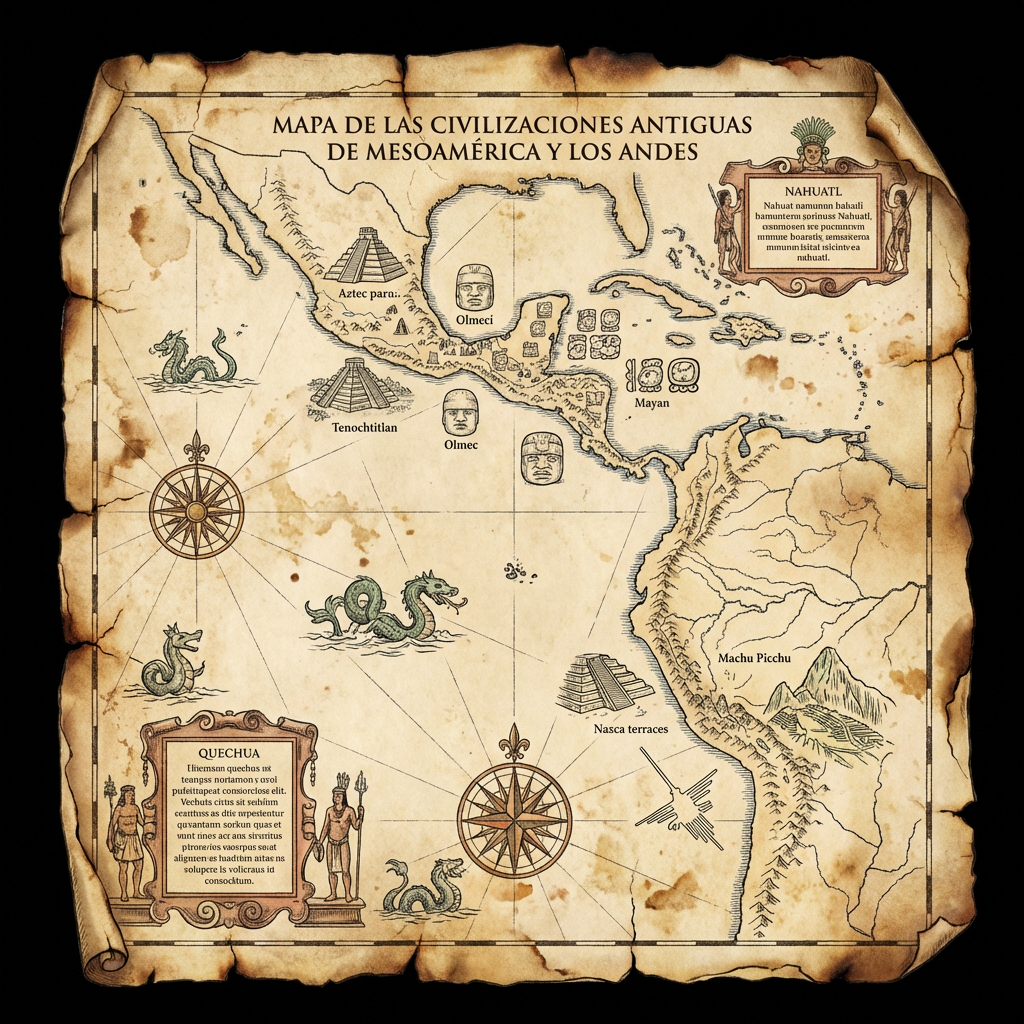
Mexica (Aztec) • Maya • Inca • Purépecha (Tarascan Empire)
Four Distinct World‑Systems at the Moment of Contact
These were not variations of a single Indigenous “type.”
They were four different civilizational architectures, each with its own:
- cosmology
- political logic
- economic structure
- territorial strategy
- military doctrine
- diplomatic norms
Understanding their contrasts reveals the diversity of the hemisphere — and the specificity of what was lost, taken hostage, or transformed.
1. Cosmology & Sacred Order
Mexica (Aztec)
- Cosmos in precarious balance; sun requires nourishment.
- Ritual sacrifice central to cosmic maintenance.
- Tenochtitlan engineered as a cosmic center.
Maya
- Deep‑time cosmology; creation cycles spanning millennia.
- Underworld journeys, maize deity, ancestor veneration.
- Cities aligned with astronomical events.
Inca (Tawantinsuyu)
- Cosmos organized through three realms (Hanan Pacha, Kay Pacha, Ukhu Pacha).
- Sacred geography structured through ceque lines radiating from Cusco.
- Ritual tied to agricultural cycles and imperial legitimacy.
Purépecha (Tarascan Empire)
- Cosmology centered on fire, metallurgy, and sacred lakes.
- Less emphasis on monumental ritual sacrifice.
- Strong priestly class tied to fire temples (yácatas).
Contrast:
Four cosmologies, four metaphysical architectures — none interchangeable.
2. Political Structure & Governance
Mexica
- Triple Alliance: federated imperial system.
- Tlatoani chosen by noble council.
- Tribute empire with strong military hierarchy.
Maya
- Network of independent city‑states.
- Ajaw (ruler) tied to divine lineage.
- Politics driven by dynastic rivalry, not empire.
Inca
- Highly centralized imperial state.
- Sapa Inca as divine ruler.
- Bureaucratic administration with census, labor drafts (mit’a), road system.
Purépecha
- Centralized kingdom with capital at Tzintzuntzan.
- Cazonci (ruler) advised by council of nobles and priests.
- Strong, unified state — rare in Mesoamerica.
Contrast:
Mexica = imperial federation
Maya = city‑state constellation
Inca = centralized empire
Purépecha = centralized kingdom with strong internal cohesion
3. Economy & Labor Systems
Mexica
- Tribute economy; markets highly regulated.
- Pochteca merchants as traders and spies.
- Chinampa agriculture.
Maya
- Regional specialization; lineage estates.
- Long‑distance trade in jade, cacao, obsidian.
- Less centralized tribute.
Inca
- State‑controlled economy; no markets in the Mexica sense.
- Mit’a labor drafts; redistribution through state storehouses.
- Terracing, irrigation, and vertical archipelagos.
Purépecha
- Economy centered on metallurgy (copper, bronze).
- Strong craft specialization.
- Tribute system less extractive than Mexica.
Contrast:
Four different economic logics — tribute, trade, redistribution, metallurgy.
4. Urbanism & Infrastructure
Mexica
- Tenochtitlan: hydraulic metropolis with canals, causeways, aqueducts.
- Urban density and engineering unmatched in Mesoamerica.
Maya
- Monumental cities dispersed across rainforest.
- Pyramids, stelae, ballcourts, astronomical observatories.
Inca
- Road network (Qhapaq Ñan) spanning 25,000+ miles.
- Cusco as imperial center; Machu Picchu as royal estate.
- Terracing and mountain engineering.
Purépecha
- Distinctive yácata temples (semi‑circular pyramids).
- Planned capital at Tzintzuntzan.
- Strong fortifications.
Contrast:
Mexica = water city
Maya = sacred cities
Inca = road empire
Purépecha = fortified highland kingdom
5. Warfare & Military Doctrine
Mexica
- Warfare for tribute, captives, and cosmic maintenance.
- Elite warrior societies (Eagle, Jaguar).
- Ritualized combat with rules.
Maya
- Warfare for dynastic prestige, captives, and political theater.
- Less emphasis on mass sacrifice.
- City‑state rivalries.
Inca
- Professional army; logistics through road system.
- Siege warfare, diplomacy, and forced resettlement (mitmaqkuna).
- Integration of conquered peoples.
Purépecha
- The only major power the Mexica could not defeat.
- Metallurgy gave them superior weapons (bronze-tipped spears, axes).
- Defensive warfare and strategic fortifications.
Contrast:
Mexica = ritual‑imperial
Maya = dynastic‑ritual
Inca = logistical‑imperial
Purépecha = metallurgical‑defensive (and extremely effective)
6. Writing, Knowledge & Time
Mexica
- Pictorial codices; dual calendars.
- History tied to migration and imperial legitimacy.
Maya
- Fully developed writing system (logosyllabic).
- Long Count calendar; deep‑time histories.
Inca
- No writing system in the Mesoamerican sense.
- Quipu (knotted cords) for census, accounting, and narrative memory.
- Knowledge held by specialist classes (quipucamayoc).
Purépecha
- Limited pictorial writing; strong oral tradition.
- Knowledge tied to metallurgy, ritual, and lineage.
Contrast:
Maya = full writing
Mexica = pictorial writing
Inca = quipu information system
Purépecha = hybrid oral‑pictorial tradition
7. Experience of Contact
Mexica
- Rapid imperial collapse (1519–1521).
- Moctezuma taken hostage; Tenochtitlan besieged.
- Disease waves catastrophic.
Maya
- Fragmented, region‑by‑region conquest (1500s–1697).
- Last independent kingdom (Itza) fell in 1697.
- Long resistance.
Inca
- Civil war between Atahualpa and Huáscar at contact.
- Atahualpa taken hostage and executed.
- Conquest 1532–1572 (Vilcabamba).
Purépecha
- Cazonci Tangaxuan II negotiated with Spaniards.
- Empire not militarily defeated by Mexica or Spanish.
- Eventually dismantled through political manipulation and execution of the ruler.
Contrast:
Mexica = sudden collapse
Maya = slow siege
Inca = hostage‑execution + civil war
Purépecha = political dismantling of a militarily strong state
8. Why the Purépecha Matter
The Purépecha (Tarascan Empire) were:
- a major imperial power in western Mexico
- technologically advanced in metallurgy
- politically unified
- militarily formidable
- the only major power the Mexica could not conquer
- a civilization with its own cosmology, architecture, and statecraft
They are often omitted from popular narratives because:
- they didn’t fall in a dramatic siege like Tenochtitlan
- they didn’t leave monumental ruins like the Maya
- they didn’t build a continental empire like the Inca
But structurally, they were one of the hemisphere’s four great powers at contact.
The contrast in one sentence
Mexica = imperial federation built on cosmic maintenance
Maya = deep‑time constellation of sacred city‑states
Inca = centralized road empire with state redistribution
Purépecha = metallurgical highland kingdom that resisted both Mexica and Spanish power
Apple Music
YouTube Music
Amazon Music
Spotify Music


Explore Mini-Topics
Leave a Reply