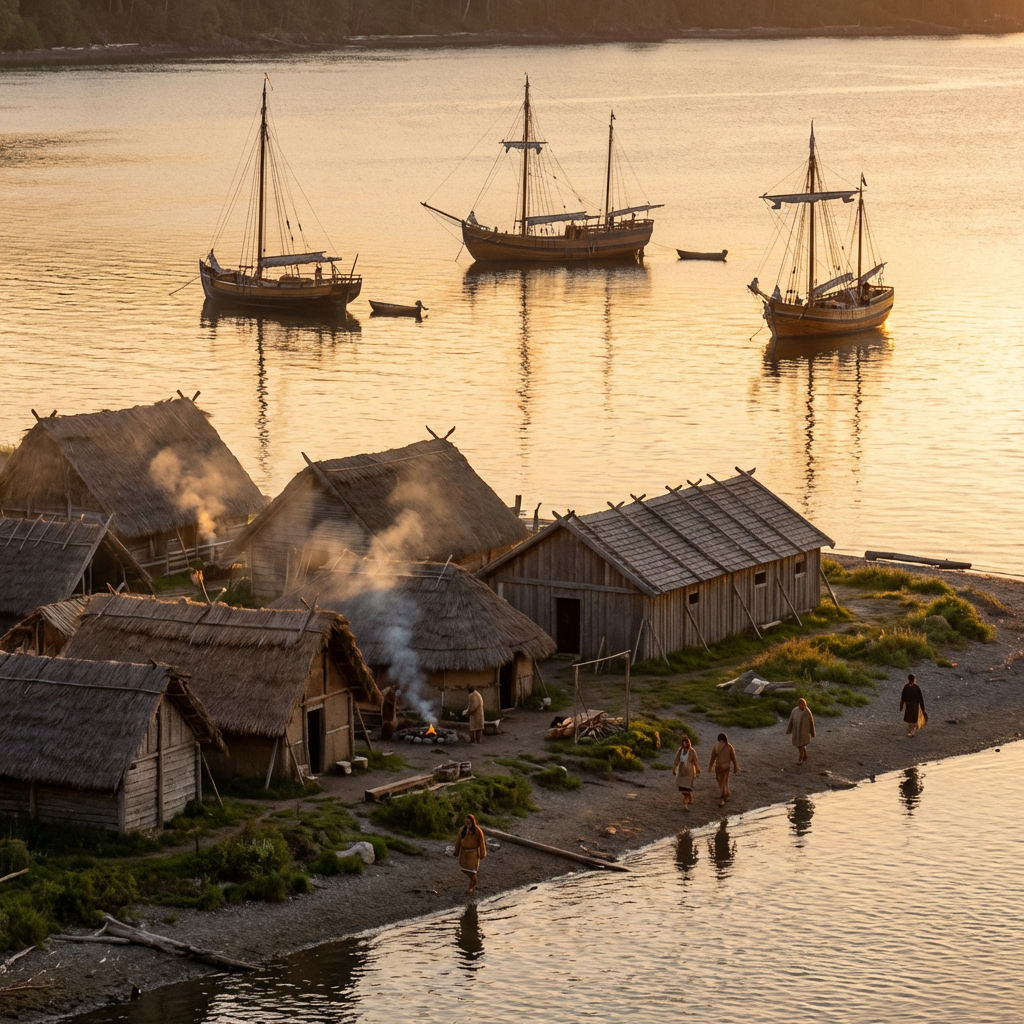
Indigenous Worlds at Contact
The Other Side of the Hostage‑Pledge System
Not a single “Indigenous experience,” but many distinct nations, polities, and worlds
encountering the same expanding machinery of European captivity.
1. Land and place
Before contact (many nations):
- Land as relation: a living relative, not a commodity.
- Territory as woven: hunting grounds, seasonal rounds, shared zones, sacred sites.
- Sovereignty as embedded: authority tied to specific places, waters, migrations.
At contact:
- Europeans arrive with property, title, patents, Doctrine of Discovery.
- Land becomes “claimable,” “sellable,” “cedable,” “surveyable.”
- Treaties translate relational territories into lines on paper.
Hostage‑pledge from their side:
The land itself is taken hostage—its fate pledged to foreign crowns—and with it, the continuity of their own worlds.
2. Kinship, peoplehood, and belonging
Before contact:
- Kinship as law: clans, moieties, extended families structuring obligation and care.
- Adoption and incorporation: captives and outsiders sometimes adopted, woven into kin networks.
- Peoplehood: land, language, sacred history, ceremony held together.
At contact:
- Europeans impose race, blood quantum, fixed “tribe” labels.
- Kinship systems ignored or distorted for administrative convenience.
- Adoption and fluid belonging delegitimized or criminalized.
Hostage‑pledge from their side:
Definitions of who counts as “their people” are put under siege; future recognition is held hostage to colonial categories.
3. Governance and decision‑making
Before contact:
- Councils, consensus, clan representation, rotating leadership.
- Authority earned through generosity, oratory, diplomacy, care.
- In many nations, women hold significant political authority (clan mothers, land‑holding lines).
At contact:
- Europeans demand single “chiefs” who can sign away land.
- Councils bypassed; internal dissent exploited.
- Governance reinterpreted through European notions of sovereignty.
Hostage‑pledge from their side:
Political legitimacy is held hostage to whether they conform to European expectations of “proper” authority.
4. Economy, reciprocity, and value
Before contact:
- Economies organized around reciprocity, gift exchange, seasonal abundance, shared use.
- Wealth measured in relations, obligations fulfilled, ceremonial generosity.
- Long‑distance trade networks already in place.
At contact:
- Fur trade, metal goods, guns, alcohol, and credit create dependency traps.
- Overhunting and ecological disruption follow market logics, not relational ones.
- Debt leveraged to force land cessions and political concessions.
Hostage‑pledge from their side:
Access to tools, food, and security becomes hostage to imperial trade terms they did not design.
5. Spiritual worlds and cosmology
Before contact:
- Worlds filled with persons beyond the human: animals, rivers, mountains, winds.
- Ceremony as maintenance of balance, not private belief.
- Sacred stories encode law, ecology, ethics, and history.
At contact:
- Christianity arrives as exclusive truth; existing cosmologies labeled “pagan,” “devil,” “superstition.”
- Missions target children, language, and ceremony.
- Sacred sites desecrated, flooded, mined, fenced.
Hostage‑pledge from their side:
Access to ceremony, language, and sacred places is held hostage to missionary and state control.
6. Time, history, and continuity
Before contact:
- Time experienced as cyclical, seasonal, ceremonial.
- History held in oral tradition, landmarks, names, songs.
- Future imagined as continuity of obligations to land and descendants.
At contact:
- Europeans impose linear “progress,” “civilization stages,” and timelines that place Indigenous peoples as “behind.”
- Histories overwritten as “pre‑history” or “myth.”
- Future recast as either assimilation or disappearance.
Hostage‑pledge from their side:
Their future is held hostage to colonial narratives of inevitability—“vanishing,” “uplift,” “integration.”
7. Violence, war, and captivity
Before contact:
- Warfare with rules, rituals, limits; captive adoption and rebalancing.
- Captivity could end in adoption, alliance, or ritual resolution.
At contact:
- Total war, scorched earth, siege, mass enslavement, genocidal campaigns.
- Captivity shifts from relational to chattel, transport, sale.
- Raiding economies distorted by demand for captives in colonial markets.
Hostage‑pledge from their side:
Bodies, children, and kin are taken as literal hostages to secure colonial peace, trade, and expansion.
8. Knowledge, language, and epistemic control
Before contact:
- Knowledge is situated, embodied, land‑based; passed through story, apprenticeship, ceremony.
- Languages encode ecological and relational detail Europeans cannot see.
At contact:
- European writing, maps, and law become the “official” record.
- Oral histories dismissed as unreliable.
- Languages suppressed; interpreters become choke points of power.
Hostage‑pledge from their side:
The ability to define reality is held hostage to foreign documents, courts, and categories.
9. What “contact” structurally feels like
From their side, contact is not a single moment but a cascade:
- First arrivals: strange ships, new goods, cautious curiosity, strategic diplomacy.
- Disease waves: villages emptied, elders lost, knowledge chains broken.
- Missionaries: pressure to convert, children targeted, ceremonies criminalized.
- Traders: guns and goods in exchange for furs, captives, land.
- Soldiers: forts, patrols, punitive expeditions, massacres.
- Surveyors and settlers: fences, fields, roads, permanent loss.
At each stage, something once relational becomes conditional on colonial permission.
That is the hostage‑pledge system from their side.
10. The contrast in one line
From the European side, contact is “discovery,” “expansion,” “civilization,” “empire.”
From the Indigenous side, contact is:
A slow, uneven, often catastrophic process in which land, kinship, governance, ceremony, and future are progressively taken hostage to someone else’s story of what the world is for.
Nations and peoples who experienced this (partial but wide‑ranging list)
Organized roughly by region; many of these nations have complex internal divisions, confederacies, and name variants.
Eastern Woodlands & Northeast
- Haudenosaunee / Iroquois Confederacy: Mohawk, Oneida, Onondaga, Cayuga, Seneca, Tuscarora
- Wabanaki Confederacy: Mi’kmaq, Maliseet (Wolastoqiyik), Passamaquoddy, Penobscot, Abenaki
- Algonquian‑speaking peoples (broadly):
- Pequot
- Mohegan
- Narragansett
- Massachusett
- Wampanoag
- Nipmuc
- Lenape / Delaware
- Shawnee
- Powhatan (including many constituent groups in Tidewater Virginia)
- Nanticoke
- Mahican
- Ojibwe / Anishinaabe (Great Lakes)
- Odawa
- Potawatomi
- Menominee
- Sauk
- Fox (Meskwaki)
- Miami
- Kickapoo
- Other Northeast / Great Lakes nations:
- Huron‑Wendat
- Erie
- Neutral (Attawandaron)
- Illinois Confederation (Kaskaskia, Peoria, Cahokia, Tamaroa, etc.)
- Ho‑Chunk (Winnebago)
Southeast
- “Five Civilized Tribes” (U.S. term, not theirs):
- Cherokee
- Muscogee (Creek)
- Choctaw
- Chickasaw
- Seminole
- Other Southeastern nations:
- Catawba
- Yamasee
- Timucua
- Apalachee
- Guale
- Natchez
- Hitchiti
- Yuchi
- Biloxi
- Tunica
- Houma
- Calusa
Eastern Subarctic & Northern Regions
- Cree (various groups)
- Innu (Montagnais‑Naskapi)
- Dene / Athabaskan peoples (various)
- Inuit / Inupiat / Yupik (Arctic coastal regions)
Plains
- Lakota, Dakota, Nakota (Sioux)
- Cheyenne
- Arapaho
- Blackfoot Confederacy (Siksika, Kainai, Piikani)
- Crow (Apsáalooke)
- Kiowa
- Comanche
- Pawnee
- Mandan
- Hidatsa
- Arikara (Sahnish)
- Osage
- Omaha
- Ponca
- Otoe‑Missouria
- Wichita and affiliated groups
Southwest
- Diné (Navajo)
- Hopi
- Zuni
- Apache peoples (Chiricahua, Mescalero, Jicarilla, Western Apache, Lipan, etc.)
- Pueblo nations (not exhaustive):
- Acoma
- Laguna
- Zia
- Santa Ana
- San Felipe
- Santo Domingo (Kewa)
- Cochiti
- Isleta
- Sandia
- Taos
- Picuris
- San Ildefonso
- Santa Clara
- Pojoaque
- Tesuque
- Nambe
- Ohkay Owingeh (San Juan)
- Tohono O’odham
- Akimel O’odham (Pima)
- Yaqui (Yoeme)
- Pima Bajo and related groups
Great Basin
- Shoshone (various bands)
- Paiute (Northern, Southern, Owens Valley, etc.)
- Ute
- Goshute
California
- Ohlone (Costanoan groups)
- Pomo (various groups)
- Miwok (Coast, Sierra, Plains)
- Yokuts (many subgroups)
- Chumash
- Tongva (Gabrielino)
- Tataviam
- Luiseño
- Cahuilla
- Kumeyaay (Diegueño)
- Maidu
- Wintu
- Karuk
- Yurok
- Hupa
- Esselen
- Salinan
Northwest Coast
- Haida
- Tlingit
- Tsimshian
- Kwakwaka’wakw
- Nuu‑chah‑nulth (Nootka)
- Coast Salish nations (not exhaustive):
- Duwamish
- Suquamish
- Snohomish
- Puyallup
- Nisqually
- Squaxin Island
- Lummi
- Saanich
- Songhees
- and many others
- Makah
- Heiltsuk
- Nuxalk
- Gitxsan
- Wet’suwet’en
Plateau
- Nez Perce (Nimiipuu)
- Cayuse
- Umatilla
- Walla Walla
- Spokane
- Colville Confederated Tribes (multiple constituent nations)
- Ktunaxa (Kootenai)
- Salish (Interior Salish groups)
Arctic & Subarctic (Alaska / Northern Canada)
- Inupiat
- Yupik
- Aleut / Unangan
- Gwich’in
- Koyukon
- Tanana
- Deg Hit’an
- Many other Dene / Athabaskan groups
Caribbean & Gulf
- Taíno (including Arawak‑related groups across the Greater Antilles)
- Kalinago (Island Carib)
- Ciboney (and related groups)
- Garifuna (Afro‑Indigenous people emerging from Carib and African histories)
- Along Gulf coasts: various smaller or now‑dispersed nations intertwined with Southeastern peoples
Mesoamerica (briefly, though your focus is North America)
- Mexica (Aztec)
- Maya nations (Yucatec, K’iche’, Kaqchikel, Tzotzil, Tzeltal, etc.)
- Mixtec
- Zapotec
- Totonac
- Huastec
- Tarascan / Purépecha
- Many others
What this list is doing
- It is naming some of the peoples whose worlds were already fully formed when Europeans arrived.
- It is not exhaustive—there are hundreds more nations, bands, confederacies, and local identities.
- It is meant to make it impossible to treat “Indigenous” as a single, flat category in the story of the hostage‑pledge system.
The machinery we mapped in the European arc did not hit an empty field.
It collided with dense, specific, relational worlds—each with its own law, story, and architecture of freedom.
Those worlds are not just the backdrop.
They are the other half of the ledger.
It is impossible to present this in any way that honors the absolute scale of this horror. I’m so sorry. Land Back.
Apple Music
YouTube Music
Amazon Music
Spotify Music


Explore Mini-Topics
Leave a Reply