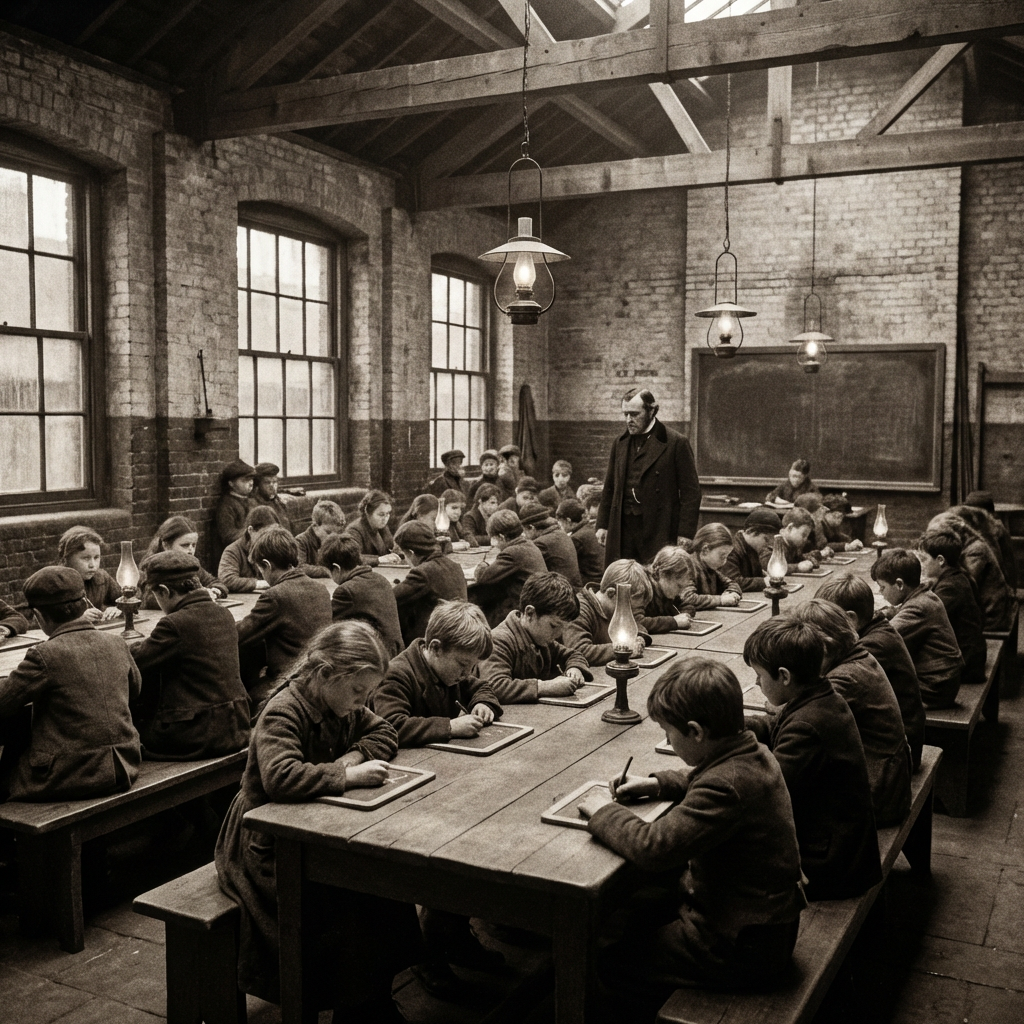
The Invention of a Population‑Scale Captivity System
The common school movement is often mythologized as the birth of American democracy. In reality, it marks the moment when education becomes a mass hostage‑management system — a mechanism for assimilating immigrants, disciplining the working class, and producing a standardized population for industrial capitalism. The state expands its authority over children, families, and communities, using schooling to extract pledges of obedience, identity, and productivity.
Hostage
Immigrant children, working‑class children, and rural poor — their languages, cultures, labor, and future mobility.
Pledge
Assimilation into Anglo‑Protestant norms, industrial discipline, and acceptance of hierarchical social order.
Sovereign
State bureaucracies, local school committees, industrial capital, and Protestant reformers.
Ideology
“Common schools create social order” — the belief that uniform schooling would prevent disorder, rebellion, and cultural fragmentation.
A. Horace Mann and the Myth of Benevolence
Horace Mann is celebrated as the father of public education, but his project was fundamentally about population control.
- He framed schooling as a cure for social unrest.
- He argued that children must be shaped into obedient citizens.
- He promoted a standardized curriculum to eliminate cultural difference.
- He insisted that schools should “mold character,” not just teach literacy.
Mann’s reforms were not democratic — they were disciplinary.
B. The Assimilation Mandate: Immigrant Children as Collateral
The common school system targeted immigrant communities, especially Irish Catholics, Germans, and later Eastern and Southern Europeans.
- English‑only instruction erased linguistic diversity.
- Protestant moral instruction was imposed as “universal.”
- Immigrant cultural practices were framed as threats to national unity.
- Truancy laws criminalized families who resisted assimilation.
Schools became assimilation factories, holding children hostage until they surrendered their cultural identities.
C. Industrial Discipline: Training the Workforce of the New Economy
As industrialization accelerated, schools adopted the logic of the factory.
- Bells, schedules, and rows mimicked industrial time discipline.
- Obedience, punctuality, and docility were taught as virtues.
- “Character education” emphasized submission to authority.
- Vocational tracking prepared poor children for manual labor.
The schoolhouse became a pre‑factory, conditioning children for the rhythms and hierarchies of industrial capitalism.
D. The Criminalization of Childhood Autonomy
The rise of compulsory attendance laws transformed childhood into a regulated category.
- Truancy officers patrolled neighborhoods like police.
- Children who worked to support their families were punished.
- Parents who resisted state control were fined or jailed.
- Childhood was redefined as a period of state‑mandated obedience.
The state claimed ownership over children’s time, bodies, and futures.
E. Protestant Sovereignty: The Hidden Curriculum
Although framed as “nonsectarian,” common schools enforced Protestant norms.
- Bible readings were mandatory.
- Catholic children were punished for refusing Protestant prayers.
- Moral instruction reinforced Anglo‑Protestant gender and family roles.
- Religious neutrality was a myth used to mask cultural domination.
The common school was a Protestant institution masquerading as universal.
F. The Rural Poor: Discipline Without Mobility
For rural white children, common schools offered discipline but not opportunity.
- Schools were underfunded and seasonal.
- Curricula emphasized obedience, not advancement.
- Teachers enforced social hierarchy within the white population.
- Education reinforced class stratification rather than disrupting it.
The hostage‑pledge system operated within whiteness as well — sorting, disciplining, and containing the rural poor.
G. The Mutation: From Local Control to State‑Scale Management
By the 1870s, the common school system had completed a major structural mutation:
- Hostage: Immigrant, working‑class, and rural children.
- Pledge: Assimilation, discipline, and cultural surrender.
- Sovereign: State bureaucracies aligned with industrial capital.
- Ideology: Social order through uniformity.
- Mechanism: Compulsory schooling, standardized curriculum, and truancy enforcement.
The common school movement created the first population‑scale educational captivity system in U.S. history — a system designed not to equalize opportunity, but to standardize obedience.
Summary of the Common School Hostage‑Pledge System
- Education becomes a mass‑management tool for the state.
- Immigrant children are assimilated through linguistic and cultural erasure.
- Industrial discipline is embedded in the structure of schooling.
- Childhood autonomy is criminalized through compulsory attendance.
- Protestant norms are imposed under the guise of neutrality.
- Class hierarchy is reinforced, not disrupted.
- The system mutates into a scalable apparatus for producing compliant citizens and workers.
The common school era establishes the template for modern educational governance: a system that manages populations through standardized captivity.
Apple Music
YouTube Music
Amazon Music
Spotify Music


Explore Mini-Topics
Leave a Reply