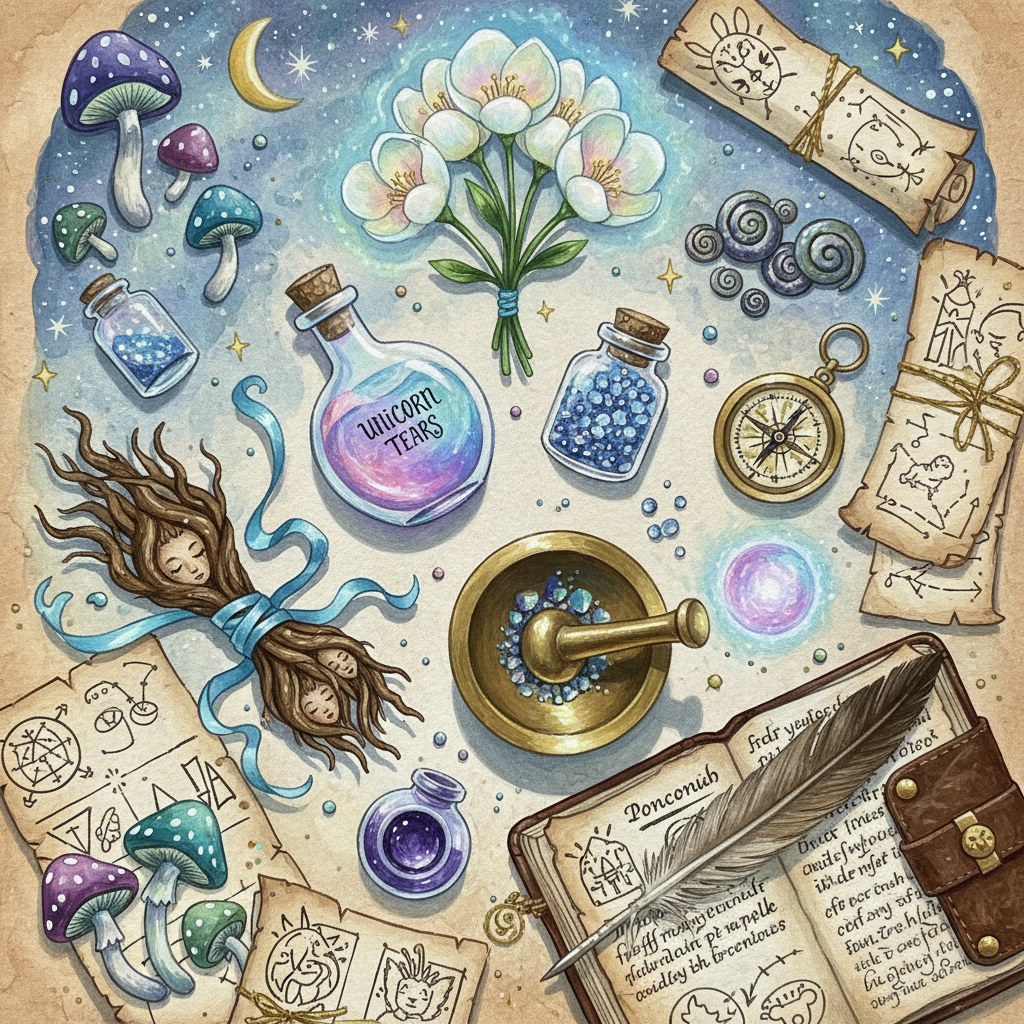
The Little Witch in the Woods

To Sam and Rho,
My forever apprentices.
Chapter One: The Whispering Roots
The Little Witch lived in a tree.
Not on a tree, like a treehouse with boards and nails, but in a tree — a great old oak whose trunk had grown around her home the way moss grows around a stone. Vines curled over the windows, ferns draped from the balcony, and tiny white mushrooms glowed softly along the stairs. From a distance, the whole place looked like a leafy bump in the branches, as if the forest had decided to grow a house of its own.
The Little Witch liked it that way. Hidden, quiet, and humming with life.
Every morning she stepped outside barefoot so she could feel what the forest was feeling. Today, the bark under her feet felt… twitchy. Not upset, exactly, but restless. Like someone whispering too softly to understand.
She crouched and pressed her palm to the trunk.
“Good morning, Oak,” she murmured. “What’s going on down there?”
A squirrel scrambled down the branches above her head, tail flicking like a feather duster. “You hear it too, don’t you?” he chattered. “The roots are arguing!”
“Arguing?” The Little Witch raised an eyebrow. “Roots don’t usually argue. They share.”
“That’s what I thought!” the squirrel squeaked. “But they’re all tangled up about something. I can’t sleep with all the grumbling.”
The Little Witch closed her eyes and listened harder. Beneath the soil, beneath the stones, beneath the tiny tunnels where beetles lived, she felt the faintest tug of tension. The roots were indeed whispering — short, sharp little pulses instead of their usual slow, steady hum.
She climbed down the rope ladder and knelt at the base of the tree. The ground was damp from last night’s rain, and the smell of wet earth rose around her like a friendly sigh.
“Let’s see,” she said softly. “Roots talk through water, and water travels through soil. If the soil is confused, the roots get confused.”
She scooped up a handful of dirt and crumbled it between her fingers. It was darker than usual. Wetter. Heavier.
“Hmm. Too much water in the lower layer,” she murmured. “The roots are trying to share it, but it’s pooling in one place.”
The squirrel leaned over her shoulder. “Is that bad?”
“Not bad,” she said. “Just uncomfortable. Imagine if all your blankets slid to one side of your bed.”
“Oh,” said the squirrel. “That is uncomfortable.”
The Little Witch smiled. “Exactly.”
She stood, brushing soil from her hands. “I’ll need a Root-Calming Spell. Something gentle. Something that reminds the roots how to share again.”
The squirrel perked up. “Do you need help?”
“Always,” she said. “Go fetch me some dew from the morning leaves. I’ll gather moss.”
The squirrel zipped away, and the Little Witch wandered into the underbrush, humming a tune the forest liked. She plucked soft green moss from fallen logs, thanking each patch as she took only what she needed. That was the rule: take little, give much, harm none.
By the time she returned, the squirrel had a leaf full of sparkling dew.
“Perfect,” she said. “Now I just need to mix the ingredients and whisper the spell down into the soil.”
But before she began, she paused.
“This might be a good puzzle for my apprentice,” she said aloud, even though she didn’t technically have an apprentice.
Yet.
She smiled at the thought.
Chapter 1 Puzzle: The Root-Calming Spell
Here is the Little Witch’s recipe for one patch of roots:
- 3 drops of morning dew
- 1/2 handful of soil
- 4 strands of soft moss
But the oak tree has three root patches that need calming.
Your task:
Scale the spell up so she can help all three patches.
- How many drops of dew does she need in total?
- How many handfuls of soil?
- How many strands of moss?
Write the new recipe for the 3-patch Root-Calming Spell.
Research Quest
What is a mycorrhizal network?
Why do trees “talk” underground?
Draw a picture of what you think the root-network looks like.
Chapter Two: The Missing Moon Moths
The Little Witch was grinding dried lavender when the knock came.
It wasn’t a normal knock. Not a paw-scratch, not a beak-tap, not even the polite thump of a deer’s hoof. This knock was soft and fluttery, like someone brushing wings against the door.
She opened it slowly.
A Luna moth—pale green, long-tailed, shimmering like moonlight caught in a leaf—wobbled in the air before her. It looked exhausted.
“Oh dear,” the Little Witch said, cupping her hands so the moth could rest. “You’re out far too early. The moon isn’t even up yet.”
The moth trembled. “We… we can’t wake the others,” it whispered in a voice like silk sliding over bark. “The Moon Moths are missing.”
“Missing?” The Little Witch blinked. “All of them?”
The moth nodded weakly. “We’re supposed to emerge tonight. But the cocoons stayed cold. No stirring. No glowing. Nothing.”
The Little Witch felt a prickle of worry. Moon Moths were important. They pollinated the night-blooming flowers, carried moonlight between the trees, and kept the forest’s nighttime magic balanced. Without them, the night would feel… thin.
“Show me,” she said.
The moth guided her through the woods to a cluster of low branches where dozens of pale cocoons hung like tiny lanterns. Except they weren’t glowing. They were dull and still.
The Little Witch touched one gently. Cool. Too cool.
“Hmm,” she murmured. “Cocoons need warmth to finish metamorphosis. Something must be blocking the moonlight.”
She looked up. The canopy above was unusually thick—branches woven so tightly that barely a sliver of sky peeked through.
“That explains it,” she said. “The trees grew too fast after last week’s rain. They made too much shade.”
The moth drooped. “Can you help them wake?”
“I can,” she said. “But I’ll need a Moon-Moth Warming Spell. Something gentle. Something that reminds the cocoons it’s safe to glow.”
She knelt and drew a small circle in the dirt.
“For one cocoon,” she said, “I’ll need:
- 2 moon-petals,
- 1/4 cup nectar,
- and 6 moth-whispers.”
The moth tilted its head. “But there are so many cocoons…”
“Yes,” the Little Witch said, smiling. “Which is why this is a perfect puzzle for my apprentice.”
She winked at the moth, who didn’t know what an apprentice was but nodded politely anyway.
Chapter 2 Puzzle: The Moon-Moth Warming Spell
Here is the Little Witch’s recipe for one cocoon:
- 2 moon-petals
- 1/4 cup nectar
- 6 moth-whispers
But she only has 1/8 cup of nectar left.
Your task:
How many full batches of the spell can she make with 1/8 cup of nectar?
(Each batch needs 1/4 cup. You may draw, divide, or use fraction bars to help.)
Then write the recipe for the number of batches she can make.
Research Quest
Find one real nocturnal pollinator (besides moths).
Draw it and write one fact about how it helps its ecosystem.
Chapter Three: The Frog with Too Many Echoes
The Little Witch was sorting river stones by color when she heard it.
“Rrrr-ROINK!”
Then again.
“Rrrr-ROINK! Rrrr-ROINK! Rrrr-ROINK!”
She frowned. That wasn’t normal frog behavior. Frogs croaked, sure. Some even sang. But they did not usually echo like someone shouting into a canyon.
She followed the sound down the winding path to the pond. Dragonflies zipped past her ears like tiny helicopters, and cattails swayed in the breeze. Everything looked peaceful—except for one very frustrated frog sitting on a lily pad.
He croaked again.
“Rrrr-ROINK!”
And the sound bounced back at him three times, each echo louder than the last.
The frog slapped the water with his foot. “Make it stop! I can’t hear myself think!”
The Little Witch crouched beside the pond. “Hello, Echo-Frog.”
“I wasn’t an Echo-Frog yesterday,” he grumbled. “I was just a regular frog with a perfectly normal voice.”
She dipped her fingers into the water. It felt deeper than usual. Colder, too.
“Hmm,” she said. “Echoes happen when sound waves bounce off something. But ponds don’t usually echo like caves.”
The frog puffed up. “Tell that to my ears!”
She leaned closer to the water. The pond’s bottom looked darker than she remembered. The recent rain must have filled it too quickly, changing the depth and shape of the water. Sound behaved differently now—bouncing, bending, repeating.
“Your pond is too deep,” she said gently. “Your croak is hitting the new water layer and bouncing back.”
The frog blinked. “Water can do that?”
“Oh yes,” she said. “Water is a wonderful trickster. It bends light, carries sound, and hides secrets.”
He groaned. “Can you fix it?”
“I can help balance the sound,” she said. “But I’ll need a Sound-Steadying Charm. Something that smooths the waves so your croak doesn’t bounce around like a rubber ball.”
She plucked a reed and held it to her ear, listening to the tiny vibrations inside.
“For one croak,” she said, “I’ll need:
- 5 frog-notes,
- and 2 reed-vibrations.”
The frog tilted his head. “What’s a frog-note?”
“It’s the sound you make when you croak,” she said. “You’re very good at producing them.”
He puffed up proudly. “I am quite musical.”
She smiled. “Yes. Which is why this is a perfect puzzle for my apprentice.”
The frog looked around. “You have an apprentice?”
“Not yet,” she said. “But I think one is on the way.”
Chapter 3 Puzzle: The Sound-Steadying Charm
Here is the Little Witch’s recipe for one croak:
- 5 frog-notes
- 2 reed-vibrations
Today, the frog croaked 20 times.
Your task:
How many reed-vibrations does the Little Witch need to steady all 20 croaks?
(Each croak needs 2 reed-vibrations. Multiply to find the total.)
Then write the full recipe for the 20-croak Sound-Steadying Charm.
Research Quest
What is an amphibian?
Why do frogs sing?
Draw a frog and label one interesting feature.
Chapter Four: The Overgrown Garden
The Little Witch woke to a strange sound.
A rustling. A swishing. A sort of leafy shhhhhh that didn’t belong inside her treehouse.
She sat up in bed.
A vine was dangling from the ceiling.
Another curled around her bookshelf.
A third had politely wrapped itself around her teapot, as if trying to pour itself a cup.
“Oh no,” she whispered. “Not again.”
She hurried outside—and gasped.
Her garden had exploded.
Not literally, of course. But it had grown so wildly overnight that it looked like a green ocean had risen up and swallowed half the clearing. Sunflowers towered over the roof. Mint bushes sprawled across the path. The pumpkin patch had become a pumpkin mountain.
A rabbit poked its head out of the mint and sneezed. “Your garden is too enthusiastic,” it said, nose twitching. “I can’t even find my burrow.”
The Little Witch pressed her hands to her hips. “This is what happens when plants get too much sunlight and too much water at the same time. They grow faster than they can think.”
The rabbit blinked. “Plants think?”
“In their own way,” she said. “They stretch toward light, sip water from the soil, and talk to each other through their roots. But when everything happens too fast, they get confused.”
She knelt beside a sunflower whose head was so heavy it drooped like a sleepy giant. “You poor thing,” she murmured. “You weren’t meant to grow this tall in one night.”
The sunflower rustled apologetically.
“I’ll help you all,” she said. “But I’ll need a Growth-Slowing Spell. Something gentle. Something that reminds the plants to breathe and take their time.”
She brushed dirt from a flat stone and began to write the recipe with a twig.
“For one garden bed,” she said, “I’ll need:
- 1/3 cup shadewater,
- 3 leaf-breaths,
- and 9 pebble-weights.”
The rabbit tilted its head. “What’s shadewater?”
“Water that’s been sitting in the shade,” she said. “It cools the soil and calms the roots.”
The rabbit nodded as if this made perfect sense.
The Little Witch stood and surveyed the chaos. “But I have six garden beds to treat. Which means…”
She smiled.
“This is a perfect puzzle for my apprentice.”
The rabbit looked around. “You have an apprentice?”
“Not officially,” she said. “But I think one is learning.”
Chapter 4 Puzzle: The Growth-Slowing Spell
Here is the Little Witch’s recipe for one garden bed:
- 1/3 cup shadewater
- 3 leaf-breaths
- 9 pebble-weights
But she has six garden beds that need help.
Your task:
Scale the spell up to treat all six beds.
- How many cups of shadewater does she need in total?
- How many leaf-breaths?
- How many pebble-weights?
Write the full recipe for the 6-bed Growth-Slowing Spell.
Research Quest
What does a plant need to grow?
What happens when it gets too much of one ingredient (sunlight, water, nutrients)?
Draw a plant and label its parts.
Chapter Five: The Lost Feather Map
The Little Witch was sweeping her doorstep when a shadow passed overhead.
Not a cloud. Not a leaf. Something with wings.
A glossy black feather drifted down and landed at her feet. Then another. Then a whole flutter of them, swirling like a tiny storm.
She looked up.
A crow spiraled down from the branches, cawing urgently. He landed on the railing, puffed his feathers, and dropped something into her hands.
It was a feather.
But not just any feather.
This one shimmered with shifting colors—blue, then silver, then green—like it couldn’t decide what it wanted to be. As she watched, the feather bent itself into the shape of a tiny map.
“Oh,” she breathed. “A Feather Map. I haven’t seen one of these in years.”
The crow hopped anxiously. “It keeps changing,” he croaked. “I can’t read it. One moment it points north, then it curls south, then it folds itself into a knot!”
The Little Witch held the feather up to the light. Sure enough, the map rippled and twisted, its lines rearranging themselves like a restless dream.
“Feather Maps only behave like this when the winds are confused,” she said. “Something must be shifting the air currents.”
The crow flapped his wings. “I knew it! The wind has been blowing in circles all morning. I tried to fly east and ended up west. I tried to fly north and ended up in a bush.”
She smiled gently. “Winds can get tangled, just like roots. They need direction. They need clarity.”
The crow leaned closer. “Can you fix it?”
“I can help,” she said. “But I’ll need a Direction-Finding Charm. Something that reminds the winds where they’re supposed to go.”
She knelt and drew a compass shape in the dirt.
“For one small map,” she said, “I’ll need:
- 4 north-feathers,
- 2 east-feathers,
- and 1 south-feather.”
The crow blinked. “But this map is… bigger than small.”
The Little Witch nodded. “Twice as big, actually. Which means…”
She paused, smiling.
“This is a perfect puzzle for my apprentice.”
The crow tilted his head. “You keep mentioning this apprentice.”
“I do,” she said. “Because I think she’s ready.”
Chapter 5 Puzzle: The Direction-Finding Charm
Here is the Little Witch’s recipe for one small Feather Map:
- 4 north-feathers
- 2 east-feathers
- 1 south-feather
But the crow’s Feather Map is twice as large as a normal one.
Your task:
Double the ingredients to make a charm strong enough for the larger map.
- How many north-feathers does she need?
- How many east-feathers?
- How many south-feathers?
Write the full recipe for the double-sized Direction-Finding Charm.
Research Quest (Optional)
How do real birds migrate?
What tools do they use to find their way?
Draw a bird and label one adaptation that helps it navigate.
Chapter Six: The Sleepy Stream
The Little Witch was gathering pine needles for tea when she noticed something odd.
The forest was quiet.
Not peaceful-quiet. Not morning-quiet.
A different kind of quiet — the kind that makes birds tilt their heads and squirrels freeze mid‑acorn.
She followed the silence to the stream that wound through the clearing like a silver ribbon.
Except today, it wasn’t silver.
It was barely moving at all.
The water trickled so slowly that fallen leaves just sat on the surface, drifting in lazy circles. A dragonfly hovered above the stream, confused. A pair of minnows poked their heads out of the water, blinking sleepily.
The Little Witch knelt beside the bank. “Oh dear,” she murmured. “You’re tired.”
The stream burbled weakly, as if trying to agree.
A beaver waddled up, looking frazzled. “I tried to build a tiny dam for practice,” he said, “but the water didn’t push back. It’s like the stream forgot how to flow!”
The Little Witch dipped her hand into the water. It was cooler than usual. Heavier, too.
“Streams don’t just slow down for no reason,” she said. “Something must be blocking the water upstream.”
The beaver nodded vigorously. “I checked! A bunch of fallen branches got stuck after last night’s storm. They’re clogging the narrow bend.”
“That explains it,” she said. “The water can’t move freely, so the whole stream feels sleepy.”
The beaver wrung his paws. “Can you wake it up?”
“I can help,” she said. “But I’ll need a Water-Waking Spell. Something gentle. Something that reminds the stream how to dance.”
She drew a spiral in the mud with her fingertip.
“For one stretch of stream,” she said, “I’ll need:
- 1/2 cup riverlight,
- 3 pebble-beats,
- and 12 splash-notes.”
The beaver squinted. “What’s riverlight?”
“Sunlight reflected on water,” she said. “It carries warmth and motion.”
The beaver nodded slowly. “And splash-notes?”
“The sound water makes when it’s happy.”
He accepted this without question.
The Little Witch looked up the length of the stream. “But this whole stretch needs help. And I only have a little riverlight left.”
She smiled softly.
“This is a perfect puzzle for my apprentice.”
The beaver blinked. “You have an apprentice?”
“Not officially,” she said. “But she’s learning spellcraft faster than she realizes.”
Chapter 6 Puzzle: The Water-Waking Spell
Here is the Little Witch’s recipe for one stretch of stream:
- 1/2 cup riverlight
- 3 pebble-beats
- 12 splash-notes
But she only has 1/4 cup of riverlight left.
Your task:
Scale the entire spell down so she can make a smaller batch using only 1/4 cup of riverlight.
- What fraction of the original recipe can she make?
- How many pebble-beats does she need for the smaller batch?
- How many splash-notes?
Write the full recipe for the scaled-down Water-Waking Spell.
Research Quest
What is a watershed?
Where does the water in your local streams come from?
Draw a simple map showing how water moves through an ecosystem.
Chapter Seven: The Mushroom Council
The Little Witch was sorting acorns by size when she felt a tap on her ankle.
Tap.
Tap.
Tap-tap.
She looked down.
A ring of mushrooms had formed around her feet—tiny brown caps, tall white stems, speckled red domes, and one very round puffball who seemed to be in charge.
The puffball cleared its throat. “Ahem. We request your presence.”
The Little Witch blinked. “The Mushroom Council? Here?”
All the mushrooms nodded in unison, which looked very silly because mushrooms don’t have necks.
The puffball continued, “There is a problem in the forest floor. A pattern has appeared. A strange pattern. A pattern that does not belong.”
The Little Witch followed them to a clearing where dozens of mushrooms had sprouted overnight. But instead of growing in their usual scattered clusters, they had arranged themselves in spirals, zigzags, and even a perfect square.
“Oh my,” she whispered. “This is unusual.”
A tall, thin mushroom wobbled nervously. “We didn’t do it! We woke up like this!”
The Little Witch knelt and touched the soil. It was rich and warm, full of life. But something was off—an imbalance in the nutrients, a shift in the underground map of roots and decomposing leaves.
“Mushrooms grow where the forest needs them,” she said. “If you’re forming patterns, it means the soil is trying to tell us something.”
The puffball bobbed. “Exactly! But we cannot read the message. We need a map.”
The Little Witch smiled. “Then we’ll make one.”
She brushed aside leaves and drew a circle in the dirt.
“For one small map,” she said, “I’ll need:
- 8 spore-dots,
- 4 bark-lines,
- and 2 moss-anchors.”
The mushrooms leaned in eagerly.
“But,” she continued, “this pattern covers a much larger area. At least one and a half times bigger than a normal patch.”
The puffball gasped. “One and a half!”
The Little Witch nodded. “Which means…”
She paused, smiling.
“This is a perfect puzzle for my apprentice.”
The mushrooms murmured excitedly. “An apprentice! How delightful!”
The Little Witch winked. “She’s learning fast.”
Chapter 7 Puzzle: The Spore-Mapping Charm
Here is the Little Witch’s recipe for one small map:
- 8 spore-dots
- 4 bark-lines
- 2 moss-anchors
But the Mushroom Council’s pattern is 1.5 times larger than a normal patch.
Your task:
Scale the spell up by multiplying each ingredient by 1.5.
- How many spore-dots does she need?
- How many bark-lines?
- How many moss-anchors?
Write the full recipe for the 1.5× Spore-Mapping Charm.
Research Quest
What is a decomposer?
Why are mushrooms important for forests?
Draw a mushroom and label its parts (cap, gills, stem, mycelium).
Chapter Eight: The Wind That Forgot Its Name
The Little Witch was hanging bundles of herbs to dry when a strange hush swept through the treetops.
Not a calm hush.
Not a peaceful hush.
A confused hush — like the forest was holding its breath.
She stepped outside and immediately felt it: the air was wrong.
The wind wasn’t blowing north or south or east or west.
It wasn’t blowing gently or strongly.
It wasn’t blowing at all.
It was… wandering.
A leaf drifted past her face, spinning in slow, uncertain circles. A blue jay attempted to glide from one branch to another, only to wobble and land in a bush with a disgruntled squawk.
The Little Witch frowned. “Wind doesn’t just forget where it’s going.”
A fox trotted up, fur ruffled. “Tell that to my tail,” he grumbled. “The breeze keeps swirling backward. I tried to sniff the air for news, and it sniffed me instead.”
The Little Witch closed her eyes and listened. Usually, she could feel the wind’s direction in her bones — a steady pull, a gentle push, a whisper of movement. But today, the air felt like a lost traveler spinning in circles.
“Something has confused the currents,” she said. “Maybe a pressure shift. Maybe a storm far away. Maybe the sky just woke up on the wrong side of the clouds.”
The fox tilted his head. “Can you help it remember?”
“I can try,” she said. “But I’ll need a Wind-Remembering Spell. Something gentle. Something that reminds the air how to move with purpose.”
She knelt and drew a spiral in the dust — the ancient symbol for windpaths.
“For one forest glade,” she said, “I’ll need:
- 3 breeze-threads,
- 1/3 cup skywater,
- and 9 whisper-turns.”
The fox sniffed the ingredients list. “What’s skywater?”
“Water collected from the first raindrop of a storm,” she said. “It carries the memory of clouds.”
“And whisper-turns?”
“The tiny twist the wind makes when it changes direction.”
The fox nodded as if this made perfect sense.
The Little Witch looked around. The confused wind wasn’t just affecting one glade — it was drifting through the entire forest, touching every leaf and branch.
“This is a big job,” she said softly. “I’ll need to scale the spell up.”
She smiled.
“This is a perfect puzzle for my apprentice.”
The fox perked up. “Your apprentice again?”
“Oh yes,” she said. “She’s learning to read the wind.”
Chapter 8 Puzzle: The Wind-Remembering Spell
Here is the Little Witch’s recipe for one forest glade:
- 3 breeze-threads
- 1/3 cup skywater
- 9 whisper-turns
But the confused wind is drifting through four glades.
Your task:
Scale the spell up by multiplying each ingredient by 4.
- How many breeze-threads does she need?
- How many cups of skywater?
- How many whisper-turns?
Write the full recipe for the 4-glade Wind-Remembering Spell.
Research Quest
What causes wind?
What is air pressure, and how does it shape weather?
Draw a simple diagram showing how warm and cool air move.
Chapter Nine: The Night the Stars Hid
The Little Witch loved the night.
She loved the cool air, the soft hoots of owls, the glow of fireflies drifting like tiny lanterns. But most of all, she loved the stars — bright, steady, and always exactly where she expected them to be.
So when she stepped outside that evening and looked up, she froze.
The stars were… dim.
Not gone. Not missing. Just faint, like someone had draped a thin veil across the sky.
A bat swooped down and landed on her shoulder, wings folding neatly. “You see it too, don’t you?” he squeaked. “The sky is sleepy.”
The Little Witch squinted upward. “Stars don’t get sleepy.”
“Then why are they hiding?” the bat asked. “I nearly flew into a pine tree. I couldn’t see a thing!”
She frowned. The forest around her was brighter than usual — fireflies, lantern mushrooms, even the glowworms along the path were shining extra brightly tonight.
“Hmm,” she murmured. “Too much light down here can make the sky look dim. The stars haven’t changed — the forest has.”
The bat blinked. “We’re… too bright?”
“In a way,” she said. “Light from the ground can wash out the starlight. It’s called skyglow.”
The bat flapped anxiously. “Can you fix it? I need the stars to navigate!”
“I can help,” she said. “But I’ll need a Starglow Charm. Something gentle. Something that reminds the night how to balance its light.”
She knelt and drew a circle in the dirt.
“For one patch of sky,” she said, “I’ll need:
- 7 star-seeds,
- 1/2 cup night-ink,
- and 14 glow-breaths.”
The bat tilted his head. “Night-ink?”
“Water collected at midnight,” she said. “It holds the darkness of the hour.”
“And glow-breaths?”
“The soft exhale you make when you blow out a candle.”
The bat nodded solemnly.
The Little Witch looked at her supplies. “But I only have a little night-ink left. Just one quarter cup.”
She smiled.
“This is a perfect puzzle for my apprentice.”
The bat perked up. “Your apprentice again?”
“Oh yes,” she said. “She’s learning to read the night.”
Chapter 9 Puzzle: The Starglow Charm
Here is the Little Witch’s recipe for one patch of sky:
- 7 star-seeds
- 1/2 cup night-ink
- 14 glow-breaths
But she only has 1/4 cup of night-ink left.
Your task:
How many half-batches of the spell can she make?
(Each full batch needs 1/2 cup. How many halves fit into 1/4?)
Then write the recipe for the number of half-batches she can make.
Research Quest
Find one constellation and draw it.
What story is connected to it?
Bonus: What is light pollution, and how does it affect animals?
Chapter Ten: The Forest’s Big Question
The Little Witch was stirring a pot of pine‑needle soup when every creature in the clearing suddenly went still.
The birds stopped singing.
The squirrels froze mid‑scamper.
Even the wind paused, as if holding its breath.
Then she felt it.
A deep, gentle rumble beneath her feet — not frightening, not urgent, but ancient. Like the heartbeat of something enormous waking up.
She stepped outside and placed her palm on the trunk of her oak tree.
“Forest?” she whispered.
The ground hummed in reply.
A deer stepped forward, ears twitching. “We all felt it,” she said softly. “The forest is… asking something.”
A raccoon nodded. “But we don’t know what.”
The Little Witch closed her eyes and listened with her whole body — her feet on the soil, her hand on the bark, her breath matching the rhythm of the leaves.
The hum grew clearer.
Not a warning.
Not a cry for help.
A question.
The forest was wondering about itself.
She opened her eyes. “The balance is shifting,” she said. “The roots, the wind, the water, the light — everything has been a little off lately. The forest wants to understand how all its parts fit together.”
The owl hooted thoughtfully. “Like a puzzle?”
“Exactly,” she said. “An ecosystem puzzle.”
The fox sat beside her. “Can you answer the forest’s question?”
“I can help,” she said. “But this is bigger than one creature or one spell. I’ll need a Harmony Charm — something gentle, something steady, something that reminds every part of the forest how to work together.”
She knelt and drew a wide circle in the dirt, large enough for all the animals to gather around.
“For one ecosystem,” she said, “I’ll need:
- 5 unity-stones,
- 10 leaf-notes,
- and 2 cups shared-water.”
The raccoon scratched his chin. “But the forest has more than one ecosystem.”
The Little Witch nodded. “Three, at least — the meadow, the stream, and the deep woods.”
She smiled.
“This is a perfect puzzle for my apprentice.”
The owl blinked. “Your apprentice again?”
“Oh yes,” she said. “She’s learning how everything connects.”
Chapter 10 Puzzle: The Harmony Charm
Here is the Little Witch’s recipe for one ecosystem:
- 5 unity-stones
- 10 leaf-notes
- 2 cups shared-water
But the forest has three ecosystems that need balancing.
Your task:
Scale the spell up by multiplying each ingredient by 3.
- How many unity-stones does she need?
- How many leaf-notes?
- How many cups of shared-water?
Write the full recipe for the 3-ecosystem Harmony Charm.
Research Quest
What is an ecosystem?
Choose one (forest, desert, ocean, tundra, grassland) and list:
- three living things
- three nonliving things
- one way they depend on each other
Draw a simple diagram showing how energy or resources move through your chosen ecosystem.
Conclusion: The Apprentice’s Path
When the Harmony Charm settled over the forest, the Little Witch felt the whole world sigh in relief.
The roots hummed together again.
The wind remembered its name.
The stream danced.
The stars brightened.
The mushrooms relaxed back into their usual, wiggly shapes.
Animals wandered back to their burrows and nests, chattering softly about how strange the week had been. The oak tree rustled its leaves in gratitude. Even the fireflies blinked a little brighter, as if celebrating.
The Little Witch sat on her doorstep, warm mug in hand, watching the forest breathe in its new balance.
“It wasn’t just me,” she said quietly to the night. “Someone else helped. Someone who listened. Someone who learned.”
The forest rustled in agreement.
She smiled, a small, secret smile meant for one person only — the apprentice who had solved every puzzle, scaled every spell, and followed every clue woven into the woods.
“You’re ready,” she whispered. “Not to leave the forest, but to see it more clearly. To notice the small things. To ask good questions. To help where you can.”
A soft breeze curled around her, gentle as a hug.
The Little Witch lifted her mug in a tiny toast.
“To the apprentice,” she said. “May your curiosity stay bright, your kindness stay steady, and your magic grow with every step.”
And somewhere in the branches above, an owl hooted — not a warning, not a mystery, but a welcome.
Because the forest knew.
A new witch was learning its language.
Apple Music
YouTube Music
Amazon Music
Spotify Music


Explore Mini-Topics
Leave a Reply