
THE RELATIONAL ENGINEERING COMPENDIUM
Part I: The Discipline of Relational Engineering
Part II: The Sub‑Disciplines of Relational Engineering
PART I — RELATIONAL ENGINEERING
The Design, Construction, and Optimization of Relational Systems
1. Engineering as the Praxis of Pluriology
Relational Engineering is the applied arm of the entire relational cosmology.
Where Relational Physics describes forces,
Relational Chemistry describes interactions,
Relational Biology describes organisms,
Relational Mathematics describes structure,
Relational Engineering describes how to build with them.
It is the discipline of:
- designing relational architectures
- constructing coherent systems
- optimizing metabolic flow
- preventing collapse
- embedding repair
- engineering resilience
- tuning ecosystems for sustainability
Engineering is where theory becomes infrastructure.
2. The Architecture of a Relational System
Every relational system — from a partnership to a creative ecosystem — has:
- Geometry (shape)
- Topology (continuity)
- Flow (energy, attention, meaning)
- Load (relational weight)
- Capacity (metabolic limits)
- Rhythm (pulse, cycles)
- Boundaries (integrity)
- Redundancy (resilience)
- Repair Pathways (self‑maintenance)
Engineering designs these intentionally rather than leaving them emergent.
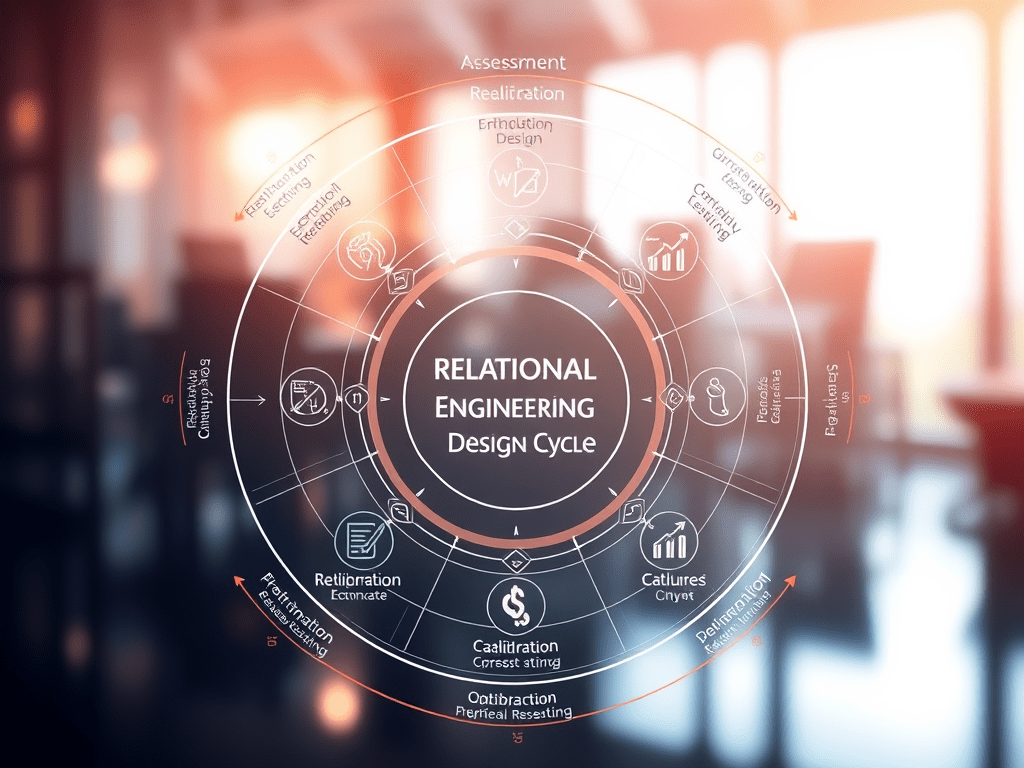
3. The Engineering Cycle
Relational Engineering follows a predictable cycle:
- Assessment — map the field
- Design — architect the system
- Construction — implement structures
- Calibration — tune flows and loads
- Stress Testing — identify failure points
- Optimization — refine for sustainability
- Maintenance — embed repair
- Evolution — adapt to new environments
This cycle mirrors biological metabolism and physical systems design.
4. Load‑Balancing and Capacity Design
A relational system collapses when too much weight sits on too few nodes.
Engineering distributes:
- emotional load
- decision load
- identity load
- meaning load
- coherence load
This uses Relational Linear Algebra to ensure no single node becomes a failure point.
5. Relational Circuitry
Relational energy flows through circuits:
- trust circuits
- meaning circuits
- resonance circuits
- attention circuits
Engineering ensures these circuits are:
- efficient
- buffered
- non‑leaking
- non‑overloaded
- redundantly supported
This is the relational equivalent of electrical engineering.
6. Failure Analysis
Every relational system has predictable failure modes:
- boundary collapse
- coherence fracture
- metabolic overload
- distortion propagation
- viral infiltration
Engineering identifies:
- weak points
- stress points
- tipping points
- cascade triggers
This is where Relational Dynamical Systems and Virology become essential.
7. Optimization and Sustainability
Optimization tunes the system for:
- coherence
- resilience
- distributed agency
- metabolic health
- long‑term sustainability
This is the engineering expression of the Quadrivium.
8. The Limits of Engineering
Engineering can design for:
- coherence
- resilience
- sustainability
But it cannot eliminate:
- entropy
- distortion
- viral infiltration
- ecological mismatch
This is why the sub‑disciplines exist — to handle complexity at scale.
PART II — THE SUB‑DISCIPLINES OF RELATIONAL ENGINEERING
The Specialized Fields That Build, Maintain, and Evolve Relational Systems
Relational Engineering is not one discipline — it is a family of disciplines.
Each sub‑discipline applies a different part of the Quadrivium and the extended mathematical branches.
Below is the full taxonomy.
1. Structural Relational Engineering
Architecture, Geometry, and Load‑Bearing Design
Focuses on:
- relational geometry
- boundary architecture
- coherence scaffolding
- structural redundancy
- load‑bearing roles
Uses:
- Relational Geometry
- Relational Topology
- Relational Algebra
Purpose: build systems that don’t collapse under stress.
2. Energetic Relational Engineering
Energy Flow, Circuits, and Metabolic Efficiency
Focuses on:
- attention flow
- meaning flow
- resonance flow
- energy conservation
- energy leakage
Uses:
- Relational Physics
- Relational Chemistry
- Relational Information Theory
Purpose: optimize the system’s energetic metabolism.
3. Metabolic Relational Engineering
Capacity, Rhythm, and Sustainable Throughput
Focuses on:
- metabolic load
- rhythm design
- contraction–crest–rebound cycles
- burnout prevention
- restoration pathways
Uses:
- Relational Biology
- Relational Calculus
- Relational Statistics
Purpose: ensure the system can metabolize experience without collapse.
4. Network Relational Engineering
Graph Architecture, Connectivity, and Ecosystem Design
Focuses on:
- relational graphs
- coherence clusters
- bridge nodes
- propagation paths
- ecosystem topology
Uses:
- Relational Graph Theory
- Relational Dynamical Systems
- Relational Topology
Purpose: design networks that are resilient, adaptive, and coherent.
5. Identity Relational Engineering
Multiplicity, Braid Logic, and Internal Architecture
Focuses on:
- identity multiplicity
- braid geometry
- internal coherence
- mode alignment
- identity load distribution
Uses:
- Relational Geometry
- Relational Linear Algebra
- Relational Category Theory
Purpose: build identities that can hold complexity without collapse.
6. Ecological Relational Engineering
Environment Matching, Niche Design, and Field Ecology
Focuses on:
- relational niches
- environmental fit
- ecological stressors
- adaptive design
- ecosystem metabolism
Uses:
- Relational Biology
- Relational Ecology
- Relational Physics
Purpose: ensure systems thrive in their actual environment.
7. Safety & Boundary Engineering
Integrity, Containment, and Viral Resistance
Focuses on:
- boundary design
- containment architecture
- viral resistance
- distortion buffering
- relational immunity
Uses:
- Relational Virology
- Relational Chemistry
- Relational Physics
Purpose: protect the system from infiltration and collapse.
Closing: Engineering as the Craft of Coherent Worlds
Together, Relational Engineering and its sub‑disciplines form the applied arm of Pluriology. They turn the entire relational cosmology into:
- architecture
- infrastructure
- design logic
- operational systems
- sustainable ecosystems
This two‑part chapter is the blueprint for building relational systems that can thrive, adapt, and endure.





























 Survivor Literacy
What do you think?