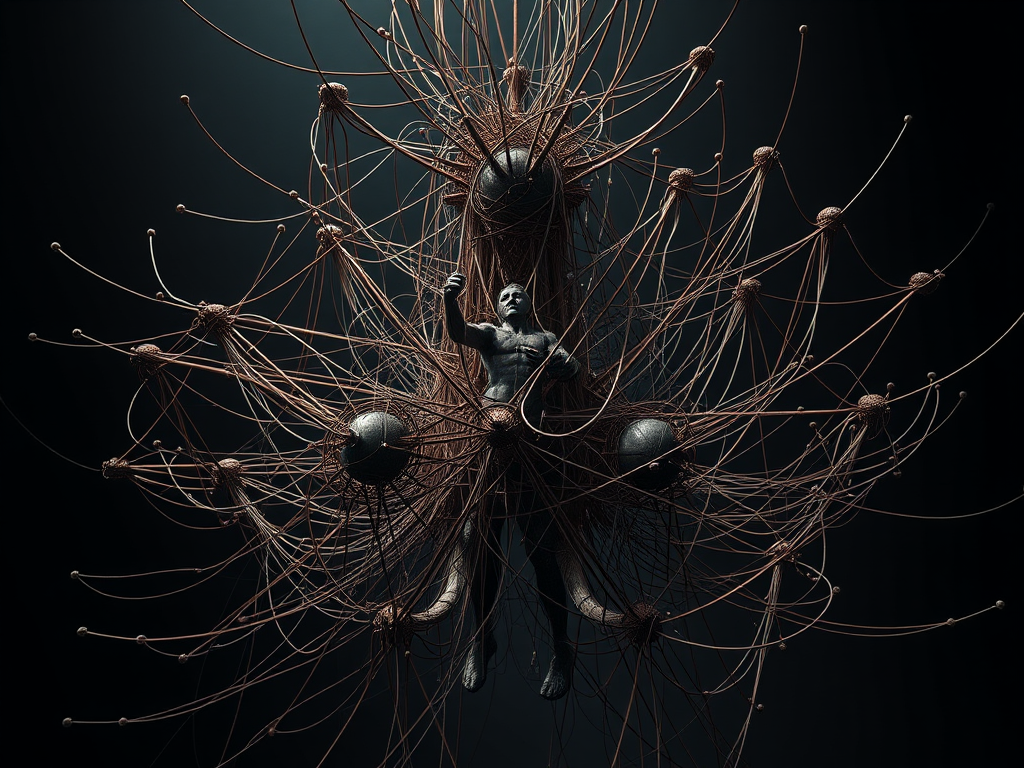
Unified Theory of the Panthenogenesis of Power
CHAPTER 1 – THE PANTHENOGENESIS OF POWER
Power is often narrated as a story of singular figures: a tyrant on a throne, a general on a horse, a legislator with a pen. The image is clean and cinematic. It suggests that if the tyrant falls, the system collapses; if the law changes, the harm ends. This is a comforting story. It is also structurally false.
Power does not begin with a person.
Power begins with a logic.
It begins with a way of arranging bodies, obligations, and fear so effectively that no central figure is required to maintain it. Once this logic is installed, power becomes self‑birthing. It reproduces through conduct, through culture, and through the internalized threat that lives inside those who have learned what happens when the system is displeased.
This is the panthenogenesis of power:
power that creates itself, sustains itself, and multiplies itself without needing a single author.
1. Power Before the Throne
Before power becomes a palace, it is a pattern.
Before it becomes law, it is practice.
Before it becomes coercion, it is expectation.
Long before modern states, courts, or police, communities developed ways to secure obedience and manage risk. Some of these methods were explicit—oaths, pledges, public punishments. Others were implicit—customs, stories, reputations, and the quiet knowledge of what happens to those who step outside the accepted order.
In early medieval Europe, for example, hostages were not primarily kidnapped by enemies; they were given as guarantees. Children, siblings, and kin were handed over to secure treaties, debts, and wartime commitments. Their presence in another ruler’s custody served as a living pledge that promises would be kept. Oxford Academic
This practice reveals something crucial about power’s origin. The system did not rely on constant violence. It relied on a structure in which the threat of harm—held in reserve, rarely enacted—was enough to keep entire lineages in line. The hostage’s body became the hinge between agreement and annihilation. The logic was simple and devastating:
“If the agreement fails, the body pays.”
This is power before the throne: a relational architecture in which safety is conditional, loyalty is enforced through bodies, and fear is distributed through kinship.
2. Power as Self‑Birthing Structure
Panthenogenesis, in biological terms, refers to reproduction without fertilization—self‑creation. Applied to power, it describes a system that no longer needs an external spark. Once the logic is in place, power reproduces through the very people it constrains.
The hostage‑pledge system is an early example of this self‑birthing structure. Once rulers, families, and communities accept that bodies can be pledged as collateral, the logic begins to replicate:
- agreements require hostages
- hostages require obedience
- obedience stabilizes the system
- stability normalizes the practice
Over time, the practice no longer feels like a choice. It feels like the way the world works.
This is the first key insight of the panthenogenesis of power:
once a structure can reproduce itself through conduct, it no longer needs a mastermind.
The system is carried forward by those who participate in it, even when they are harmed by it. Parents hand over children because that is what guarantees survival. Rulers demand hostages because that is what guarantees loyalty. The logic is internalized as necessity.
Power has learned to self‑birth.
3. The Story the Body Learns First
Before power becomes a written story, it becomes a story the body learns to tell.
A child raised in a world where safety is conditional learns, without instruction, that stability depends on someone being at risk. A ruler’s promise is backed by a hostage’s vulnerability. A treaty’s durability is measured in the life of a pledged child. The body understands the stakes long before the mind can articulate them.
This is not unique to medieval Europe. The same structure appears wherever bodies are used as collateral for order:
- enslaved people whose lives guarantee plantation wealth Oxford Academic
- colonized populations whose obedience guarantees imperial stability
- incarcerated people whose confinement guarantees political narratives of “safety”
- undocumented workers whose precarity guarantees economic flexibility
In each case, the system teaches the same lesson:
someone must be held for the structure to hold.
The story is not told in abstract terms. It is told through who is safe, who is expendable, who is protected, and who is sacrificed. The body learns the story through proximity to threat.
4. Language as Evidence of the Logic
Power does not only leave traces in law and architecture. It leaves traces in language.
The Gaelic ghiùlain—to carry, to bear, to conduct oneself—and the Old French gisel—hostage, pledge—are not merely linguistic curiosities. They are semantic fossils of a shared cultural logic: systems carry their power by carrying hostages. The same root geometry appears across languages where hostageship was a political institution, embedding the logic of collateral into everyday speech. Archive
Relational linguistics treats these resonances as evidence, not coincidence. When words that describe conduct, burden, and carrying echo words that describe hostages and pledges, language is confessing the structure that shaped it. The culture has carried its operating system into its vocabulary.
This is the second key insight of the panthenogenesis of power:
power writes itself into language, and language carries power forward.
Even when the original practices fade, the residues remain. Words for debt, duty, burden, and loyalty often carry the shadow of collateral. The system’s logic survives in the metaphors people use to describe obligation and worth.
5. From Event to Architecture
Most public narratives of power focus on events: a war, a revolution, a law, a crisis. The panthenogenesis of power shifts attention from events to architecture.
An event can be overturned.
An architecture must be dismantled.
The hostage‑pledge system is not a single historical episode; it is an architecture that recurs in new forms:
- in the transatlantic slave trade, where enslaved bodies became collateral for loans, insurance policies, and national economies Oxford Academic
- in colonial governance, where entire populations were held as guarantees of imperial order
- in modern immigration regimes, where visas, status, and deportation function as tools of conditional belonging
- in the prison‑industrial complex, where incarcerated bodies are counted for political representation and monetized through contracts Oxford Academic
Each of these systems appears historically distinct. Underneath, the same architecture persists: bodies as collateral, safety as conditional, obedience as the price of survival.
The panthenogenesis of power names this continuity. It refuses to treat each manifestation as an isolated injustice. It insists on reading them as iterations of a single operating system.
6. The Invisible Normal
Once a logic has reproduced itself across centuries, it becomes invisible. It is no longer experienced as a choice or a policy; it is experienced as reality.
The expectation that some lives must be risked to secure others becomes common sense. The idea that safety is a privilege, not a baseline, becomes unremarkable. The belief that those who suffer must have failed some test of worthiness becomes moral doctrine.
This invisibility is not accidental. It is the result of successful panthenogenesis. A system has fully succeeded when it no longer appears as a system at all—when its rules feel like the weather.
At this stage, power does not need constant enforcement. It needs only occasional reminders of what happens to those who refuse their assigned role. A deportation, a publicized incarceration, a denied insurance claim, a ruined whistleblower—each serves as a contemporary hostage, a living pledge that keeps the rest in line. Medievalists.net baylor.primo.exlibrisgroup.com
The architecture is maintained through a combination of memory, fear, and the quiet calculation of risk.
7. From Logic to Field
The panthenogenesis of power is not a theory of individual cruelty. It is a theory of fields.
A field is a patterned space of relations: laws, norms, expectations, institutions, and stories that together define what is possible, what is rewarded, and what is punished. Within such a field, individuals act, but their actions are shaped by the architecture that precedes them.
The hostage‑pledge system is one such field. It organizes:
- who can be pledged
- who can demand pledges
- whose safety is negotiable
- whose safety is assumed
Over time, this field becomes self‑maintaining. New generations inherit roles—pledge, beneficiary, enforcer, collateral—without ever being told that these roles exist. The logic has become atmospheric.
This is the third key insight of the panthenogenesis of power:
power is not a possession; it is a field that reproduces itself through conduct.
8. Why Origin Matters
Tracing the origin of power’s logic is not an academic exercise. It is a structural necessity.
If power is treated as a series of disconnected abuses, the response will be a series of disconnected reforms. A law is amended here, a policy is revised there, a scandal is addressed, a leader is replaced. The architecture remains intact.
By contrast, when power is understood as panthenogenetic—self‑birthing, self‑replicating, self‑maintaining—the question changes. The task is no longer to correct individual outcomes. The task is to interrupt the reproductive logic itself.
To do that, the origin must be named:
- the moment bodies became collateral
- the moment safety became conditional
- the moment loyalty became enforceable through threat
- the moment language began to carry this logic forward
This chapter has traced that origin in outline. It has shown how a world organized around hostages and pledges created a logic that could survive the fall of empires, the rise of nation‑states, and the transformation of economies.
The chapters that follow will track how this logic scales, mutates, and installs itself inside people—until the system no longer needs chains, because the body has learned to hold itself hostage.
The origin is not the past.
The origin is the pattern that still lives in the present.


Leave a Reply