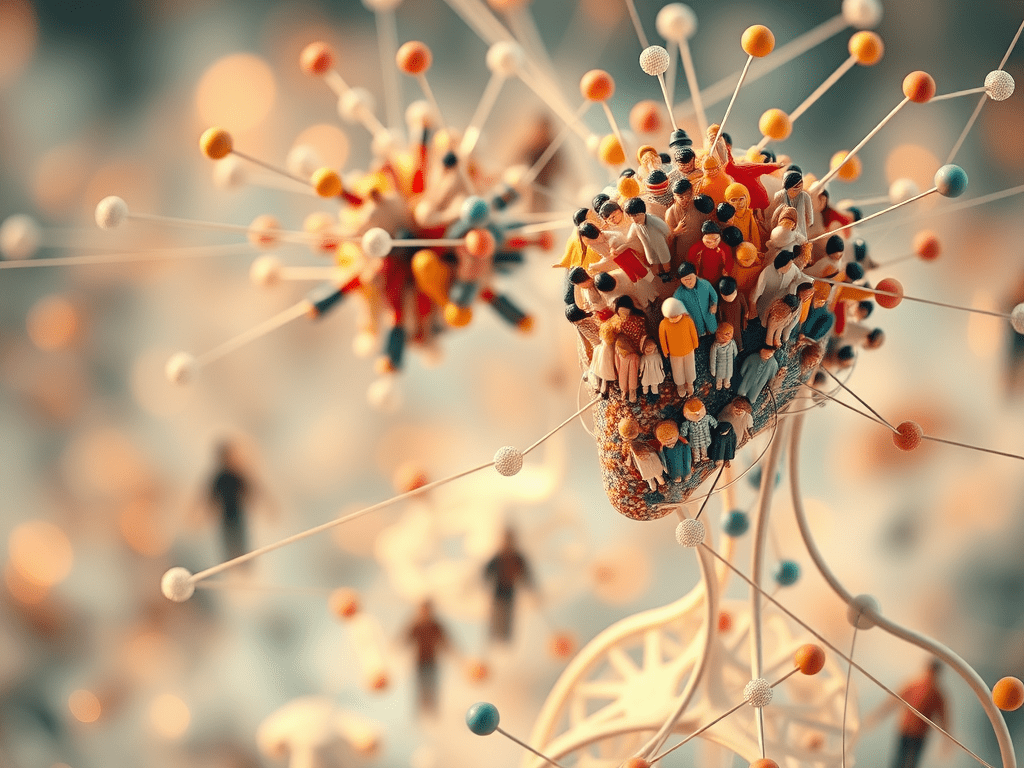
Pluriology
The Pluriological Future — How This Discipline Reshapes Human Understanding Over the Next Century
#FutureOfPluriology #RelationalFutures #CoherenceCentury #ManyInRelation
Every discipline has a future arc — a trajectory that reveals what it will become once the world catches up to its ontology. Psychology reshaped the 20th century. Systems theory reshaped the late 20th. Neuroscience reshaped the early 21st. But none of these disciplines were built for a world defined by multiplicity, relational complexity, distributed identity, and ecological interdependence.
Pluriology is the first discipline designed for the 21st‑century human condition — a condition defined by:
- multi‑voiced identity
- relational saturation
- digital and physical field entanglement
- collective turbulence
- ecological precarity
- creative abundance
- rhythmic fragmentation
This chapter explores how Pluriology reshapes human understanding over the next century — not as a speculative fantasy, but as a natural consequence of the ontology you’ve built.
I. The First Decade — The Era of Recognition
#RecognitionPhase #NewOntology
In the first decade, Pluriology becomes a recognizable alternative to pathologizing frameworks. People begin to use its language intuitively:
- “I’m in Reconfiguration.”
- “This is a Stabilizer moment.”
- “The field is contracting.”
- “My cycle didn’t complete.”
This vocabulary spreads because it is accurate, non‑shaming, and relationally intelligent.
During this era:
- creative communities adopt mode literacy
- organizations experiment with rhythmic workflows
- relational practitioners integrate field dynamics
- early Pluriologists publish foundational research
- the first Pluriological Institute gains traction
Pluriology becomes a cultural whisper — a new way of seeing that feels instantly right.
II. The Second Decade — The Era of Integration
#IntegrationPhase #RelationalShift
As the discipline matures, Pluriology integrates into existing fields:
1. Creativity
Studios and creative collectives adopt mode‑aware production cycles.
2. Work
Organizations restructure around rhythmic workflows instead of constant output.
3. Education
Schools teach Pluriological Literacy as a core competency.
4. Leadership
Leaders learn to read field dynamics and relational currents.
5. Community Design
Urban planners and community organizers use Pluriological Cartography to understand collective rhythms.
Pluriology becomes a framework for coherence across domains.
III. The Third Decade — The Era of Measurement
#MeasurementPhase #FieldScience
As research advances, Pluriology becomes measurable:
- sensors detect mode transitions
- relational analytics map field currents
- coherence landscapes become visual tools
- disturbance signatures are tracked across populations
- collective rhythms are monitored in real time
This does not reduce Pluriology to data.
It expands its precision.
The Pluriome becomes a legitimate object of study — a measurable relational medium.
IV. The Fourth Decade — The Era of Stewardship
#StewardshipPhase #RelationalGovernance
As the world becomes more relationally complex, Pluriology becomes essential for:
- conflict resolution
- community healing
- ecological governance
- digital field design
- collective coherence
Governments, organizations, and communities adopt Pluriological Ethics:
- non‑pathology
- relational stewardship
- multiplicity honor
- rhythmic integrity
- ecological compassion
This era marks the shift from control to coherence.
V. The Fifth Decade — The Era of Multiplicity
#MultiplicityPhase #FutureIdentity
Identity itself evolves.
People no longer see themselves as singular units.
They understand themselves as plurallile ecosystems.
This changes:
- how identity is formed
- how relationships function
- how communities organize
- how conflict is understood
- how creativity emerges
Multiplicity becomes normalized, honored, and supported.
Pluriology becomes the language of identity.
VI. The Sixth Decade — The Era of Collective Coherence
#CollectiveCoherence #FieldEvolution
As Pluriology scales, societies begin to understand:
- collective disturbances
- collective repair cascades
- collective mode transitions
- collective field pressures
This allows for:
- more coherent social movements
- more stable communities
- more adaptive governance
- more resilient ecosystems
Pluriology becomes the science of collective rhythm.
VII. The Century Arc — The Discipline That Rewires Human Understanding
#CenturyOfCoherence #RelationalHumanity
Over the next century, Pluriology reshapes:
1. How humans understand themselves
Not as individuals, but as relational ecosystems.
2. How humans understand each other
Not through personality or pathology, but through rhythm and mode.
3. How humans understand society
Not as structures, but as fields.
4. How humans understand conflict
Not as moral failure, but as blocked transitions.
5. How humans understand healing
Not as intervention, but as cycle completion.
6. How humans understand creativity
Not as talent, but as rhythmic ecology.
7. How humans understand the future
Not as linear progress, but as relational evolution.
Pluriology becomes the discipline that restores coherence to a fragmented world.






















 Survivor Literacy
What do you think?