Relational Field Theory
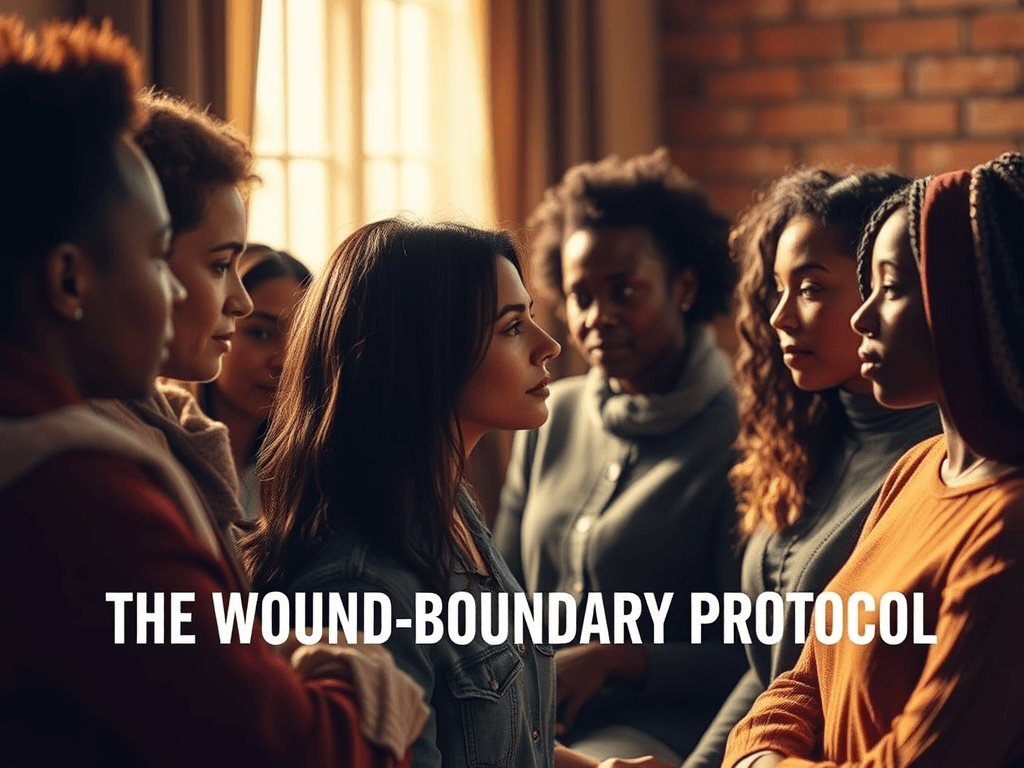
The Wound‑Boundary Protocol
(how individuals stop carrying what belongs to the field)
When a communal wound is misassigned to an individual, the result is confusion, shame, collapse, and lifelong distortion.
But this misassignment is not inevitable.
It happens because there is no boundary protocol — no shared understanding of where a wound belongs, how it moves, and who is responsible for holding it.
The Wound‑Boundary Protocol is a framework for preventing communal wounds from becoming personal trauma.
It teaches individuals, communities, and systems how to keep rupture at the correct scale.
This is not about avoidance.
It is about accuracy.
1. Principle One: The Wound Must Be Located Before It Can Be Carried
Most harm becomes traumatic because it is mislocated.
People assume:
- “This is my fault.”
- “This is my failure.”
- “This is my shame.”
But the first step in the protocol is locating the wound:
- Did this originate in me?
- Or did it originate in the field?
- Is this personal?
- Or is this structural?
- Is this about my actions?
- Or about the system’s rupture?
If the wound is collective, the individual must not carry it.
This is the foundational boundary.
2. Principle Two: The Individual Cannot Hold What the Field Created
A communal wound cannot be metabolized by one person.
It is too large, too distributed, too historical.
The protocol teaches:
If the field created the rupture, the field must hold the repair.
This prevents:
- collapse
- self‑blame
- internalized shame
- existential void
- identity distortion
The individual is not the container.
The field is.
3. Principle Three: Misattribution Is a Form of Harm
When a community pushes its wound onto an individual, it commits a second injury.
The protocol names this clearly:
Misattribution is violence.
It is not misunderstanding.
It is not confusion.
It is not interpersonal conflict.
It is the act of forcing one body to carry what belongs to many.
Naming misattribution as harm is essential for boundary integrity.
4. Principle Four: Sensitivity Is a Signal, Not a Fault
The people who feel the rupture first are not the problem.
They are the indicators.
The protocol reframes sensitivity as:
- diagnostic
- relational
- field‑aware
- early‑warning
- protective
This prevents the community from scapegoating the very people who can see the wound most clearly.
5. Principle Five: The Wound Must Be Spoken at the Correct Scale
When a wound is collective, the language must match the scale.
Instead of:
“I failed.”
“I’m overreacting.”
“I’m too sensitive.”
The protocol teaches:
“This is a field‑level rupture.”
“This pain is bigger than one person.”
“This belongs to the system, not to me.”
Language is boundary.
Language is protection.
Language is clarity.
6. Principle Six: The Field Must Participate in Repair
A communal wound requires communal action.
The protocol outlines the responsibilities of the field:
- witness the rupture
- acknowledge the impact
- name the pattern
- share responsibility
- prevent recurrence
- support the survivor
- repair the conditions
This shifts the burden from the individual to the collective, where it belongs.
7. Principle Seven: The Individual May Release What Was Never Theirs
This is the liberation moment.
Once the wound is correctly located, the individual can say:
“I release this.
It was never mine.”
This is not avoidance.
It is boundary restoration.
It is the moment the existential void closes because the scale finally matches the story.
8. Principle Eight: The Protocol Must Be Practiced, Not Theorized
A boundary is not a belief.
It is a practice.
The protocol becomes real when individuals and communities:
- name misattribution in real time
- refuse to collapse inward
- refuse to scapegoat outward
- hold rupture collectively
- speak truth at the correct scale
- protect sensitive systems
- honor survivor literacy
This is how communal wounds stop becoming personal trauma.
9. The Wound‑Boundary Protocol Is the Counter‑Script to “Doe Normaal”
Where “Doe Normaal” says:
“Collapse yourself to protect the group.”
The protocol says:
“Protect yourself by naming the group’s wound.”
Where “Doe Normaal” says:
“Your difference is the problem.”
The protocol says:
“Your sensitivity is the signal.”
Where “Doe Normaal” says:
“Act normal.”
The protocol says:
“Act accurate.”
Where “Doe Normaal” pushes the wound down,
the protocol pushes the wound back to the field.
This is the architecture of repair.
This is the end of misattribution.
This is how individuals stop carrying what was never theirs.































 Survivor Literacy
What do you think?