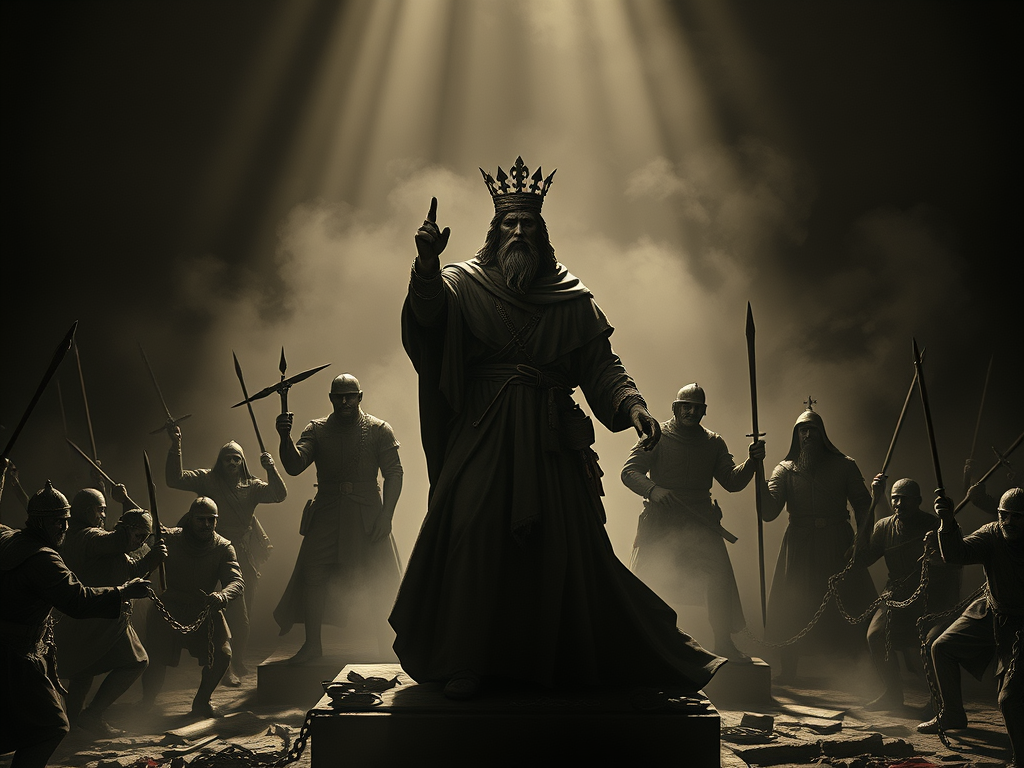
Unified Theory of the Panthenogenesis of Power
PART II — REPRODUCTION
How Power Multiplies Itself Across Time
Chapter 4 — From Hostage to Captive: Scaling the Logic
The hostage‑pledge system didn’t disappear.
It scaled.
As Europe moved from clan politics into feudalism, the logic of hostageship expanded from elite kin to entire populations. What began as a political guarantee between rulers became a social structure:
- serfs bound to land
- peasants bound to lords
- vassals bound by oath
- towns bound by tribute
- bodies bound by obligation
The logic remained the same:
A life is held as collateral for someone else’s stability.
This is the moment when hostageship becomes governance.
Chapter 5 — Colonialism & Slavery: Industrialized Hostage Logic
When Europe expanded outward, it exported its operating system — but with a mutation.
Instead of pledging their own kin, colonial powers pledged other people’s kin.
Instead of temporary hostages, they created permanent captives.
Instead of conditional safety, they created hereditary bondage.
The trans‑Atlantic slave trade is not a separate system.
It is hostage logic scaled to empire:
- enslaved bodies as collateral for wealth
- children as inherited pledges
- entire lineages held as guarantees of profit
- violence as the enforcement mechanism
- racialization as the sorting algorithm
This is the industrialization of the original operating system.
Chapter 6 — The American Revolution: Reconfiguring Who Is Held
The American Revolution is often framed as a break from tyranny.
But structurally, it is a reallocation of hostage logic.
Colonial elites refused to remain hostages to a distant empire.
They wanted to hold the pledge, not be the pledge.
So they:
- severed imperial control
- localized power
- preserved slavery
- expanded Indigenous dispossession
- built a new system of conditional belonging
Freedom for some was secured by the continued hostaging of others.
The logic didn’t end.
It changed hands.
- #UnifiedTheoryOfPower
- #HostageLogic
- #ColonialContinuities
- #SystemsOfDomination
- #HistoricalStructures
- #PowerReproduction
- #DeepHistory
- #StructuralAnalysis


Leave a Reply