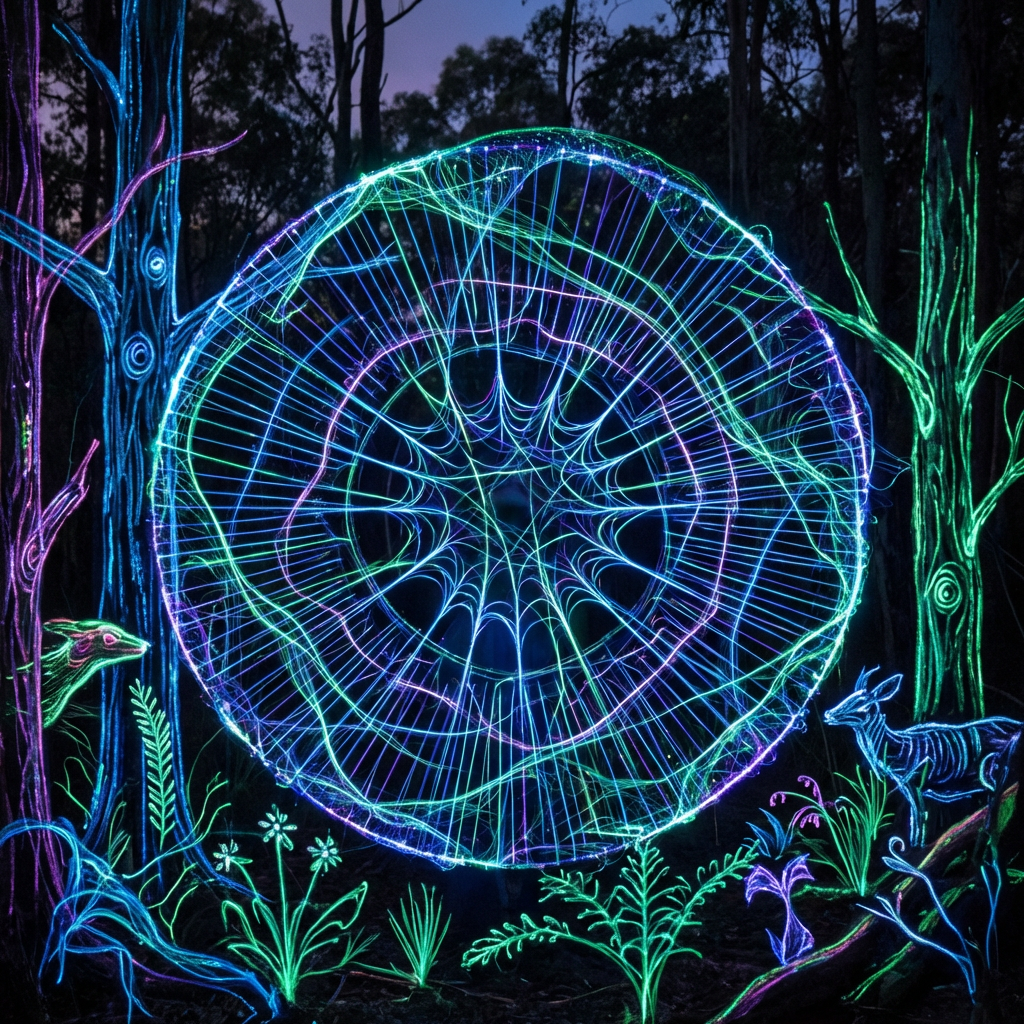
The Little Witch in the Woods
LITTLE WITCH: A FIELD-THINKING ADVENTURE
Full Book Arc + Branching Structure
PART I — THE FOREST TILTS
Opening Scene
The Little Witch wakes to a forest behaving strangely:
- Birds flying in circles
- Mushrooms spiraling outward
- River running too fast
- Light bending in odd directions
The Balance Stone has cracked.
The apprentice (reader) must help restore equilibrium.
First Choice: How to Begin
- Observe the Forest First → leads to The Listening Path
- Rush to Fix the Stone Immediately → leads to The Hasty Path
- Ask the Creatures What Happened → leads to The Relational Path
Each path teaches a different mode of field attention.
PART II — THE LISTENING PATH (Observation-first)
Branch A1 — Follow the Whispering Ferns
- Child notices patterns in wind, leaf movement, and animal behavior.
- Clue: the imbalance started near the river bend.
Choice:
A1a. Follow the river
A1b. Climb the ridge to look from above
A1a — River Path
- River is swollen; fish are stressed.
- Natural outcome: taking water worsens flow; stabilizing banks helps.
Choice:
- Reinforce the bank with stones → improves river health
- Try to magically slow the water → causes upstream pooling
A1b — Ridge Path
- From above, child sees three zones affected differently.
- They choose which zone to investigate:
- The Dark Patch (fungal imbalance)
- The Bright Clearing (light distortion)
- The Crooked Grove (tree communication disrupted)
Each zone becomes a later chapter branch.
PART III — THE HASTY PATH (Action-first)
Branch B1 — Attempt to Repair the Stone Immediately
- Child tries a spell without understanding the system.
- Natural outcome: the crack glows but spreads.
Choice:
B1a. Add more magic
B1b. Stop and gather information
B1c. Call for help from forest creatures
B1a — Overcharging the Stone
- Stone emits a shockwave.
- Forest reacts: mushrooms wilt, birds scatter.
- Child must now repair the damage caused by haste.
B1b — Pause and Observe
- This branch loops back to A1 (Observation Path).
B1c — Ask for Help
- Leads to C1 (Relational Path).
PART IV — THE RELATIONAL PATH (Creature-first)
Branch C1 — Speak to the Creatures
Three creatures respond:
- Ember Fox (fire, energy, speed)
- Moss Bear (soil, slowness, memory)
- Glasswing Moth (light, perception, subtlety)
Child chooses a guide.
C1a — Ember Fox Guide
- Teaches about energy flow and overuse.
- Leads to a branch where the forest is “running hot.”
C1b — Moss Bear Guide
- Teaches about slow processes and root systems.
- Leads to a branch where the imbalance is underground.
C1c — Glasswing Moth Guide
- Teaches about light, illusions, and hidden patterns.
- Leads to a branch where perception is the key.
Each guide shapes the child’s understanding of the field.
PART V — THE THREE ZONES OF IMBALANCE
Regardless of path, the child eventually explores all three zones, but the order changes the state of each zone.
Zone 1 — The Dark Patch (Fungal Network)
- Mycelium is overproducing fruiting bodies.
- Natural outcomes:
- Helping one species may suppress another.
- Removing mushrooms weakens the network.
- Strengthening soil moisture stabilizes the system.
Zone 2 — The Bright Clearing (Light Distortion)
- Light is refracting unpredictably.
- Natural outcomes:
- Redirecting light helps plants but confuses insects.
- Dimming the clearing helps insects but slows growth.
- Balancing canopy gaps stabilizes both.
Zone 3 — The Crooked Grove (Tree Communication)
- Trees are sending mixed signals.
- Natural outcomes:
- Cutting vines frees trees but removes habitat.
- Leaving vines increases stress.
- Creating alternate supports stabilizes the grove.
Each zone has three possible states when the child arrives:
- Stable
- Unstable
- Collapsed
States depend on earlier choices.
PART VI — THE FEEDBACK LOOPS
After visiting all three zones, the forest enters one of three global states:
1. The Forest Calms
- Child made balanced, observant choices.
- Systems self-correct with minimal intervention.
2. The Forest Strains
- Child made mixed choices.
- Some zones stabilize; others remain stressed.
3. The Forest Spirals
- Child acted hastily or without context.
- Systems amplify each other’s instability.
Each global state changes the final chapter.
PART VII — THE FINAL REPAIR
The Balance Stone can only be repaired when the child understands:
- What caused the imbalance
- How systems interact
- How their choices shaped outcomes
Three endings emerge:
Ending 1 — The Apprentice of Balance
- Child restores the stone gently.
- Forest returns to harmony.
- Creatures acknowledge the child’s field awareness.
Ending 2 — The Steward of the Strained Forest
- Stone is repaired, but some zones remain unstable.
- Child learns that systems take time to heal.
- Encourages replay to explore different outcomes.
Ending 3 — The Wanderer in the Tilted Woods
- Stone cannot be fully repaired.
- Forest remains partially chaotic.
- Child is invited to try again with new understanding.
PART VIII — REPLAY LOOPS
The book encourages replay by:
- Changing zone states based on earlier choices
- Allowing different guides to reveal different information
- Letting the child see how small actions ripple outward
The structure is designed so that:
- No path is “wrong”
- Every path teaches a different system dynamic
- Children naturally discover field thinking through play

Apple Music
YouTube Music
Amazon Music
Spotify Music


Explore Mini-Topics
Leave a Reply