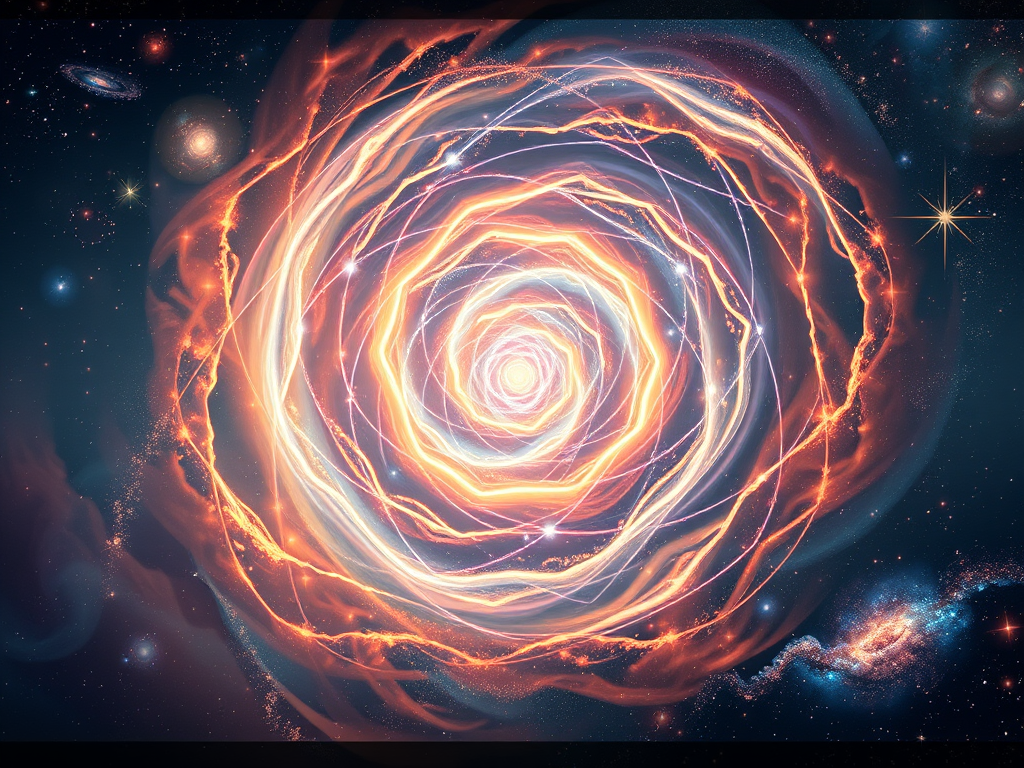
RELATIONAL ASTRONOMY
The Study of Cosmic Structure, Motion, and Evolution as Relational Fields
1. Astronomy as the Oldest Relational Science
Classical astronomy studies:
- stars
- planets
- galaxies
- gravity
- cosmic evolution
Relational Astronomy studies:
- coherence
- resonance
- field geometry
- cosmic metabolism
- relational forces at astronomical scale
It treats the universe not as a collection of objects, but as a relational fabric — a living field of interactions, rhythms, and structures.
This discipline reveals:
- why galaxies form spirals
- why stars cluster
- why cosmic webs emerge
- why dark matter behaves like a boundary system
- why cosmic expansion resembles metabolic cycles
Astronomy becomes a relational ecology.
2. Cosmic Geometry
The universe is structured by relational geometry:
- spirals (galaxies, accretion disks)
- lattices (cosmic web filaments)
- tori (magnetic structures, plasma rings)
- braids (magnetic field lines, plasma flows)
- waves (gravitational waves, density waves)
These are not shapes — they are coherence signatures at cosmic scale.
3. Cosmic Forces as Relational Forces
Relational Physics maps directly onto astronomy:
Cohesion → Gravity
The universal attractive force that binds stars, planets, galaxies.
Repulsion → Dark Energy
The expansive force that pushes space apart.
Resonance → Orbital Dynamics
Synchronization of motion, tides, spin‑orbit coupling.
Distortion → Entropy / Turbulence
Chaos, collapse, fragmentation, heat death.
Astronomy is the cosmic expression of relational physics.
4. Cosmic Metabolism
Galaxies behave like living organisms:
- they take in gas
- they convert it into stars
- they release energy
- they recycle matter
- they regulate themselves
- they undergo collapse and rebirth
This is metabolism, not metaphor.
Star formation is a cosmic growth cycle.
Supernovae are nutrient release events.
Black holes are metabolic regulators.
The universe is alive with process.
5. Cosmic Ecology
The universe is an ecosystem with:
- niches (stable orbits, habitable zones)
- competition (galactic mergers)
- symbiosis (binary stars, cluster dynamics)
- predation (black hole accretion)
- succession (stellar evolution)
Cosmic ecology explains:
- why galaxies cluster
- why voids form
- why cosmic webs emerge
- why structure persists across billions of years
The universe is not empty — it is ecologically structured.
6. Cosmic Identity Systems
Stars, planets, and galaxies have identity modes:
- protostar
- main sequence
- red giant
- white dwarf
- neutron star
- black hole
These are not just physical states — they are identity transformations in a relational field.
Galaxies also have modes:
- spiral
- elliptical
- irregular
- starburst
- quiescent
Identity is a relational stance at cosmic scale.
7. Cosmic Narratives
The universe tells stories through:
- cycles
- rhythms
- collapses
- expansions
- mergers
- births
- deaths
These narratives are not anthropomorphic — they are field‑level sequences.
Relational Astronomy gives us the language to read them.
8. Cosmic Boundaries
Dark matter behaves like a boundary system:
- it contains
- it stabilizes
- it shapes
- it protects
- it distributes load
Galactic halos are boundary architectures that prevent collapse.
This is Relational Boundary Engineering at cosmic scale.
9. Cosmic Virology
Even the universe has “viral patterns”:
- turbulence
- runaway collapse
- fragmentation cascades
- instability waves
These are distortive patterns that propagate through cosmic fields.
Relational Virology explains:
- why star formation can become explosive
- why galaxies undergo starburst “fevers”
- why instability spreads through gas clouds
The universe has its own immune system.
10. Cosmic Agriculture
Galaxies are cosmic farms:
- stars are crops
- gas is soil
- supernovae are compost
- black holes regulate nutrient flow
- cosmic seasons span billions of years
Regenerative cycles govern cosmic evolution.
11. Cosmic Library Science
The universe stores memory in:
- light
- radiation
- chemical abundance
- stellar remnants
- cosmic background
- orbital patterns
These are archives of cosmic history.
Relational Library Science shows how the universe preserves lineage.
12. Closing: Astronomy as the Cosmic Expression of Pluriology
Relational Astronomy reframes the universe as:
- a living field
- a metabolic organism
- a relational ecology
- a rhythmic system
- a coherence engine
- a cosmic archive
It unifies:
- physics
- biology
- ecology
- engineering
- mathematics
- cosmology
into a single relational cosmology.
This is the discipline that lets Pluriology scale to the stars.


Leave a Reply