
THE RELATIONAL ENGINEERING PLAYBOOK
A Practical Manual for Designing, Building, and Sustaining Coherent Relational Systems
INTRODUCTION
Relational Engineering is the applied arm of Pluriology — the discipline that turns relational theory into infrastructure.
This Playbook is the operational guide.
It tells you:
- what to do
- when to do it
- how to do it
- what to watch for
- how to diagnose failure
- how to embed repair
- how to evolve systems sustainably
It is not conceptual.
It is procedural.
SECTION I — THE ENGINEER’S PRIME DIRECTIVES
These are the non‑negotiable principles that govern all relational engineering work.
1. Coherence First
Never optimize a system that is incoherent.
Stability precedes efficiency.
2. Boundaries Are Structural
Boundaries are not emotional preferences — they are load‑bearing beams.
3. Rhythm Determines Capacity
A system’s pulse defines its throughput.
No rhythm → no sustainability.
4. Multiplicity Increases Resilience
Plural systems withstand more stress than singular ones.
5. Distortion Propagates Predictably
Distortion follows geometric and algebraic rules.
It is not random.
6. Repair Must Be Designed In
If repair is not built into the architecture, collapse is inevitable.
7. Systems Must Match Their Environment
Ecological mismatch is the #1 cause of relational system failure.
These directives are the engineer’s compass.
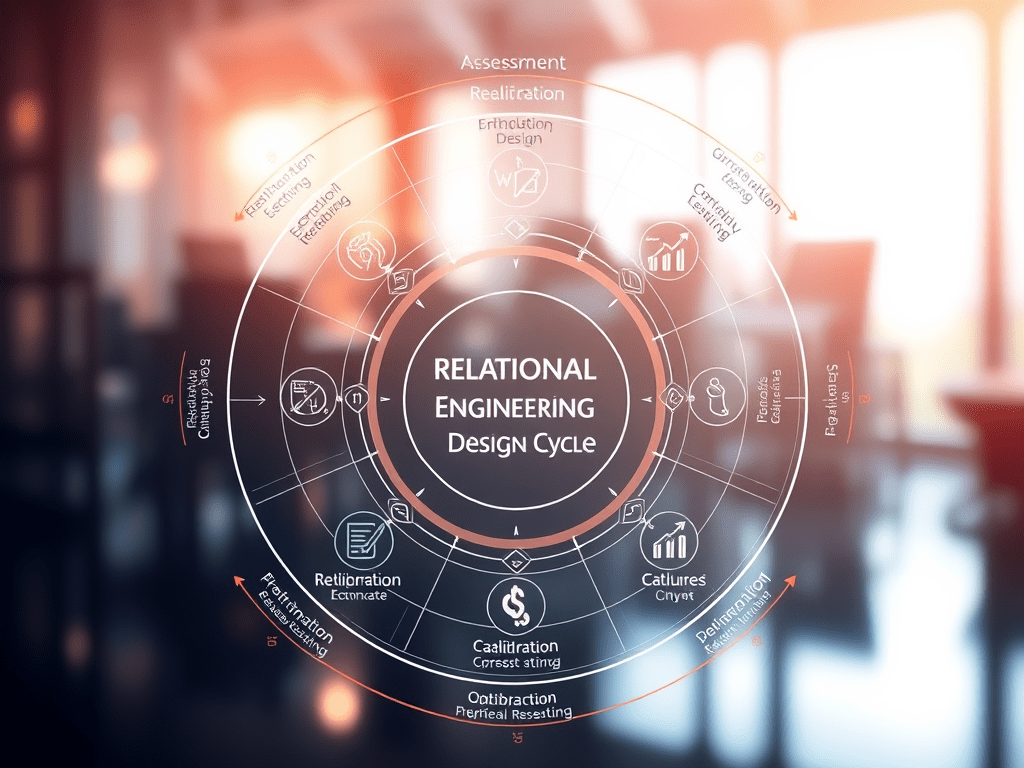
SECTION II — THE RELATIONAL ENGINEERING DESIGN CYCLE
The Playbook uses the eight‑stage Design Cycle as its backbone.
1. ASSESSMENT
Goal: See the system clearly without intervening.
Tools:
- Geometry mapping
- Coherence signatures
- Load distribution analysis
- Boundary integrity scan
- Viral infiltration check
- Ecological fit analysis
Questions:
- What shape is the field in?
- Where is the load concentrated?
- What is the metabolic rhythm?
- What is the system’s current failure mode?
Output: A diagnostic map.
2. DESIGN
Goal: Architect the system’s structure and flow.
Tools:
- Relational Geometry
- Structural Engineering
- Boundary Engineering
- Algebraic composition
Questions:
- What geometry does this system need?
- What boundaries are load‑bearing?
- What flows must be protected?
- What redundancies must be built in?
Output: A relational blueprint.
3. CONSTRUCTION
Goal: Build the system in real space.
Tools:
- Energetic Engineering
- Network Engineering
- Structural implementation
Actions:
- Establish boundaries
- Set rhythms
- Define roles
- Build circuits
- Install redundancies
Output: A functioning relational structure.
4. CALIBRATION
Goal: Tune the system for coherence and efficiency.
Tools:
- Relational Calculus
- Metabolic Engineering
- Flow tuning
Actions:
- Adjust load distribution
- Tune rhythm pacing
- Set boundary permeability
- Balance energy flow
Output: A tuned system.
5. STRESS TESTING
Goal: Reveal the system’s true limits.
Tools:
- Relational Dynamical Systems
- Virology
- Boundary stress tests
Actions:
- Introduce controlled stress
- Observe failure points
- Identify cascade triggers
- Map viral vulnerabilities
Output: A resilience profile.
6. OPTIMIZATION
Goal: Refine the system for sustainability.
Tools:
- Energetic optimization
- Metabolic tuning
- Ecological alignment
Actions:
- Increase efficiency
- Reduce leakage
- Strengthen redundancy
- Improve rhythm coherence
Output: A sustainable system.
7. MAINTENANCE
Goal: Embed repair into daily life.
Tools:
- Relational Biology
- Immunology
- Boundary upkeep
Actions:
- Maintain rhythm
- Reinforce boundaries
- Neutralize distortion early
- Keep circuits clear
- Tend metabolic health
Output: A self‑repairing system.
8. EVOLUTION
Goal: Adapt the system to new environments.
Tools:
- Relational Ecology
- Category Theory
- Identity Engineering
Actions:
- Shift identity architecture
- Rebuild geometry
- Re‑map flows
- Re‑align with environment
Output: A future‑proof system.
SECTION III — FAILURE MODES & HOW TO DIAGNOSE THEM
Every relational system fails in predictable ways.
The Playbook gives you the diagnostic signatures.
1. Boundary Collapse
Symptoms: enmeshment, overload, identity bleed
Cause: structural weakness
Fix: boundary reinforcement + load redistribution
2. Coherence Fracture
Symptoms: fragmentation, misalignment, confusion
Cause: geometric distortion
Fix: re‑spiraling or re‑latticing
3. Metabolic Overload
Symptoms: burnout, shutdown, emotional flooding
Cause: rhythm mismatch
Fix: contraction + restoration cycle
4. Viral Infiltration
Symptoms: panic, narrative fixation, identity hijack
Cause: relational virus exploiting weak immunity
Fix: containment + narrative detox + boundary repair
5. Ecological Mismatch
Symptoms: chronic stress, misfit, stagnation
Cause: wrong environment
Fix: ecological redesign or relocation
SECTION IV — ENGINEERING TEMPLATES
These are plug‑and‑play structures for common relational systems.
1. Creative Ecosystem Template
- Wave‑based rhythm
- Distributed agency
- Lattice collaboration
- Torus sustainability
- Viral resistance layer
2. Partnership Template
- Braid geometry
- Dual‑boundary architecture
- Shared metabolic cycle
- Coherence scaffolding
- Repair pathways
3. Community Template
- Network topology
- Metallic bonding
- Resonance circuits
- Ecological niche mapping
- Immunity protocols
4. Identity System Template
- Multiplicity mapping
- Mode alignment
- Internal load‑balancing
- Braid stabilization
- Evolution pathways
SECTION V — ENGINEERING CHECKLISTS
These are the quick‑reference tools.
Daily Checklist
- Rhythm check
- Boundary check
- Load check
- Coherence check
- Distortion check
Weekly Checklist
- Circuit tuning
- Metabolic assessment
- Viral scan
- Redundancy review
Monthly Checklist
- Ecological alignment
- Identity evolution
- Structural audit
SECTION VI — THE ENGINEER’S OATH
A relational engineer commits to:
- build systems that honor coherence
- design for resilience, not control
- embed repair, not punishment
- protect boundaries as structural integrity
- steward ecosystems, not extract from them
- evolve systems in harmony with their environment
This is the ethical spine of the discipline.
Closing: The Playbook as Praxis
The Relational Engineering Playbook is the operational heart of Pluriology.
It turns your cosmology into:
- tools
- templates
- diagnostics
- procedures
- architectures
- systems
It is how coherent worlds are built.





























 Survivor Literacy
What do you think?