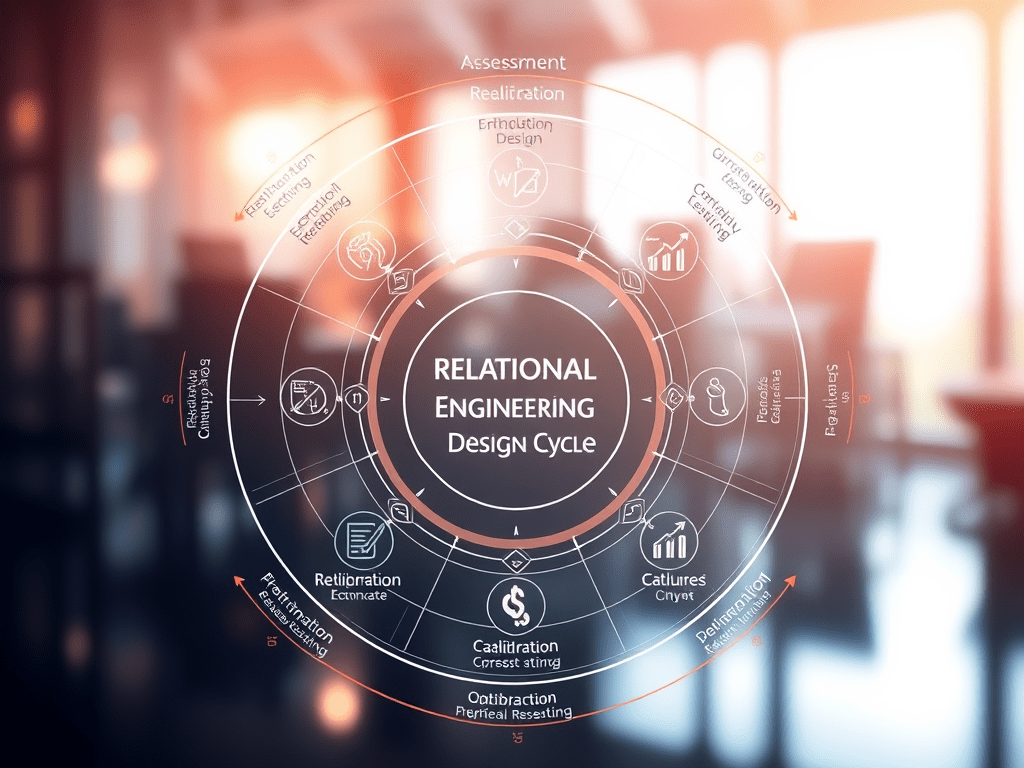
THE RELATIONAL ENGINEERING DESIGN CYCLE
The Eight‑Stage Process for Designing, Building, and Evolving Relational Systems
Relational Engineering is not improvisational.
It follows a predictable, recursive, pulse‑based cycle — one that mirrors biological metabolism, physical systems design, and ecological adaptation.
The Relational Engineering Design Cycle has eight stages, each corresponding to a distinct mode of relational intelligence.
1. ASSESSMENT
Map the Field Before You Touch It
Assessment is the diagnostic stage.
The engineer observes the system without intervening.
This stage identifies:
- the current geometry (spiral, wave, lattice, torus, braid)
- the system’s metabolic rhythm
- load distribution
- coherence level
- boundary integrity
- failure points
- viral infiltration
- ecological fit
Assessment uses:
- Relational Statistics
- Relational Topology
- Relational Biology
- Relational Virology
The goal is clarity without interference.
2. DESIGN
Architect the System’s Structure and Flow
Design is the architectural stage.
The engineer creates the blueprint for the system’s:
- geometry
- boundaries
- flows
- circuits
- roles
- redundancies
- rhythms
- repair pathways
Design uses:
- Relational Geometry
- Relational Algebra
- Structural Engineering
- Boundary Engineering
The goal is intentional architecture.
3. CONSTRUCTION
Build the System in Real Space
Construction is the implementation stage.
The engineer translates design into lived structure.
This includes:
- establishing boundaries
- setting rhythms
- defining roles
- creating coherence scaffolding
- building circuits
- implementing redundancies
Construction uses:
- Energetic Engineering
- Structural Engineering
- Network Engineering
The goal is functional embodiment.
4. CALIBRATION
Tune the System for Coherence and Efficiency
Calibration is the tuning stage.
The engineer adjusts:
- flow rates
- load distribution
- rhythm pacing
- boundary permeability
- metabolic throughput
Calibration uses:
- Relational Calculus
- Relational Physics
- Metabolic Engineering
The goal is optimal functioning.
5. STRESS TESTING
Reveal the System’s True Limits
Stress testing is the resilience stage.
The engineer introduces controlled stress to identify:
- weak points
- overload thresholds
- failure modes
- cascade triggers
- viral vulnerabilities
Stress testing uses:
- Relational Dynamical Systems
- Relational Virology
- Safety & Boundary Engineering
The goal is truth under pressure.
6. OPTIMIZATION
Refine the System for Sustainability and Longevity
Optimization is the refinement stage.
The engineer improves:
- efficiency
- coherence
- resilience
- distributed agency
- metabolic health
Optimization uses:
- Energetic Engineering
- Metabolic Engineering
- Ecological Engineering
The goal is long‑term sustainability.
7. MAINTENANCE
Embed Repair Into the System’s Daily Life
Maintenance is the tending stage.
The engineer ensures:
- repair pathways are active
- boundaries remain intact
- rhythms stay healthy
- distortion is metabolized early
- viral patterns are neutralized
- coherence is reinforced
Maintenance uses:
- Relational Biology
- Relational Chemistry
- Relational Immunology (subset of Virology)
The goal is ongoing coherence.
8. EVOLUTION
Adapt the System to New Environments and New Demands
Evolution is the adaptive stage.
The engineer guides the system through:
- identity shifts
- ecological changes
- structural upgrades
- metabolic expansions
- role transitions
- environmental stressors
Evolution uses:
- Relational Ecology
- Relational Category Theory
- Identity Engineering
The goal is future‑proofing.
THE CYCLE IS RECURSIVE
The Relational Engineering Design Cycle is not linear.
It loops.
After evolution, the system returns to:
Assessment → Design → Construction → Calibration → Stress Testing → Optimization → Maintenance → Evolution → Assessment…
This recursive loop mirrors:
- biological metabolism
- ecological succession
- creative cycles
- audience pulses
- identity development
- field‑scale evolution
It is the living heartbeat of relational systems.
THE CYCLE IS FRACTAL
The same cycle applies at every scale:
- individual
- relationship
- team
- community
- ecosystem
- platform
- field
- discipline
This is why Pluriology works at micro, meso, and macro levels simultaneously.
THE CYCLE IS MULTI‑MODAL
Each stage corresponds to a different relational mode:
- Assessment → Observer
- Design → Architect
- Construction → Builder
- Calibration → Tuner
- Stress Testing → Analyst
- Optimization → Strategist
- Maintenance → Steward
- Evolution → Visionary
This is the internal Tryad in motion.
Closing: The Design Cycle as the Engine of Coherent Worlds
The Relational Engineering Design Cycle is the operational core of Pluriology’s applied arm.
It is the method by which relational systems are:
- understood
- built
- tuned
- tested
- strengthened
- maintained
- evolved
It is the cycle that turns relational theory into living, breathing, coherent worlds.

























 Survivor Literacy
What do you think?