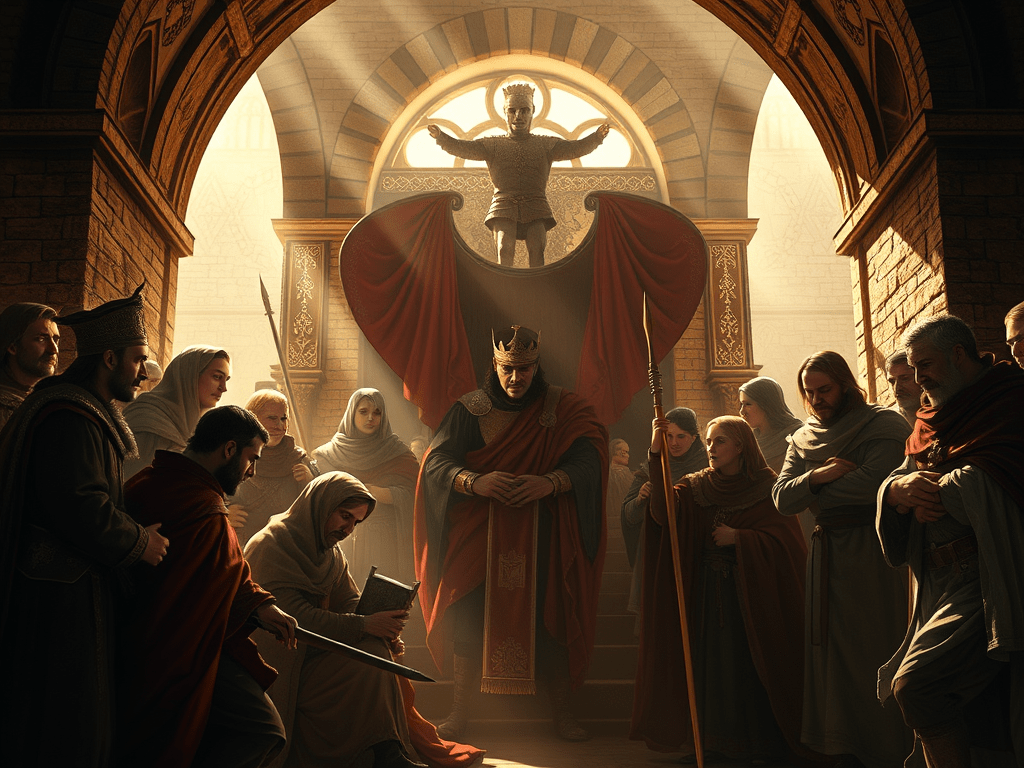
Unified Theory of the Panthenogenesis of Power
CHAPTER 4 – FROM HOSTAGE TO CAPTIVE: SCALING THE LOGIC
The hostage‑pledge system began as a political instrument among elites, but its logic did not remain confined to courts, treaties, or dynastic negotiations. Over time, the structure expanded outward, absorbing entire populations into its gravitational field. What began as a mechanism for stabilizing alliances between rulers became a mechanism for stabilizing societies themselves.
This chapter traces the moment when hostageship ceased to be a practice and became a logic—a way of organizing bodies, labor, land, and loyalty. It is the moment when the system learned to scale.
1. When the Logic Outgrows the Palace
In early medieval Europe, hostageship was a tool of elite governance. But as feudal structures solidified, the logic of conditional safety began to apply to people who were never formally exchanged as hostages.
Serfs were bound to land.
Peasants were bound to lords.
Vassals were bound by oath.
Towns were bound by tribute.
Merchants were bound by debt.
None of these people were called hostages.
All of them lived under hostage logic.
The structure was identical:
- safety was conditional
- loyalty was enforced
- bodies were collateral
- disobedience carried risk
- stability depended on vulnerability
The hostage‑pledge system had scaled from a political instrument to a social architecture.
2. The Birth of Captivity as a Social Category
As the logic expanded, a new category emerged: the captive.
A captive was not necessarily imprisoned. A captive was someone whose life, labor, or mobility was constrained by obligations they did not choose. Captivity became a social condition, not a physical location.
This shift produced several structural consequences:
- Captivity became normalized.
Most people lived under some form of constraint. - Freedom became exceptional.
Freedom was not a universal right; it was a privilege of status. - Obligation became inherited.
Children inherited the constraints of their parents. - Loyalty became a survival strategy.
Compliance was the price of safety.
The hostage‑pledge system had mutated into a broader architecture of captivity.
3. The Feudal Field as Hostage Logic at Scale
Feudalism is often described as a system of land tenure and military obligation. But beneath the surface, it was a scaled version of the hostage‑pledge system.
The logic was identical:
- A lord offered protection.
- A vassal offered loyalty.
- A serf offered labor.
- A body guaranteed the agreement.
The threat of violence—whether from rival lords, bandits, or the lord’s own enforcers—functioned as the enforcement mechanism. The system did not require constant brutality. It required only the credible possibility of it.
This is the hallmark of hostage logic:
the threat is enough.
4. Captivity as Economic Infrastructure
As European economies expanded, captivity became an economic infrastructure. Debt bondage, indentured servitude, and forced labor systems emerged as extensions of the same logic.
A debtor’s body became collateral for repayment.
An indentured servant’s years became collateral for passage.
A tenant’s harvest became collateral for land use.
The system did not need to call these people hostages.
The structure was unchanged.
Captivity became the engine of economic growth.
5. The Expansion of Conditional Belonging
As the logic scaled, belonging itself became conditional. Communities developed hierarchies of worthiness:
- insiders vs. outsiders
- citizens vs. subjects
- free people vs. unfree people
- protected vs. unprotected
Belonging was no longer a matter of presence.
It was a matter of compliance.
A person belonged only as long as they fulfilled the obligations assigned to them. Failure to comply resulted in exclusion, punishment, or loss of protection.
This is the moment when hostage logic became cultural logic.
6. The Emotional Reproduction of Captivity
Captivity did not reproduce itself through force alone. It reproduced itself through emotion.
Fear taught people to comply.
Shame taught people to internalize their role.
Loyalty taught people to justify the system.
Hope taught people to endure it.
These emotional structures were not accidental. They were the psychological infrastructure of the hostage‑pledge system at scale.
A captive who believes their captivity is natural will not resist.
A captive who believes their captivity is deserved will enforce it on themselves.
This emotional architecture laid the groundwork for the internalization processes explored in later chapters.
7. The Transition from Hostage to Captive
The transition from hostage to captive marks a critical shift in the evolution of power:
- A hostage is held explicitly.
- A captive is held implicitly.
A hostage knows they are collateral.
A captive believes they are obligated.
A hostage is exchanged.
A captive is inherited.
A hostage is a political instrument.
A captive is a social category.
This shift allowed the system to scale indefinitely.
It no longer needed to take hostages.
It only needed to create captives.
8. The Logic That Survives Its Form
By the late medieval period, formal hostageship declined. But the logic survived in new forms:
- serfdom
- debt bondage
- forced labor
- indenture
- colonial extraction
- racialized captivity
- carceral systems
Each of these systems appears historically distinct.
Each is a mutation of the same operating system.
The hostage‑pledge system had become a field—a patterned space of relations that organized bodies, obligations, and risk.
This field would later expand into empire, slavery, immigration regimes, and the prison‑industrial complex. But the logic remained unchanged:
someone must be held for the structure to hold.






























 Survivor Literacy
What do you think?